Suspension System
The main functions of a car suspension system are to increase the friction between the tires and the road surface, to provide steering stability with good handling and to ensure the comfort of the passengers.
Basic components of suspension
Most suspension systems have the same basic components: spring, shock absorber and anti-sway bar. But they are different in type and arrangement to connect them to the frame and wheel.
Springs
There are four major types of spring in use today: coil spring, air spring, leaf spring and torsion bar as shown in Fig.6-1a.
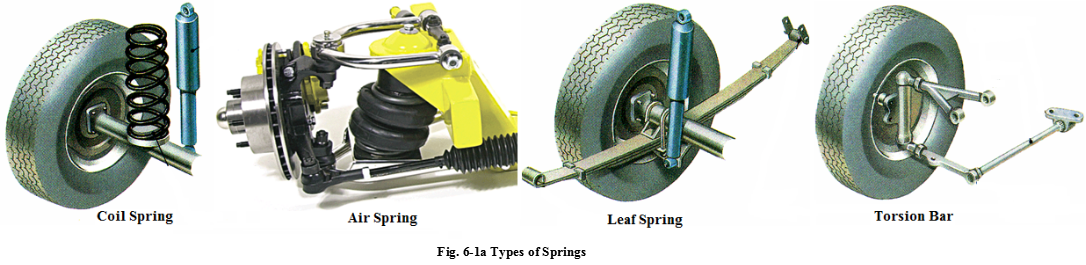
Coil springs are the most common type of spring used on almost all cars. This type of spring is made up of a round steel rod which is wound into a shape of coil. Coil springs can compress and expand to absorb the motion of the wheels.
Air springs are often found on luxury cars. It is a rubber cylinder filled with compressed air. This type of spring uses the compressed air to absorb the wheel vibrations.
Leaf springs are used today on most trucks and heavy-duty vehicles. This type of spring consists of several layers of metal plates of varying lengths bound together to act as a single unit. Leaf springs can provide good stability and excellent suspension for the tow vehicles.
Torsion bars are used on some light trucks and spot utility vechicles (SUV) . It is a straight bar of spring steel. Torsion bars use the twisting properties of a steel bar to provide spring performance.
Shock absorber
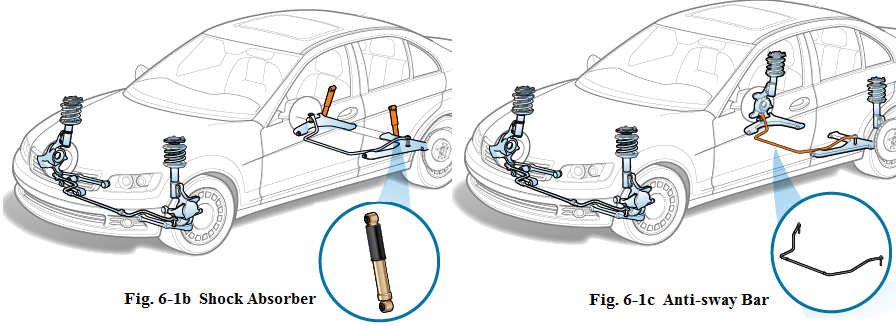
The function of shock absorber is to control the movements of spring and suspension, that is, to prevent the springs from bouncing to keep the tires firmly contacting the road surface. A shock absorber is basically an oil pump placed between the frame of the car and the wheels (see Fig.6-2). The faster the suspension moves, the more resistance the shock absorber provides.
Anti-sway bar
Anti-sway bar also called stabilizer bar that will help stabilize the car and reduce its side-to-side motion when it is cornering. It is simply a metal rod connected to both of the lower control arms (see Fig.6-3).
Common types of suspension
The modern cars use different types of suspension in front and rear axles. The two front wheels are connected by the front axle and the two rear wheels are connected by the rear axle, and they must work together in perfect harmony.
MacPherson strut suspension
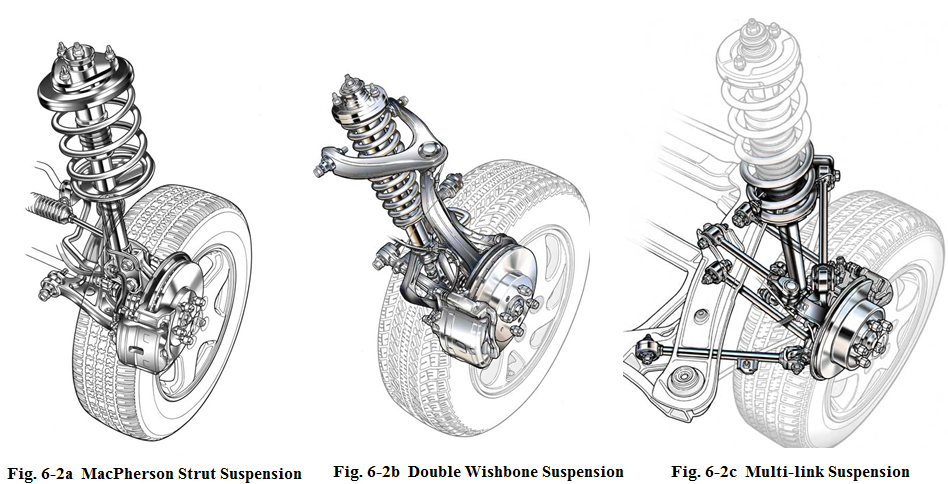
MacPherson strut suspension is the most widely used in front independent suspension, especially for front-wheel drive cars (see Fig.6-4) . It combines a shock absorber and a coil spring into a single unit. The advantages of this type suspension are more compact in structure and lighter in weight.
Double wishbones suspension
Double wishbones suspension also known as an A-arm suspension (see Fig.6-5), which is another common front independent suspension. It uses a shorter upper control arm and a longer lower control arm that hold the wheel to the frame. The advantages of this type suspension are always to keep the wheel moving up and down perpendicularly to the road surface and to ensure good handling.
Multi-link suspension
Multi-link suspension is often found in rear independent suspension. As the name suggests, multi-link suspension has more than 4 control arms and forms different geometries(see Fig.6-6). The advantages of this type suspension are to offer not only the pleasant comfort but also good handling, especially for off-road driving.
Torsion beam suspension
Torsion beam suspension in fact is only a half-independent rear suspension often used on less expensive cars. Two trailing arms are connected by means of a cross torsion beam, which also serves as an anti-sway bar (see Fig.6-7). The advantages of this type suspension are very space-saving for it engages little width of the car so as to enlarge rear seat room, and cheap in cost.
译文:
课文 悬架系统
汽车悬架系统的主要功能是加大车轮和路面的摩擦力,为转向稳定性提供良好的操纵性,并确保乘客的舒适性。
悬架系统基本部件
大多数悬架系统的基本零部件是相同的:弹簧、减振器和横向稳定杆。但是它们与车架和车轮的连接的类型及安装方式各异。
弹簧
目前,广泛应用的弹簧主要有四种,分别是:螺旋弹簧、空气弹簧、钢板弹簧和扭杆弹簧(见图6-1)。
螺旋弹簧是车上使用最为普遍的一种弹簧,几乎应用在所有轿车上.这种弹簧由一根圆形钢筋绕制成螺旋状。螺旋弹簧通过压缩和伸张吸收车轮的运动。
空气弹簧通常用于豪华轿车上.它是一个充满压缩气体的橡胶圆简。空气弹簧利用压缩气体来吸收车轮的振动。
钢板弹簧通常用于大多数的货车和重载汽车上。这类弹簧是由几层不同长度的钢板片叠加在一起组成一个单元。钢板弹簧可为牵引车提供良好的稳定性和优异的悬架作用。
扭杆弹簧用于一些轻型货车和越野车上。它是一根直的弹簧钢杆。扭杆弹簧利用钢杆的扭转特性发挥弹簧性能。
减振器
减振器的作用是控制弹簧和悬架运动,即防止弹簧弹跳来保持轮胎与路面紧密接触。减振器位于车架和车轮之间(见图6-2),实质上是个液压泵。悬架运动越快,减振器产生的阻力就越大。
横向稳定杆
横向稳定杆也称为平衡杆,有助于汽车的行驶稳定,以及减少汽车转弯时的左右摇摆。横向稳定杆是一种金属杆,与两个下控制臂连接(见图6-3)。
常见的悬架类型
现代汽车的前、后桥使用不同类型的悬架。两个前轮由前桥连在一起,两个后轮由后桥连在一起,彼此间须完美协调。
麦弗逊滑柱式悬架
麦弗逊滑柱式悬架在前独立悬架中使用最广泛,尤其是用于前驱汽车上(见图6-4)。它将减振器和螺旋弹簧合为一体,成为一个装置。该型的悬架优点是结构更加紧凑,重量更轻。
双叉臂悬架
双叉臂悬架,也称为A形臂悬架(见图6-5),是另一种常见的前独立悬架。它用较短的上控制臂和较长的下控制臂将车轮固定在车架上.该型悬架的优点是始终保持车轮与路面垂直上下运动,保证良好的操纵性。
多连杆式悬架
多连杆式悬架多用于后独立悬架。多连杆式悬架有四个或更多的控制臂,组成不同的几何形状(见图6-6)。该型悬架的优点是不仅舒适度高,而且具有良好的操纵性,尤其对于越野车驾驶。
扭力梁悬架
事实上,扭力梁悬架只是半独立后悬架,广泛用于比较便宜的汽车上。两个拖拽臂通过扭力横梁连接在一-起,该横梁起着横向稳定杆的作用(见图6-7)。该型悬架的优点是节省空间,因为它几乎不占用车的宽度,因此车后座空间更大,成本更低。

