Transmissions
Transmission is the most important component in the drive train. Often the term “transmission” refers simply to gearbox. Its jobs are to vary the gear ratio, controlling the car speed; to provide directional control, forward and reverse; and to interrupt the engine power to the transmission to make the engine idle.
In accordance with the operational control mode, car transmissions can be divided into manual transmission (MT) and automatic transmission (AT). There are three main kinds of automatic transmissions, respectively is automatic transmission (AT), continuously variable transmission (CVT) and direct shift gearbox (DSG).
Manual Transmission (MT)
A manual transmission mainly contains some shift forks, collars, different sizes of gears along the shafts such as input and output shafts, and lay shaft as shown in Fig.4-1.
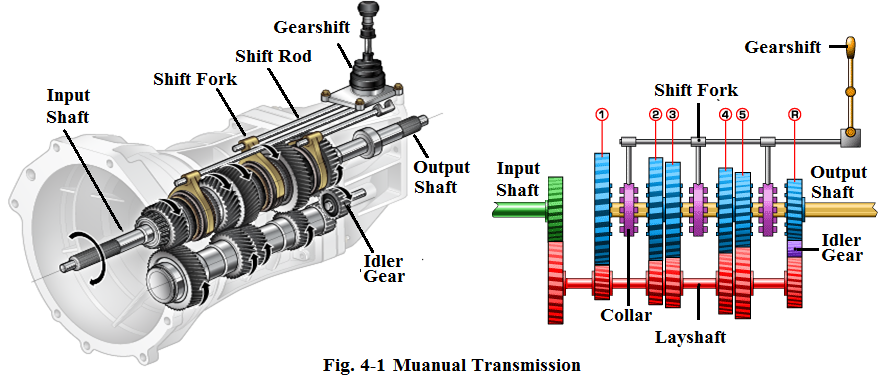
If you drive a car with a MT, you have to shift the gears by yourself, usually with the gearshift on the console and the clutch pedal on the floor on the left side.
MT usually has five speeds. The first gear is the lowest gear which is used to make your car start going. The second gear is used to make your car move faster. The third and fourth gears mean that both input and output shafts turn at the relatively the same rate of speed. The wheels can go very fast.The fifth gear is often regarded as “overdrive” which means the output shaft can turn faster than the input shaft for good fuel economy. Some cars now have as many as six and seven gears. Although the gear ratio may be the same as in six- or seven-speed transmission as in five-speed transmission, the more forward speeds, the smoother shifting is and more fuel-efficient the car becomes.
Automatic Transmission (AT)
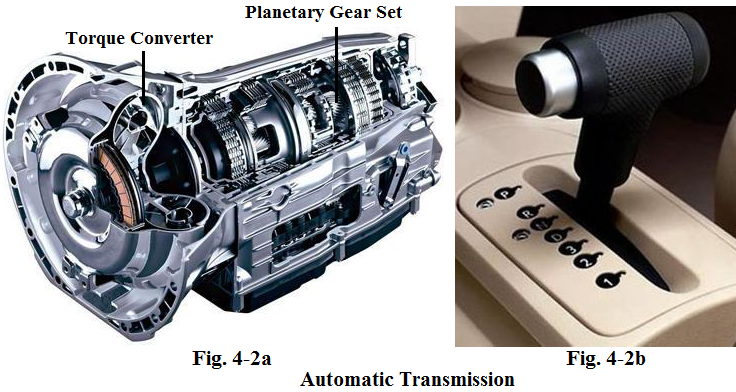
An automatic transmission is the most complicated mechanical component in today’s car.It consists of mechanical system, hydraulic system, electrical system and electronic control system, all working together in perfect harmony.
If you have a car with an AT, the gears are changed automatically without any help from you. This is accomplished through the torque converter, a planetary gear set including a sun gear, planet gears and a carrier, and other shift operating devices (see Fig.4-2).All automatic transmissions have a gearshift that has at least 4 positions: park (P), reverse (R), neutral (N) and drive (D) as shown in Fig.4-3.
Continuously Variable Transmission (CVT)
A continuously variable transmission is not a complicated system. CVT moves seamlessly from one gear ratio to the next through a pulley system which not only offers smoother shifting but also improves better fuel economy (see Fig.4-4).
The major components of a CVT include an input drive pulley, an output driven pulley and a metal belt as shown in Fig.4-5.
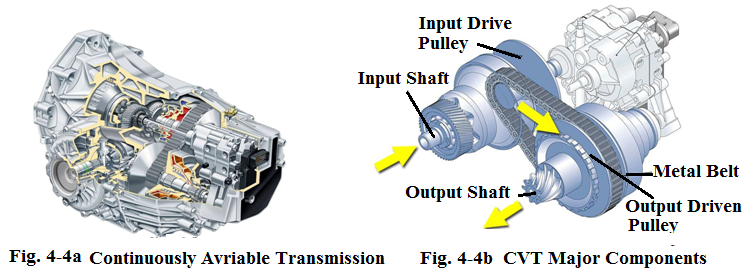
Each pulley has two cones, forming a groove, and the belt rides in the two grooves. As the distance between the cones changes, the belt rides higher or lower in the grooves, which determines the gear the car is in.
Direct Shift Gearbox (DSG)
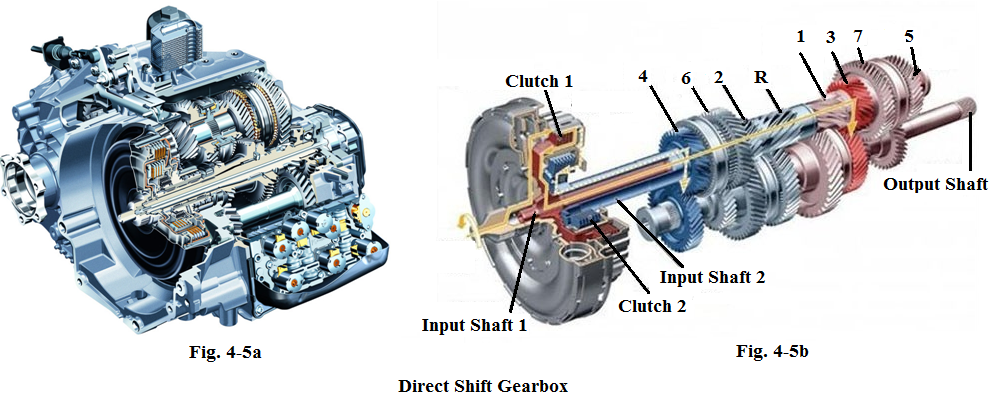
If you drive a car with DSG, the gears shift automatically, or you can manually select them by yourself without operating a clutch pedal. It is known as direct shift gearbox (DSG) (see Fig.4-6a) .
The greatest structural difference is that a DSG has two clutches. One clutch operates the odd-numbered gears, and the other clutch controls the even-numbered gears.The result is that the flow of power to the transmission from the engine isn’t interrupted as the transmission shifts from one gear to another. The DSG also has two transmission input shafts, one inside the other.The hollow outer shaft contacts the even-numbered gears, and the shaft inside it contacts the odd-numbered gears (see Fig.4-6b) .
DSG operates more smoothly than ordinary AT or MT, and it can deliver better fuel economy, as well.
译文:
课文 变速器
变速器是传动系统中最重要的组成部分。变速器,俗称变速箱,其作用是:①通过改变传动比来控制汽车的行驶速度;②提供方向控制以及前进和倒车:③中断发动机功率传输,使发动机空转。
按操作控制模式不同,汽车变速器可分为手动变速器(MT)和自动变速器(AT)。常见的自动变速器有三种,分别是液力自动变速器(AT)、无级变速器(CVT)和双离合变速器(DSG)。
手动变速器(AT)
手动变速器主要包括换档拨叉、结合套以及安装在输入轴、输出轴和中间轴上的不同尺寸的齿轮,如图4-1所示。
如果驾驶的是手动变速器汽车,通常须用中控台上的变速杆和左侧地板上的离合器踏板实现手动换档。
手动变速器通常有五档。一档是最低速档,用来起动车。二档时,较小的动力可使汽车行驶加快。三档和四档意味着输入与输出轴以同样的速度运转,汽车可以快速行驶。五档通常称为“超速档”。此时,输出轴比输入轴转速更快,可以达到更好的燃油经济性。现在,有些汽车配有六档或七档,虽然六档或七档变速器中的齿轮齿数比和五档变速器的相同,但是前进的档位越多,换档越平顺,燃油经济性也越好。
自动变速器
自动变速器是当今汽车构造中最为复杂的机械部件。它由机械系统、液压系统、电气系统和电子控制系统组成,所有系统彼此协调共同运行。
如果驾驶自动变速器汽车,则可实现自动换档。这一切是通过液力变矩器、行星齿轮组包括太阳轮、行星轮和行星齿轮架以及其他换档操作装置实现的(见图4-2)。自动变速器都有一个变速杆,至少有4个档位:驻车档、倒车档、空档和前进档,如图4-3所示。
无级变速器
无级变速器并不是一个复杂的系统。无级变速器通过带轮系统,从一个速比无缝转换到下一个速比,不仅换档更加平顺,而且能够更好地提高燃油经济性(见图4-4)。
无级变速器主要部件包括一个输入驱动带轮、一个输出从动带轮和-一个金属带,如图4-5所示。
每一个带轮都有两个锥形盘,形成-一个凹槽。金属带在两个凹槽中运行。随着锥形盘之间距离的变化,传动带在凹槽内时高时低地运行,由此决定汽车行驶的档位。
双离合变速器
如果是双离合变速器的汽车,换档可自动或手动进行而无需踩离合器踏板。这就是众所周知的双离合变速器(DSG) (见图4-6a)。
DSG在结构方面,最大的不同是它有两个离合器,一个离合器控制奇数齿轮,另一个离合器控制偶数齿轮。其结果是使变速器从一个档位换到另一个档位时,发动机传递给变速器的动力流不会中断。DSG还有两个变速器输入轴,一个输入轴嵌在另一个输入轴内。外部空心输入轴与奇数齿轮接触,内部输入轴与偶数齿轮接触(见图4-6b)。
双离合变速器比普通的自动变速器和手动变速器运行更加平顺,还可以带来更好的燃油经济性。

