
Engine Operating Principles
The piston goes up and down inside the cylinder, causing the crankshaft to turn through the connecting rod. Each movement of the piston is calleda stroke. Four strokes—intake stroke, compression stroke, power stroke and exhaust stroke—complete one working cycle. When the fourth stroke is completed, the cycle begins again. Currently, almost all cars use the four-stroke working cycle to make the engine run. However, the four-stroke working cycle varies slightly from the gasoline engine and the diesel engine.
How the gasoline engine works
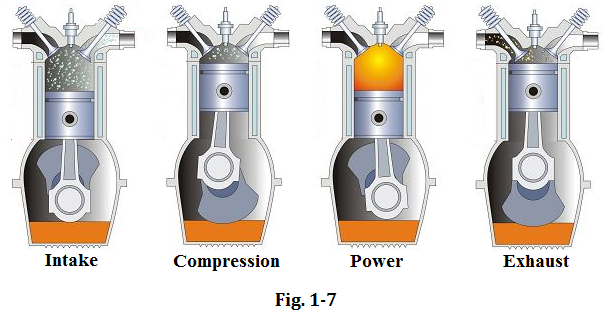
The first stroke is the intake stroke. The piston starts down, when the intake valve opens up, letting the fuel-air mixture into the cylinder. When the piston reaches the bottom of the cylinder, the intake valve closes, trapping the fuel-air mixture in the cylinder.During this stroke, the exhaust valve stays closed.
The second stroke is the compression stroke. At the bottom dead center (BDC), the piston moves back up, compressing the trapped fuel-air mixture in the cylinder with both intake and exhaust valves closed. When the piston reaches the top of the cylinder, the pressure rises.
The third stroke is the power stroke. Near the end of the compression stroke or at the top dead center (TDC), the spark plug fires, igniting the compressed fuel-air mixture that produces a powerful pressure. The combustion process pushes the piston down again with great force, turning the crankshaft to transmit the power to the drive wheels.
Thefourth stroke is the exhaust stroke. With the piston at BDC, the exhaust valve opens up, and the piston moves up again and forces the burned gases out of the cylinder into the exhaust manifold. From there, the burned gases travel through the exhaust system into the environment. The piston goes up to TDC, exiting all the exhaust gases in preparation for starting the four-stroke cycle over again (see Fig. 1-7).
How the diesel engine works
Most diesel engines also use a four-stroke working cycle, which is similar to, but not the same as, that of a gasoline engine. Here’s how the diesel’s four-stroke working cycle works:
Intake stroke
The piston goes downward, the intake valve opens, letting the air into the cylinder.
Compression stroke
The intake and exhaust valves are closed as the piston moves upward and places the air under extreme pressure. As the pressure increases, the air heats up to flash point. Just before the flash point is reached, fuel injectors spray fuel into the combustion chambers at the precise instant when ignition is to take place.
Power stroke
This stroke is the same as that of a gasoline engine. The diesel fuel ignites, and combustion forces the piston down. This driving power is transmitted through the transmission to the wheels, causing the car to move.
Exhaust stroke
The exhaust valve opens as the piston rises and pushes the burned gases out of the cylinder.
译文:
发动机工作原理
活塞在气缸内.上下运动,通过连杆使曲轴转动。活塞的每次运动称为行程。四个行程——进气行程、压缩行程、做功行程和排气行程——组成一个工作循环。当第四行程完成时,工作循环再次开始。当今,大部分汽车都采用四冲程工作循环,使发动机运转。但是,汽油机和柴油机的四冲程工作循环略有不同。
汽油机工作原理
第一行程是进气行程。活塞开始向下运动,这时进气门打开,可燃混合气进入气缸内。当活塞到达进气行程底部时,进气门关闭,留住缸内的可燃混合气。在该行程中,排气门保持关闭状态。
第二行程是压缩行程。在下止点(BDC)处,活塞返回向上运动,压缩留在气缸内的可燃混合气,进、排气门均关闭。当活塞到达气缸顶部时,压力升高。
第三行程是做功行程.在接近压缩行程结束时,即在上止点(TDC)时,火花塞点火,点燃可燃混合气,产生强大的压力。燃烧过程强力推动活塞再次向下运动,使曲轴转动,将动力传递给驱动轮。
第四行程是排气行程。当活塞在下止点时,排气门开启,活塞再次向上运动使废气排出气缸,进入排气歧管中。之后,废气通过排气系统排入外界。活塞向上到上止点,排出所有的废气,准备开始再次的四冲程循环(见图1-7)。
柴油机工作原理
大多数柴油机也采用四冲程工作循环,与汽油机类似,但又不相同。柴油机四冲程工作循环的工作原理如下:
进气行程
活塞向下运行,进气门开启,空气进入气缸。
压缩行程
当活塞向上运动时,进、排气门关闭,使空气处于极大压力之下。当压力增大时,空气升温至燃点。刚好到达燃点时,燃油器在精准时刻将燃油喷射到燃烧室中,这时产生燃烧。
做功行程
该行程与汽油机相同。柴油被点燃,燃烧使活塞向下运动。驱动力通过变速器传递给车轮,使汽车行驶。
排气行程
排气门开启,活塞向上运行,将废气排出气缸

