
Part I Topic for Discussion:
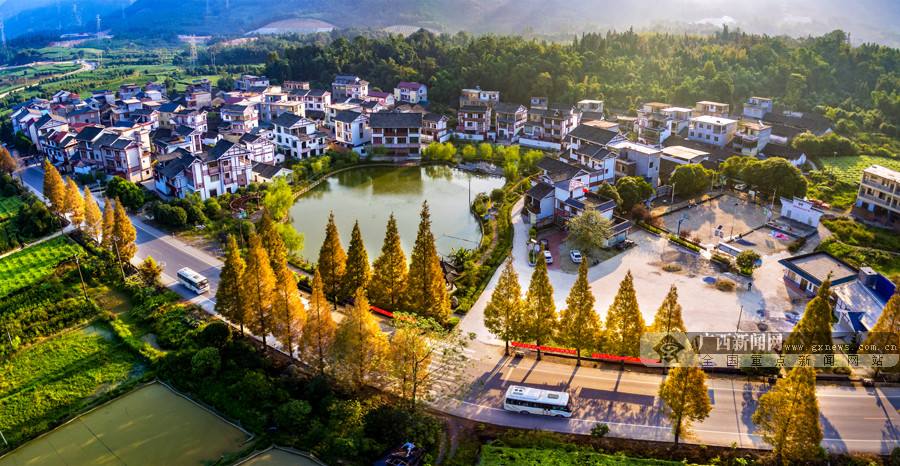
Where do you like to live, in the city or in the countryside? Why?

Part II Listening Practice:
Task One: Listen to the conversation Living in Urban City or Country and choose the best answer for each question.
1.
A) London. B) Bangkok.
C) Shanghai. D) San Francisco.
2.
A) Because of the fresh air.
B) Because of the beauty.
C) Because of the concrete jungles.
D) Because of the dullness.
3.
A) In the city.
B) In the country.
C) Both in the city and the country.
D) Not mentioned.
4.
A) You can form a good relationship with the few people you do meet.
B) You can’t just go to any restaurant at any time.
C) You can’t go see a museum.
D) You can’t go see a ball game or goto a nightclub.
5.
A) The man will miss museums in the city.
B) The man will miss concerts in the city.
C) The man will relax himself in the country later on.
D) The man will live in the city.
Task Two: Listento the passage Opportunities and Challenges inUrbanization and mark the statements T (true) orF (false).



___1. 15 million of rural migrant workers have swarmed into big cities to seek jobs.
___2. Urbanization creates a large demand and a positive cycle.
___3. Urban living provides the realization of a dream for a better life for all rural migrant workers.
___4. An income gap between migrant workers and local citizens is not a big problem.
___5. The government should put the brakes on fierce competition for jobs and so on.
请在下面的章节测验里填写以上两个任务的答案
Part III Watching and Listening
You are going to watch a video clip Did You Know (2'20''), and then do the following exercises.
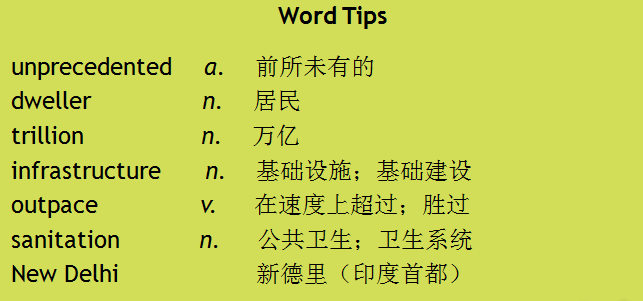
Task One: Now watch the video clip. Please get familiar with the words given below and then choose the best answer for each question.
1. As for the shocking evidence of cities’ growth, which statement is true according to the videoclip?
A) Two people are born every minute.
B) In the year 2030, about 5 million people will live in cities.
C) By 2050, there will be only 30% of us living in the countryside.
D) None of the above.
2. Which one is NOT mentioned as the example of infrastructure?
A) Hospitals. B) Public transport.
C) Schools. D) Housing.
3. A key issue that challenges people’s existence is _____.
A) energy shortage B) lack of space
C) unemployment D) global warming
Task Two: Now watch the video clip again and then fill in each blank with only one word.
Nowadays, our cities in the world grow at an (1)_______ rate. By 2050, the percentage of city (2)_______ will be far more than that of the beginning of human history. To keep up the growth, every year cities (3)________ a large sum of money into public service. In many places, urban growth tends to (4)________ even the best efforts to ensure people’s basic needs. At the same time, our cities meet great challenges as well as provide many opportunities. A key issue of the future is to build (5)________ cities. Let’s begin from now on.

