I. Lead-in Activities
1. Watch the following video about loneliness twice. Then finish a task.
Task: Fill in the blanks.
Alone in the Crowd—How Loneliness Affects the Mind and Body
There is a loneliness ___1___ in the UK. 45% of people admit to feeling lonely at least some of the time and one in eight adults report having no close friends.
Loneliness can affect anyone at any time. Often it's triggered by life event—retirement, divorce, illness or even losing a loved one. But even seemingly ___2___ events like having a baby, moving home or starting a new job can leave you feeling lonely.
But what is loneliness? As deeply social animals, most of us will feel the need to be around other people on a daily basis, and if we don't, we can risk feeling ___3___. But it's possible to feel lonely even when we're ___4___ by a roomful of other people or we have a thousand or so friends on social media because it's not just about___5___ — it's about our perception of belonging and having ___6___ relationships with other people. Having a small number of the strong social bonds is much more important than having a large number of ___7___ friendships.
Loneliness can take a huge toll on our mental health — increasing risk of ___8___and __9___. And because persistent loneliness can increase our levels of stress hormones and lead to overeating. It can have an impact on our cardiovascular (心血管的) function and immune system.
In fact, research has shown that loneliness can be more damaging than obesity or smoking —increasing our ___10___ of early death by around 26%.
2. One topic for discussion:
II. Vocabulary Study
1. Listen to the recording of new words and phrases.
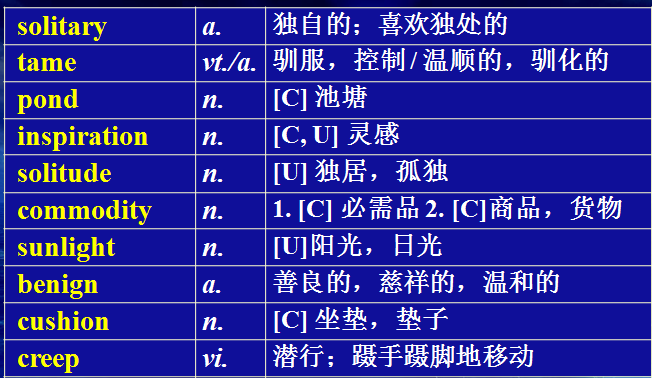
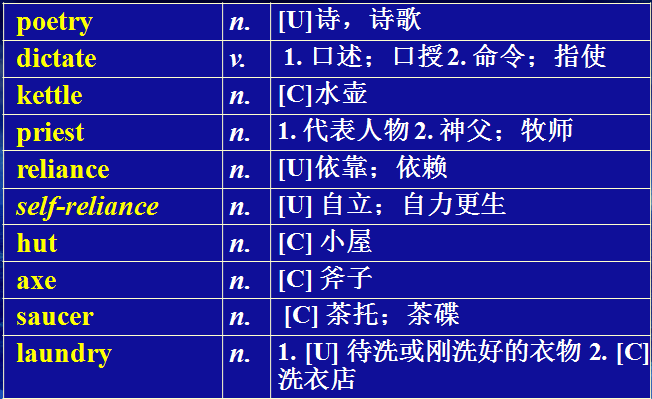
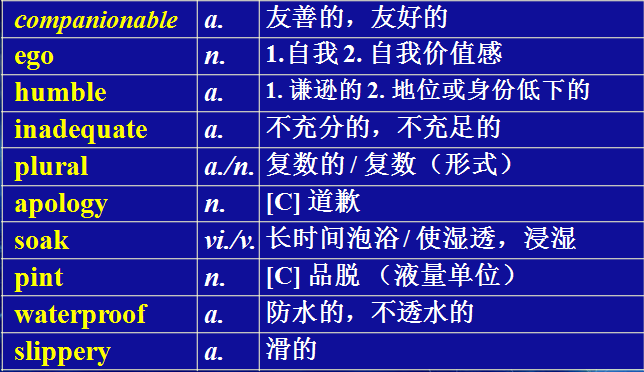
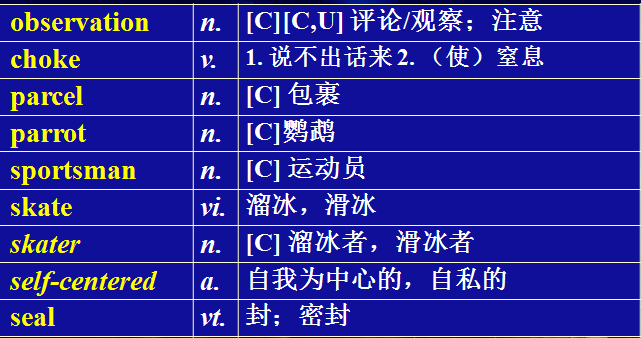
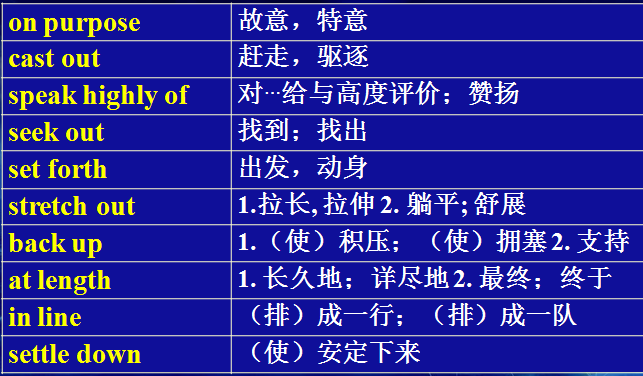
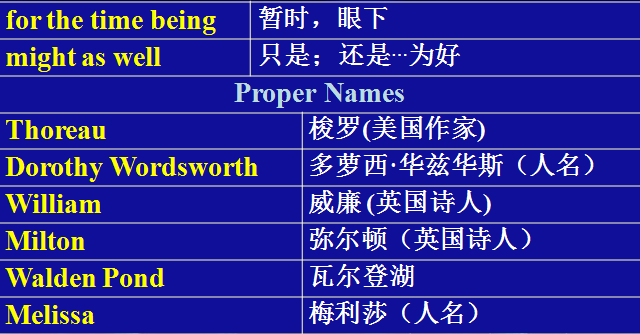
2. Vocabulary study
III. Text Structure Analysis
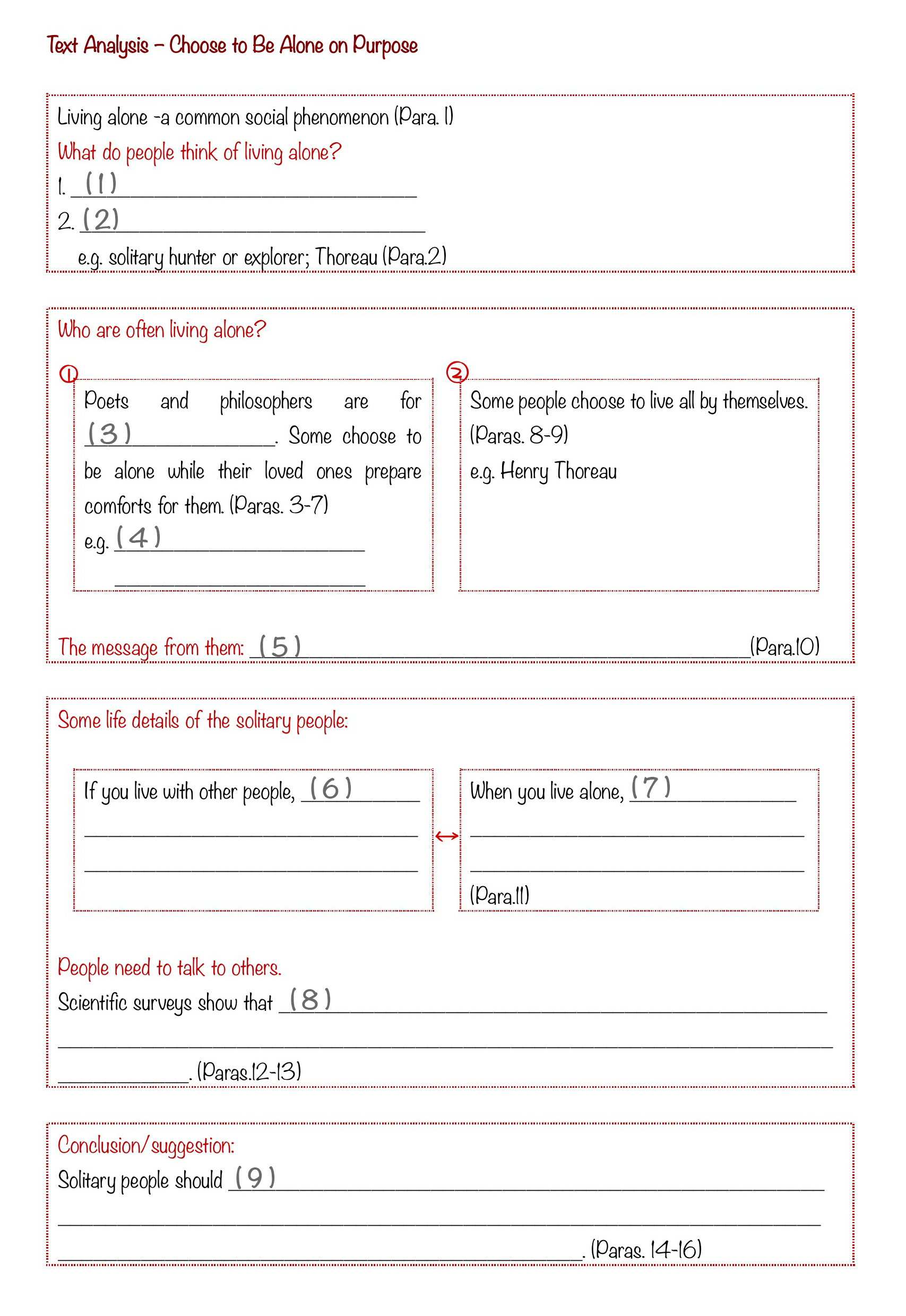
Look through the passage and then finish the following blanks.
Choose to Be Alone on Purpose
Para 1 Here we are, all by ourselves, all 22 million of us by recent count, alone in our rooms, some of us liking it that way and some of us not. Some of us divorced, some widowed, some never yet committed.
Para 2 Loneliness may be a sort of national disease here, and it's more embarrassing for us to admit than any other sin. On the other hand, to be alone on purpose, having rejected company rather than been cast out by it, is one characteristic of an American hero. The solitary hunter or explorer needs no one as they venture out among the deer and wolves to tame the great wild areas. Thoreau, alone in his cabin on the pond, his back deliberately turned to the town. Now, that's character for you.
Para 3 Inspiration in solitude is a major commodity for poets and philosophers. They're all for it. They all speak highly of themselves for seeking it out, at least for an hour or even two before they hurry home for tea.
Para 4 Consider Dorothy Wordsworth, for instance, helping her brother William put on his coat, finding his notebook and pencil for him, and waving as he sets forth into the early spring sunlight to look at flowers all by himself. How graceful, how benign, is solitude, he wrote.
Para 5 No doubt about it, solitude is improved by being voluntary.
Para 6 Look at Milton's daughters arranging his cushions and blankets before they silently creep away, so he can create poetry. Then, rather than trouble to put it in his own handwriting, he calls the girls to come back and write it down while he dictates.
Para 7 You may have noticed that most of these artistic types went outdoors to be alone. The indoors was full of loved ones keeping the kettle warm till they came home.
Para 8 The American high priest of solitude was Thoreau. We admire him, not for his self-reliance, but because he was all by himself out there at Walden Pond, and he wanted to be—all alone in the woods.
Para 9 Actually, he lived a mile, or 20 minutes' walk, from his nearest neighbor; half a mile from the railroad; three hundred yards from a busy road. He had company in and out of the hut all day, asking him how he could possibly be so noble. Apparently the main point of his nobility was that he had neither wife nor servants, used his own axe to chop his own wood, and washed his own cups and saucers. I don't know who did his laundry; he doesn't say, but he certainly doesn't mention doing his own, either. Listen to him: " I never found the companion that was so companionable as solitude."
Para 10 Thoreau had his own self-importance for company. Perhaps there's a message here The larger the ego, the less the need for other egos around. The more modest and humble we feel, the more we suffer from solitude, feeling ourselves inadequate company.
Para 11 If you live with other people, their temporary absence can be refreshing. Solitude will end on Thursday. If today I use a singular personal pronoun to refer to myself, next week I will use the plural form. While the others are absent you can stretch out your soul until it fills up the whole room, and use your freedom, coming and going as you please without apology, staying up late to read, soaking in the bath, eating a whole pint of ice cream at one sitting, moving at your own pace. Those absent will be back. Their waterproof winter coats are in the closet and the dog keeps watching for them at the window. But when you live alone, the temporary absence of your friends and acquaintances leaves a vacuum; they may never come back.
Para 12 The conditionof loneliness rises and falls, but the need to talk goes on forever. It's more basic than needing to listen. Oh, we all have friends we can tell important things to, people we can call to say we lost our job or fell on a slippery floor and broke our arm. It's the daily succession of small complaints and observations and opinions that backs up and chokes us. We can't really call a friend to say we got a parcel from our sister, or it's getting dark earlier now, or we don't trust that new Supreme Court justice.
Para 13 Scientific surveys show that we who live alone talk at length to ourselves and our pets and the television. We ask the cat whether we should wear the blue suit or the yellow dress. We ask the parrot if we should prepare steak, or noodles, for dinner. We argue with ourselves over who is the greater sportsman that figure skater or this skier. There's nothing wrong with this. It's good for us, and a lot less embarrassing than the woman in front of us in line at the market who's telling the cashier that her niece Melissa may be coming to visit on Saturday, and Melissa is very fond of hot chocolate, which is why she bought the powdered hot chocolate mix, though she never drinks it herself.
Para 14 It's important to stay rational.
Para 15 It's important to stop waiting and settle down and make ourselves comfortable, at least temporarily, and find some grace and pleasure in our condition, not like a self-centered British poet but like a patient princess sealed up in a tower, waiting for the happy ending to our fairy tale.
Para 16 After all, here we are. It may not be where we expected to be, but for the time being we might as well call it home. Anyway, there is no place like home.

