
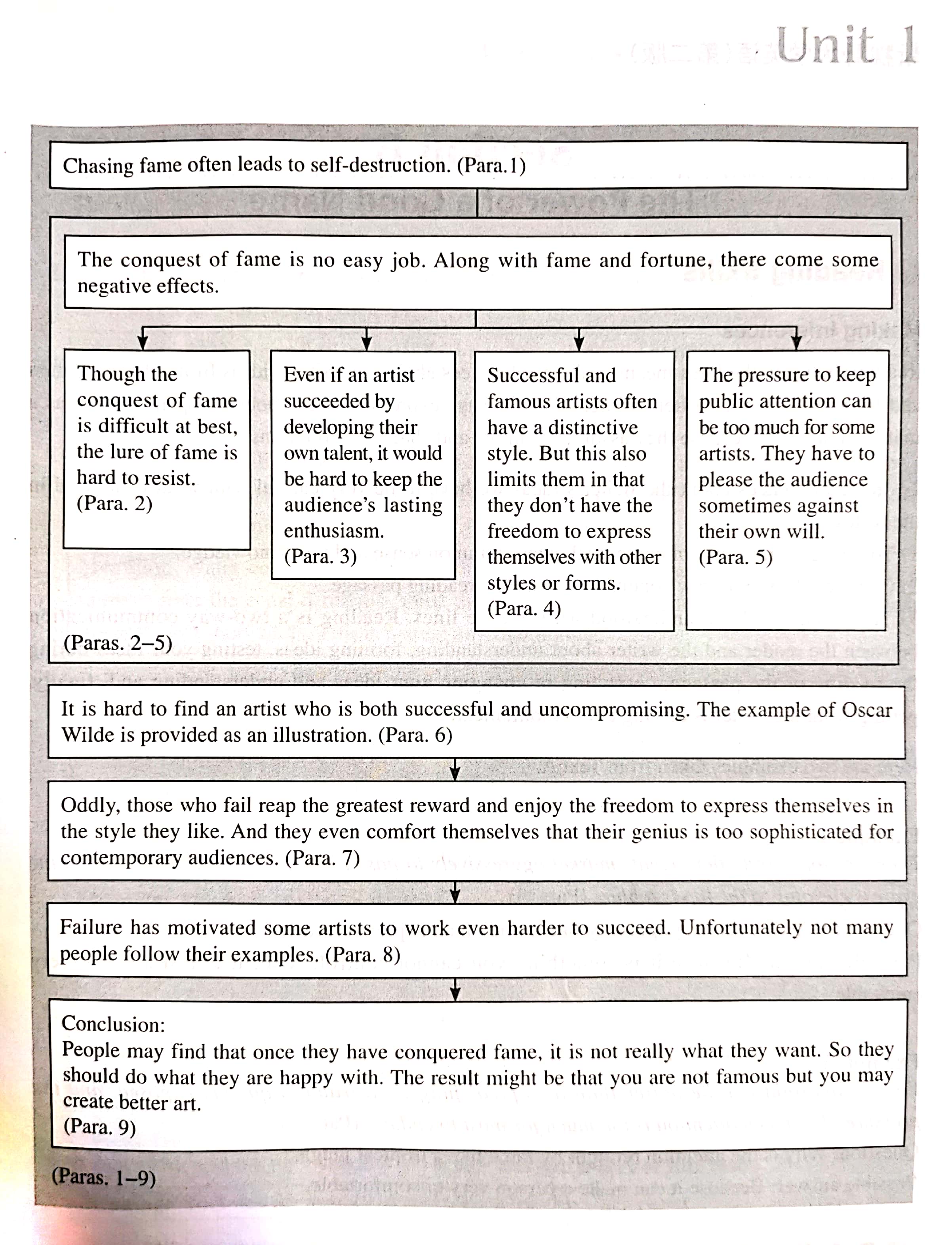
Part I (1) This part is the argument for the whole passage: Chasing fame often leads to self-destruction. The passage continues to argue for the point from four different aspects.
Para 1 An artist who seeks fame is like a dog chasing his own tail who, when he captures it, does not know what else to do but to continue chasing it. The cruelty of success is that it often leads those who seek such success to participate in their own destruction.
Part II (2~5) In this part, the writer tries to convince us that the conquest of fame is no easy job and that along with fame and fortune there comes some negative effects which could be disastrous.
Para. 2 argues that though the conquest of fame is difficult at best, the lure of fame is hard to resist.
Para 2 "Don't quit your day job!" is advice frequently given by understandably pessimistic family members andfriends to a budding artist who is trying hard to succeed. The conquest of fameis difficult at best, and many end up emotionally if not financially bankrupt.Still, impure motives such as the desire for worshipping fans and praise frompeers may spur the artist on. The lure of drowning in fame's imperial glory isnot easily resisted.
Para. 3 tells us that even if an artist succeeded by developing their own talent, it would be hart to keep the audience’s lasting enthusiasm.
Para 3 Those who gain fame most often gain it as a result of exploiting their talent for singing, dancing, painting, or writing,etc. They develop a style that agents market aggressively to hasten popularity, and their ride on the express elevator to the top is a blur. Most would behard-pressed to tell you how they even got there. Artists cannot remain idle, though. When the performer, painter or writer becomes bored, their work beginsto show a lack of continuity in its appeal and it becomes difficult to sustain the attention of the public. After their enthusiasm has dissolved, the public simply moves on to the next flavor of the month. Artists who do attempt to remain current by making even minute changes to their style of writing, dancing or singing, run a significant risk of losing the audience's favor. The public simply discounts styles other than those for which the artist has become famous.
Para. 4 argues with some examples that successful and famous artists often have a distinctive style, but this also limits them in that they don’t have the freedom to express themselves with other styles or forms.
Para 4 Famous authors' styles—a Tennessee Williams play or a plot by Ernest Hemingway or a poem by Robert Frost or T.S. Eliot—are easily recognizable. The same is true of painters like Monet, Renoir, or Dali and moviemakers like Hitchcock, Fellini, Spielberg, Chen Kaige or Zhang Yimou.Their distinct styles marked a significant change in form from others and gained them fame and fortune. However, they paid for it by giving up the freedom to express themselves with other styles or forms.
Para. 5 tells us that the pressure to keep public attention can be too much for some artists. They have to please the audience sometime against their own will.
Para 5 Fame's spotlight can be hotter than a tropical jungle—a fraud is quickly exposed, and the pressure of so much attention is too much for most to endure. It takes you out of yourself: You must be what the public thinks you are, not what you really are or could be.The performer, like the politician, must often please his or her audiences by saying things he or she does not mean or fully believe.
Part III (6) This part shows us how hard it is for successful artists to remain true to themselves.Oscar Wilde, known for his uncompromising behavior, is just an example.
Para 6 One drop of fame will likely contaminate the entire well of a man's soul, and so an artist who remains true to himself or herself is particularly amazing. You would be hard-pressed to underline many names of those who have not compromised and still succeeded in the fame game. An example, the famous Irish writer Oscar Wilde, known for his uncompromising behavior, both social and sexual, to which the public objected, paid heavily for remaining true to himself. The mother of a young man Oscar was intimate with accused him at a banquet in front of his friends and fans of sexually influencing her son. Extremely angered by her remarks, he sued the young man's mother, asserting that she had damaged his "good" name. He should have hired a better attorney, though. The judge did not second Wilde's call to have the woman pay for damaging his name, and instead fined Wilde. He ended up in jail after refusing to pay, and even worse, was permanently expelled from the wider circle of public favor. When things were at their worst, he found that no one was willing to risk his or her name in his defense. His price for remaining true to himself was to be left alone when he needed his fans the most.
Part IV (7) This part tells us that the greatest winners, oddly enough are those who initially fail in conquest of fame. They enjoy the freedom to express themselves in unique and original ways without losing the support of fans and they can even comfort themselves by saying that their genius is too sophisticated for contemporary audiences.
Para 7 Curiously enough, it is those who fail that reap the greatest reward: freedom! They enjoy the freedom to express themselves in unique and original ways without fear of losing the support of fans. Failed artists may find comfort in knowing that many great artists never found fame until well after they had passed away or in knowing that they did not sell out. They may justify their failure by convincing themselves their genius is too sophisticated for contemporary audiences.

