
目录

  • 1 Lesson 1: Stress and strain
    • 1.1 Lesson 1: Stress and strain
    • 1.2 1. What is Strain?
    • 1.3 2. What is Stress?
    • 1.4 3. Units
    • 1.5 4. The link from Load to Strain
    • 1.6 5. The link between Stress and Strain
    • 1.7 6. New Words
    • 1.8 7. Phrases and Expressions
    • 1.9 8. Text
    • 1.10 9. Note
    • 1.11 10. Exercise
  • 2 Lesson 3: Shaft design
    • 2.1 Lesson 3: Shaft design
    • 2.2 Shafts and axles
      • 2.2.1 General considerations
      • 2.2.2 Types
      • 2.2.3 The main design problems 轴设计主要问题
      • 2.2.4 Vibration stability calculations
      • 2.2.5 Rigidity calculations
      • 2.2.6 Rigidity calculations
      • 2.2.7 Selection of the shaft materials
      • 2.2.8 Selection of the shaft materials
      • 2.2.9 Selection of the shaft materials
      • 2.2.10 Selection of the shaft materials
      • 2.2.11 Selection of the shaft materials
      • 2.2.12 Structural design
      • 2.2.13 Structural design
      • 2.2.14 Tentative calculations
      • 2.2.15 Tentative calculations
      • 2.2.16 Influencing factors on structural design
      • 2.2.17 Influencing factors on structural design
      • 2.2.18 Influencing factors on structural design
      • 2.2.19 Influencing factors on structural design
      • 2.2.20 Influencing factors on structural design
      • 2.2.21 Strength check for the shafts
      • 2.2.22 Strength check for the shafts
      • 2.2.23 Strength check for the shafts
      • 2.2.24 Strength check for the shafts
      • 2.2.25 Strength check for the shafts
      • 2.2.26 Strength check for the shafts
      • 2.2.27 Strength check for the shafts
      • 2.2.28 Strength check for the shafts
      • 2.2.29 Strength check for the shafts
      • 2.2.30 Strength check for the shafts
    • 2.3 1. New Words
    • 2.4 2. Phrases and Expressions
    • 2.5 3 Text
    • 2.6 4. Note
    • 2.7 5. Exercise
  • 3 Lesson 6:The layout and main parts of automibile
    • 3.1 Lesson 6:The layout and main parts of automibile
    • 3.2 1)How many kinds of automobile you can say in English?
      • 3.2.1 1)How many kinds of automobile you can say in English?
      • 3.2.2 1)How many kinds of automobile you can say in English?
      • 3.2.3 1)How many kinds of automobile you can say in English?
      • 3.2.4 1)How many kinds of automobile you can say in English?
      • 3.2.5 1)How many kinds of automobile you can say in English?
      • 3.2.6 1)How many kinds of automobile you can say in English?
      • 3.2.7 1)How many kinds of automobile you can say in English?
      • 3.2.8 1)How many kinds of automobile you can say in English?
      • 3.2.9 1)How many kinds of automobile you can say in English?
      • 3.2.10 1)How many kinds of automobile you can say in English?
      • 3.2.11 1)How many kinds of automobile you can say in English?
    • 3.3 2)What’s the main parts of an automobile?
      • 3.3.1 2)What’s the main parts of an automobile?
      • 3.3.2 2)What’s the main parts of an automobile?
      • 3.3.3 2)What’s the main parts of an automobile?
      • 3.3.4 2)What’s the main parts of an automobile?
      • 3.3.5 2)What’s the main parts of an automobile?
    • 3.4 automobile:review
      • 3.4.1 automobile:review
      • 3.4.2 automobile:review
      • 3.4.3 automobile:review
      • 3.4.4 automobile:review
      • 3.4.5 automobile:review
      • 3.4.6 automobile:review
      • 3.4.7 automobile:review
      • 3.4.8 automobile:review
      • 3.4.9 automobile:review
      • 3.4.10 automobile:review
    • 3.5 Vocabulary, Phrases and Expression
    • 3.6 Text
    • 3.7 Notes
    • 3.8 Exercise
    • 3.9 Homework
  • 4 Lesson 7:Casting
    • 4.1 Introduction to Casting
      • 4.1.1 Primary forming process (casting)
      • 4.1.2 Casting
      • 4.1.3 Classification of casting process
      • 4.1.4 Sand casting
        • 4.1.4.1 The major features of sand moulds
        • 4.1.4.2 Sequence of operations for sand casting
      • 4.1.5 Investment casting
        • 4.1.5.1 Investment casting
        • 4.1.5.2 Sequences involve in investment casting
      • 4.1.6 Die casting
        • 4.1.6.1 Die casting
        • 4.1.6.2 Hot chamber die casting
          • 4.1.6.2.1 Hot chamber die casting
        • 4.1.6.3 Cold chamber die casting
          • 4.1.6.3.1 Cold chamber die casting
      • 4.1.7 Adv/disadv of different casting process
      • 4.1.8 Casting defects(缺陷)
        • 4.1.8.1 Casting defects – fins飞边
        • 4.1.8.2 Casting defects - swells
        • 4.1.8.3 Casting defects – scabs 结疤
        • 4.1.8.4 Casting defects- blowholes/pinholes气孔
        • 4.1.8.5 Casting defects- shrinkage
        • 4.1.8.6 Casting defects- shrinkage cavities
        • 4.1.8.7 Casting defects- porosity孔隙度
        • 4.1.8.8 Casting defects- lack of fusion未熔合
        • 4.1.8.9 Casting defects- hot tear, hot crack热撕裂
        • 4.1.8.10 Casting defects- discontinuities
        • 4.1.8.11 Casting defects- hot crack
        • 4.1.8.12 Casting defects- defective surfaces
        • 4.1.8.13 Casting defects- inclusions夹杂物
      • 4.1.9 Casting design guidelines
        • 4.1.9.1 Casting design guidelines
        • 4.1.9.2 Casting design guidelines
        • 4.1.9.3 Casting design guidelines
        • 4.1.9.4 Casting design guidelines
      • 4.1.10 References
    • 4.2 New words
    • 4.3 Phrases and Expressions
    • 4.4 Text
    • 4.5 Notes
    • 4.6 Exercises
    • 4.7 附件:  缺陷名称和分类
      • 4.7.1 A . 尺寸,形状缺陷
      • 4.7.2 B. 缩孔 ( 由凝固收缩引起 )
      • 4.7.3 C. 气体缺陷(由气体引起的孔)
      • 4.7.4 D. 裂纹
      • 4.7.5 E. 夹杂物
      • 4.7.6 F. 外观缺陷
      • 4.7.7 G. 型芯缺陷
      • 4.7.8 H. 表面缺陷
      • 4.7.9 I.  组织缺陷 ( 铸铁 )
      • 4.7.10 J.   断口缺陷
      • 4.7.11 L.  使用性能缺陷
  • 5 Lesson 8:Forging
    • 5.1 Lesson 8:Forging
    • 5.2 Vocabulary
    • 5.3 Phrases and Expression
    • 5.4 Basic Introduction
      • 5.4.1 Basic Introduction
      • 5.4.2 Basic Introduction
      • 5.4.3 Basic Introduction
      • 5.4.4 Basic Introduction
      • 5.4.5 Basic Introduction
      • 5.4.6 Basic Introduction
      • 5.4.7 Basic Introduction
      • 5.4.8 Basic Introduction
      • 5.4.9 Basic Introduction
      • 5.4.10 Basic Introduction
      • 5.4.11 Basic Introduction
    • 5.5 Text
    • 5.6 Notes
    • 5.7 Exercise
  • 6 Lesson 12:limits, fits and tolerances
    • 6.1 Lesson 12:limits, fits and tolerances
    • 6.2 Part One:Tolerances and Fits
      • 6.2.1 Part One:Tolerances and Fits
      • 6.2.2 introduction
        • 6.2.2.1 introduction
      • 6.2.3 Tolerances
        • 6.2.3.1 Tolerances
        • 6.2.3.2 Tolerances
        • 6.2.3.3 Tolerances
        • 6.2.3.4 Tolerances
      • 6.2.4 Fits
        • 6.2.4.1 Fits
        • 6.2.4.2 Fits
        • 6.2.4.3 Clearance fit
        • 6.2.4.4 Interference fit
        • 6.2.4.5 Transition fit
      • 6.2.5 ISO System of Limits and Fits
        • 6.2.5.1 ISO System of Limits and Fits
        • 6.2.5.2 ISO System of Limits and Fits
        • 6.2.5.3 ISO System of Limits and Fits
        • 6.2.5.4 ISO System of Limits and Fits
        • 6.2.5.5 ISO System of Limits and Fits
        • 6.2.5.6 ISO System of Limits and Fits
        • 6.2.5.7 ISO System of Limits and Fits
        • 6.2.5.8 ISO System of Limits and Fits
        • 6.2.5.9 ISO System of Limits and Fits
        • 6.2.5.10 ISO System of Limits and Fits
        • 6.2.5.11 ISO System of Limits and Fits
        • 6.2.5.12 ISO System of Limits and Fits
        • 6.2.5.13 ISO System of Limits and Fits
        • 6.2.5.14 ISO System of Limits and Fits
        • 6.2.5.15 ISO System of Limits and Fits
        • 6.2.5.16 ISO System of Limits and Fits
        • 6.2.5.17 ISO System of Limits and Fits
        • 6.2.5.18 ISO System of Limits and Fits
    • 6.3 Part Two:New Words
      • 6.3.1 Part Two:New Words
    • 6.4 Phrases and Expressions
    • 6.5 Text
    • 6.6 Note
    • 6.7 Exercise
  • 7 Lesson 13:Hydraulic and Pneumatic System
    • 7.1 Lesson 13:Hydraulic and Pneumatic System
    • 7.2 Hydraulic Systems-The Basics
      • 7.2.1 How does it work?
      • 7.2.2 System Parts
      • 7.2.3 Advantages & Disadvantages of Hydraulics
      • 7.2.4 Primary Hydraulic Systems
        • 7.2.4.1 Open-Center Systems
        • 7.2.4.2 Open-Center Systems
        • 7.2.4.3 Closed-Center Systems
        • 7.2.4.4 Closed-Center Systems
      • 7.2.5 Hydraulic Facts
        • 7.2.5.1 Hydraulic Facts
    • 7.3 What are Pneumatics?
      • 7.3.1 The Pneumatic “System”
      • 7.3.2 The Pneumatic “System”
      • 7.3.3 Parts of the “System” Pt.1
      • 7.3.4 Parts of the “System”: Pt. 2
      • 7.3.5 Parts of the “System”: Pt. 3
      • 7.3.6 Fittings
      • 7.3.7 Parts of the “System”: Pt. 4
      • 7.3.8 Parts of the “System”: Pt. 5
      • 7.3.9 Actuators
      • 7.3.10 Advantages of Pneumatics
      • 7.3.11 Disadvantages for Pneumatics
    • 7.4 Vocabulary
    • 7.5 Text
    • 7.6 Notes
    • 7.7 Exercise
  • 8 Lesson 14:Cutting Tools
    • 8.1 Cutting tool Basics
      • 8.1.1 Lathe Toolbit Properties
      • 8.1.2 Cutting-Tool Materials
      • 8.1.3 High-Speed Steel Toolbits
      • 8.1.4 Cemented-Carbide Toolbits
      • 8.1.5 Coated Carbide Toolbits
      • 8.1.6 Ceramic Toolbits
      • 8.1.7 Diamond Toolbits
      • 8.1.8 Cutting-Tool Nomenclature
      • 8.1.9 Cutting-Tool Nomenclature
      • 8.1.10 Lathe Toolbit Angles and Clearances
      • 8.1.11 Lathe Cutting-tool Angles
      • 8.1.12 Tool  Geometry
      • 8.1.13 Cutting-Tool Terms
      • 8.1.14 Nomenclature of a Plain Milling Cutter
      • 8.1.15 Nomenclature of an End Mill
      • 8.1.16 Nomenclature of an End Mill
      • 8.1.17 Characteristics of a  Drill Point
    • 8.2 New Words
    • 8.3 Phrases and Expressions
    • 8.4 Text
    • 8.5 Notes
    • 8.6 Exercise
  • 9 Lesson 15:Lathes
    • 9.1 Lathe
      • 9.1.1 Lathe Operations
      • 9.1.2 Cutting Tools
      • 9.1.3 Parts of the Lathe
      • 9.1.4 Parts of the Lathe
      • 9.1.5 Parts of the Lathe
      • 9.1.6 Parts of the Lathe
      • 9.1.7 Parts of the Lathe
      • 9.1.8 Lathe Accessories
      • 9.1.9 Work Holding Devices
      • 9.1.10 Lathe Centers
      • 9.1.11 Chucks
        • 9.1.11.1 Three-jaw Universal Chuck
        • 9.1.11.2 Four-Jaw Independent Chuck
        • 9.1.11.3 Chucks
      • 9.1.12 Headstock Spindles
        • 9.1.12.1 Headstock Spindles
      • 9.1.13 Collet Chuck
        • 9.1.13.1 Collet Chuck
        • 9.1.13.2 Collet Chuck
      • 9.1.14 Types of Lathe Dogs
        • 9.1.14.1 Types of Lathe Dogs
      • 9.1.15 Left-Hand Offset Toolholder
      • 9.1.16 Right-Hand Offset Toolholder
      • 9.1.17 Straight Toolholder
      • 9.1.18 Toolholders for Indexable Carbide Inserts
      • 9.1.19 Cutting-Off (Parting) Tools
      • 9.1.20 Threading Toolholder
      • 9.1.21 Super Quick-Change Toolpost
    • 9.2 New Words
    • 9.3 Phrases and Expressions
    • 9.4 Text
    • 9.5 Notes
    • 9.6 Exercise
  • 10 Lesson 16:Milling
    • 10.1 Lesson 16:Milling
    • 10.2 Basics
      • 10.2.1 Milling Machines
      • 10.2.2 The Vertical Milling Machine
        • 10.2.2.1 Vertical Milling Machine
        • 10.2.2.2 Variety of Operations
        • 10.2.2.3 Ram-Type Vertical Milling Machine
        • 10.2.2.4 Parts of Ram-Type Vertical Mill
        • 10.2.2.5 Direction of Feed: Conventional
        • 10.2.2.6 Direction of Feed: Climbing
        • 10.2.2.7 Advantages of Climb Milling
        • 10.2.2.8 Disadvantages of Climb Milling
        • 10.2.2.9 Depth of Cut
      • 10.2.3 End Mills
        • 10.2.3.1 End Mills
        • 10.2.3.2 High-Speed End Mills
        • 10.2.3.3 Carbide End Mills
        • 10.2.3.4 Common Machining Operations
        • 10.2.3.5 End Mill Forms
        • 10.2.3.6 Three common types and the relationship of the radius to the tool diameter.
        • 10.2.3.7 Common Types of End Mills
        • 10.2.3.8 Direction of Cut: Climb
        • 10.2.3.9 Direction of Cut: Conventional
        • 10.2.3.10 Direction of Cut
      • 10.2.4 Horizontal Milling Machines and Accessories
        • 10.2.4.1 Classification of Horizontal Milling Machines
        • 10.2.4.2 Plain Manufacturing Type Milling Machine
        • 10.2.4.3 Universal Horizontal Milling Machine
        • 10.2.4.4 Cross section of a Cincinnati Machine Backlash Eliminator
        • 10.2.4.5 Arbors, Collets, and Adapters
        • 10.2.4.6 Vises
        • 10.2.4.7 Fixturing Systems
      • 10.2.5 Milling Cutters
        • 10.2.5.1 Plain Milling Cutters
        • 10.2.5.2 Light-Duty Plain Milling Cutter
        • 10.2.5.3 Heavy-Duty Plain  Milling Cutters
        • 10.2.5.4 High-Helix Plain Milling Cutters
        • 10.2.5.5 Standard Shank-Type Helical Milling Cutters
        • 10.2.5.6 Side Milling Cutters
        • 10.2.5.7 Half-Side Milling Cutters
        • 10.2.5.8 Face Milling Cutters
        • 10.2.5.9 Shell End Mills
        • 10.2.5.10 Angular Cutters
        • 10.2.5.11 Types of Formed Cutters
        • 10.2.5.12 Metal-Slitting Saws
        • 10.2.5.13 T-Slot Cutter
        • 10.2.5.14 Dovetail Cutter
        • 10.2.5.15 Woodruff Keyseat Cutter
      • 10.2.6 Index Head Parts
        • 10.2.6.1 Index Head Parts
    • 10.3 New words
    • 10.4 Phrases and Expressions
    • 10.5 Text
    • 10.6 Notes
    • 10.7 Exercises
  • 11 Lesson 17:Grinding
    • 11.1 Lesson 17:Grinding
    • 11.2 Basics
      • 11.2.1 Abrasive Machining Processes
      • 11.2.2 Applications
      • 11.2.3 Process Characteristics
      • 11.2.4 Abrasives
      • 11.2.5 Abrasive Grain Size
      • 11.2.6 Forms
      • 11.2.7 The Grinding Process
      • 11.2.8 Chip Formation
      • 11.2.9 The Tool: Grinding Wheels
      • 11.2.10 Wheel Bonding Agents
      • 11.2.11 Wheel Forms
      • 11.2.12 Wheel Classification
      • 11.2.13 Grinding Wheel Operating Procedures
      • 11.2.14 Cutting Fluid
      • 11.2.15 Grinding Machines
      • 11.2.16 Grinding Operations
      • 11.2.17 Grinding Machines
    • 11.3 New  Words
    • 11.4 Phrases  and  Expressions
    • 11.5 Notes
    • 11.6 Text
    • 11.7 Exercises
  • 12 Lesson 20:Numerical Control
    • 12.1 Lesson 20:Numerical Control
    • 12.2 NC and CNC machines and Control Programming
      • 12.2.1 History of CNC
      • 12.2.2 Motivation and uses
      • 12.2.3 Advantages of CNC
      • 12.2.4 Conventional milling machines
      • 12.2.5 NC machines
      • 12.2.6 CNC terminology
      • 12.2.7 Controller components
      • 12.2.8 Types of CNC machines
      • 12.2.9 Open Loop vs. Closed Loop controls
      • 12.2.10 Open loop control of a Point-to-Point NC drilling machine
      • 12.2.11 Components of Servo-motor controlled CNC
      • 12.2.12 Motion Control and feedback
      • 12.2.13 Example 1
      • 12.2.14 Example 2
      • 12.2.15 Manual NC programming
      • 12.2.16 History of CNC
      • 12.2.17 Manual Part Programming Example
      • 12.2.18 1. Set up the programming parameters
      • 12.2.19 2. Set up the machining conditions
      • 12.2.20 3. Move tool from p0 to p1 in straight line
      • 12.2.21 4. Cut profile from p1 to p2
      • 12.2.22 5. Cut profile from p2 to p3
      • 12.2.23 6. Cut along circle from p3 to p4
      • 12.2.24 7. Cut from p4 to p5
      • 12.2.25 8. Cut from p5 to p1
      • 12.2.26 9. Return to home position, stop program
      • 12.2.27 Automatic Part Programming
      • 12.2.28 Automatic part programming and DNC
      • 12.2.29 Summary
    • 12.3 New Words
    • 12.4 Phrases and Expressions
    • 12.5 Text
    • 12.6 Notes
    • 12.7 Exercise
  • 13 Lesson 21:Robot
    • 13.1 Lesson 21:Robot
      • 13.1.1 Robotics
      • 13.1.2 Robotics
      • 13.1.3 Definition
      • 13.1.4 Ideal Tasks
      • 13.1.5 Automation vs. robots
      • 13.1.6 Types of robots
        • 13.1.6.1 Pick and Place
        • 13.1.6.2 Continuous path control
      • 13.1.7 Sensory
    • 13.2 New words
    • 13.3 Phrases and Expressions
    • 13.4 Text
    • 13.5 Notes
    • 13.6 Exercise
  • 14 Lesson 22 Computer Aided Manufacturing
    • 14.1 Lesson 22 Computer Aided Manufacturing
    • 14.2 CAD/CAM
      • 14.2.1 CAD/CAM
      • 14.2.2 The Product Cycle and CAD/CAM
      • 14.2.3 Typical Product Life Cycle
      • 14.2.4 Typical Product Life Cycle
      • 14.2.5 Typical Product Life Cycle
      • 14.2.6 Implementation of a Typical CAM Process on a CAD/CAM system
      • 14.2.7 CAM Tools Required to Support the Design Process
      • 14.2.8 Definitions of CAD Tools Based on Their Constituents
      • 14.2.9 Definition of CAD Tools Based on Their Implementation in a Design Environment
      • 14.2.10 Definitions of CAM Tools Based on Their Constituents
      • 14.2.11 Definition of CAM Tools Based on Their Implementation in a Manufacturing Environment
      • 14.2.12 Definitions of CAD/CAM Tools Based on Their Constituents
      • 14.2.13 Definition of CAD/CAM Tools Based on Their Implementation in an Engineering Environment
      • 14.2.14 Typical Utilization of CAD/CAM Systems in an Industrial Environment
      • 14.2.15 Advantages of CAD/CAM systems
    • 14.3 New Words
    • 14.4 Phrases and Expressions
    • 14.5 Text
    • 14.6 Notes
    • 14.7 Exercise
  • 15 Lesson 23:FMS Definition and Description
    • 15.1 Lesson 23:FMS Definition and Description
    • 15.2 What Will Be Covered
      • 15.2.1 What Is A Flexible Manufacturing System?
      • 15.2.2 History of FMS
      • 15.2.3 How You Can Use FMS
      • 15.2.4 Nuts and Bolts of FMS
      • 15.2.5 Automated Material Handling
      • 15.2.6 Components of Flexible Manufacturing Systems
      • 15.2.7 Flexible Automation
      • 15.2.8 FMS Nuts and Bolts-Robots
        • 15.2.8.1 Robots
        • 15.2.8.2 Common Uses of Robots
        • 15.2.8.3 Computer Integrated Manufacturing
        • 15.2.8.4 Components of CIM
      • 15.2.9 Manufacturing Technology
      • 15.2.10 Challenges with FMS
      • 15.2.11 Flexible Manufacturing
      • 15.2.12 Flexible Manufacturing
      • 15.2.13 Integration of FMS
      • 15.2.14 Making FMS Work
      • 15.2.15 A Real World Example
        • 15.2.15.1 Ford’s Problem
        • 15.2.15.2 Solution
        • 15.2.15.3 Benefits
    • 15.3 New Words
    • 15.4 Phrases and Expressions
    • 15.5 Text
    • 15.6 Notes
    • 15.7 Exercise
  • 16 review and examination
    • 16.1 review and examination
8. Text

Translate English into Chinese

要求:

1、在通读的基础上,逐段翻译课文;

2、注意专业名词、专有名词的准确性;

3、通过课文学习,了解科技文献的写作特点;

4、学习复杂句子的结构分析。


The fundamental concepts of stress and strain can be illustrated by considering a prismatic bar that is loaded by axial forces P at the ends, as shown in Fig. 1-1. A prismatic bar is a straight structural member(构件)having constant cross section throughout its length. In this illustration, the axial forces produce a uniform stretching of the bar, hence, the bar is said to be in tension.


To investigate the internal stresses produced in the bar by the axial forces, we make an imaginary cut at section mn (Fig.1-1a). This section is taken perpendicular to the longitudinal axis of the bar; hence, it is known as a cross section. We now isolate the part of the bar to the right of the cut as a free body (Fig. 1-1b). The tensile load P acts at the right-hand end of the free body; at the other end are forces representing the action of the removed part of the bar upon the part that remains.
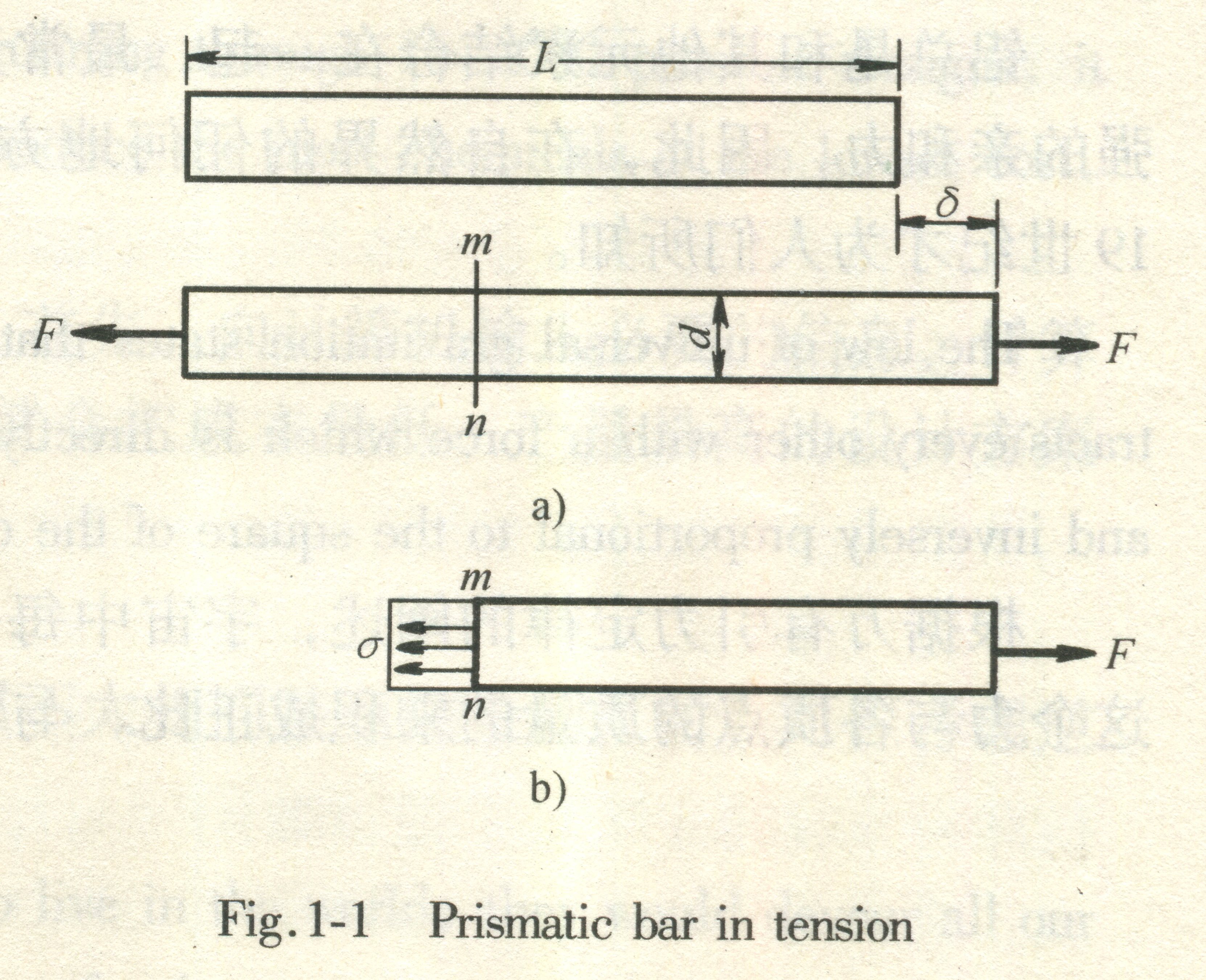


These forces are continuously distributed over the cross section, analogous to the continuous distribution of hydrostatic pressure over a submerged horizontal surface. The intensity of force (that is, the force per unit area) is called the stress and is commonly denoted by the Greek letter σ(sigma). Assuming that the stress has a uniform distribution over the cross section (see Fig. 1-1b), we can readily see that its resultant is equal to the intensity σtimes the cross-sectional area Aof the bar. Furthermore, from the equilibrium of the body shown in Fig. 1-1b, it is also evident that this resultant must be equal in magnitude and opposite in direction to the applied load P. Hence, we obtain


σ =P/A                                      (1-1)


as the equation for the uniform stress in an axially loaded, prismatic bar of arbitrary cross-sectional shape.


When the bar is stretched by the forces P, as shown in the figure, the resulting stresses are tensile stresses; if the forces are reversed in direction, causing the bar to be compressed, we obtain compressive stresses. Inasmuch as the stress σ acts in a direction perpendicular to the cut surface, it is referred to as a normal stress. Thus, normal stresses may be either tensile or compressive stresses.


When a sign convention for normal stresses is required, it is customary to define tensile stresses as positive and compressive stresses as negative.


Because the normal stress σ is obtained by dividing the axial force by thecross-sectional area, it has units of force per unit of area. When SI units are used, force is expressed in newtons (N) and area insquare meters (m2)1Hence,stress has units of newtons per square meter (N/m2), or pascals (Pa). However, the pascalis such a small unit of stress that it is necessary to work with largemultiples. To illustrate this point, we have only to note that it takes almost7000 pascals to make 1 psi. As an example, atypical tensile stress in a steel bar might have a magnitude of 140 megapascals (140 MPa),which is 140×106pascals.Other units that may be convenient to use are the kilopascal (kPa) and gigapascal (GPa);the former equals 103pascals and the latter equals 109pascals. Although it is not recommended in SI, you willsometimes find stress given in newtons per square millimeter (N/mm2), which is a unitidentical to the megapascal (MPa).


When using USCS units, stress is customarily expressedin pounds per square inch (psi) or kips per square inch (ksi)2. For instance, a typical stress in asteel bar might be 20, 000 psi or 20 ksi.

In order for the equation σ=P/Ato be valid, the stress σ must be uniformly distributed overthe cross section of the bar. This condition is realized if the axial force P acts through the centroid(质心)of the cross sectional area, as demonstrated in Example 1. When the load does not act at the centroid, bending of the bar will result, anda more complicated analysis is necessary. However, we will assume throughoutthis book that all axial forces are applied at the centroid of the cross section unlessspecifically stated otherwise.


The uniform stress condition picturedin Fig. 1-1b exists throughout the length of the member except near the ends.The stress distribution at the ends of the bar depends upon the details of howthe axial load Pis actually applied. If the load itself is distributed uniformly over the end,then the stress pattern at the end will be the same as elsewhere. However, theload is usually concentrated over a small area, resulting in high localizedstresses and nonuniform stress distributions over crosssections in the vicinity of the load. As we move away from the ends, the stressdistribution gradually approaches the uniform distribution shown in Fig. 1-1b. It is usually safe to assume that the formula σ =P/Amay be used with good accuracy at any point within the bar that is at least adistance d away from the ends, where dis the largest transverse dimension of the bar 3 (see Fig. 1-1a). Of course, even when the stress is notuniform, the equationσ=P/A will give the average normal stress.


An axially loaded bar undergoes a change in length, becoming longer when in tension and shorter when in compression. The total change in length is denoted by the Greek letter δ(delta) and is pictured in Fig. 1-1a for a bar in tension. This elongation is the cumulative result of the stretching of the material throughout the length L of the bar. Let us now assume that the material is the same everywhere in the bar. Then, if we consider half of the bar, it will have an elongation equal to δ/2; similarly, if we consider a unit length of the bar, it will have an elongation equal to 1/L times the total elongation δ. In this manner, we arrive at the concept of elongation per unit length, or strain, denoted by the Greek letter (epsilon) and given by the equation.


Epsilon = δ/L               (1-2)


If the bar is in tension, the strain is called a tensile strain, representing an elongation or stretching of the material. If the bar is in compression, the strain is a compressive strain and the bar shortens. Tensile strain is taken as positive, and compressive strain as negative. The strain is called a normal strain because it is associated with normal stresses.


Because normal strain is the ratio of two lengths, it is a dimensionless quantity; that is, it has no units. Thus, strain is expressed as a pure number, independent of any system of units. Numerical values of strain are usually very small, especially for structural materials, which ordinarily undergo only small changes in dimensions. As an example, consider a steel bar having length L of 2.0 m. When loaded in tension, the bar might elongate by an amount δequal to 1.4mm. The corresponding strain is


Epsilon = δ/L =0.0007=700X10-6


In practice, the original units of δand L are sometimes attached to the strain itself, and then the strain is recorded in forms such as mm/m, /m, and in./in. For instance, the strain in the preceding illustration could be given as 700 /m or 700×10-6 in./in.


The definitions of normal stress and strain are based upon purely statical and geometrical considerations, hence Eqs. (1-1) and (1-2) can be used for loads of any magnitude and for any material. The principal requirement is that the deformation of the bar be uniform, which in turn requires that the bar be prismatic, the loads act through the centroids of the cross sections, and the material be homogeneous (that is, the same throughout all parts of the bar)4. The resulting state of stress and strain is called uniaxial stress and strain.