
目录

  • 1 Introduction
    • 1.1 Introduction
    • 1.2 Machine Lang, Assembly lang and High-level lang
    • 1.3 History of Java
    • 1.4 Characteristics of Java
    • 1.5 Typical Java Development Environment
    • 1.6 Introduction to Java Application
  • 2 Classes and Objects
    • 2.1 Primitive Types vs. Reference Types
    • 2.2 Classes and Objects
      • 2.2.1 Declaring a Class
      • 2.2.2 Local and Instance Variables
      • 2.2.3 Methods: A Deeper Look
      • 2.2.4 Constructors
  • 3 Control Statements
    • 3.1 Control Structures
    • 3.2 if Selection
    • 3.3 while Repetition
    • 3.4 for Repetition
    • 3.5 do…while repetition
    • 3.6 switch multiple-selection
  • 4 Arrays and Collections
    • 4.1 Arrays
    • 4.2 ArrayList
    • 4.3 Set
    • 4.4 Generic Programming
  • 5 Object-Oriented Programming: Inheritance
    • 5.1 Inheritance
    • 5.2 Superclasses and Subclasses
    • 5.3 Constructors in Subclasses
  • 6 Object-Oriented Programming: Polymorphism
    • 6.1 Polymorphism
    • 6.2 Polymorphic Behavior
    • 6.3 Enable and Disable Polymorphism
  • 7 Exception Handling
    • 7.1 Exceptions
    • 7.2 Error-Handling
  • 8 Java I/O
    • 8.1 Java I/O Streams
    • 8.2 Decorator Design Pattern
  • 9 GUI Components
    • 9.1 AWT and SWING
    • 9.2 Event Model
  • 10 Multithreading
    • 10.1 Life Cycle of a Thread
    • 10.2 Thread Synchronization
    • 10.3 Producer/Consumer
Superclasses and Subclasses

§Superclasses tend to be “more general” and subclasses “more specific.”

}Because every subclass object is an object of its superclass, and one superclass can have many subclasses, the set of objects represented by a superclass is typically larger than the set of objects represented by any of its subclasses. 

}A super class exists in a hierarchical relationship with its subclasses. 
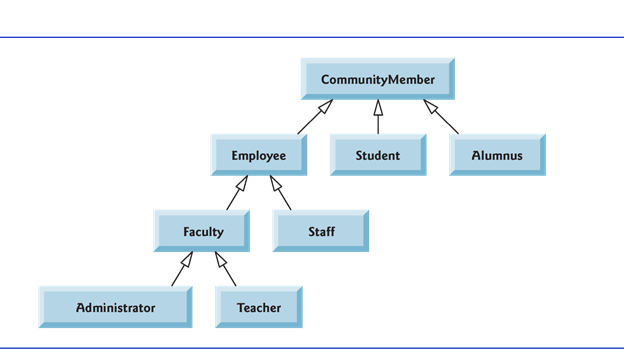


}Objects of all classes that extend a common superclass can be treated as objects of that superclass.

  §Commonality expressed in the members of the superclass. 

}Inheritance issue

  §A subclass can inherit methods that it does not need or should not have. 

  §Even when a superclass method is appropriate for a subclass, that subclass often needs a customized version ofthe method. 

  §The subclass can override(redefine) the superclass method with an appropriate implementation.