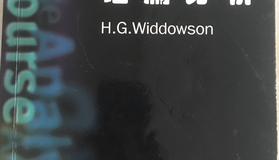
英语语篇分析

英语系 庞中兰

目录

  • 1 Introduction to Discourse Analysis
    • 1.1 Introduction of English Discourse Analysis
    • 1.2 Introduction of H.G. Widdowson'sTextbook
    • 1.3 Language in Use
      • 1.3.1 A Text
      • 1.3.2 Spoken and Written text
      • 1.3.3 Multimodal Discourse Analysis
      • 1.3.4 Analysis of Five Models
      • 1.3.5 MDA in Visual Grammatical Perspective
      • 1.3.6 Videos of Teacher's and Students'Presentation of Class One-Six
      • 1.3.7 Videos of Teacher’s and Students‘ Presentations of Class Five &Six
      • 1.3.8 Videos of Teacher’s and Students‘ Presentations of Class Three &Four
      • 1.3.9 Videos of Teacher’s and Students‘ Presentations of Class One &Two
      • 1.3.10 Videos about Conferring The Awards
      • 1.3.11 Semantic Features
      • 1.3.12 Conclusion
    • 1.4 A Test 1 for Overview of the Course
    • 1.5 A Test 2 for Langauge in Use
    • 1.6 A Test 3 for Multimodal Discourse Analysis
    • 1.7 A Test 4 for Analysis of Five Models
    • 1.8 A Test 5 for Semantic Features
    • 1.9 A Test 6 for Unit 1
    • 1.10 Unit 1 Teaching Plan
  • 2 Communication
    • 2.1 Grammar and Communication
      • 2.1.1 A Test for 2.1
    • 2.2 Grammar
      • 2.2.1 Traditional Grammar
      • 2.2.2 Universal Grammar
      • 2.2.3 SF Grammar
      • 2.2.4 M.A.K. Halliday
      • 2.2.5 A Test for SF Grammar and M.A.K.Halliday
      • 2.2.6 Structural Grammar
      • 2.2.7 Transformational-Generative Grammar
      • 2.2.8 Noam Chomsky
      • 2.2.9 A Test for Noam Chomsky
      • 2.2.10 Case Grammar
      • 2.2.11 Cognitive Grammar
      • 2.2.12 Langacker's Cognitive Grammar
      • 2.2.13 Cognitive Linguistics
      • 2.2.14 A Test for Cognitive Grammar
      • 2.2.15 Development and Schools of Linguistics
      • 2.2.16 A Test 1 for 2.2
    • 2.3 Three Kinds of Pragmatic Meaning
    • 2.4 Analysis of Examples Based on Speech Act Theory
    • 2.5 Pragmatics
    • 2.6 John Austin
    • 2.7 Communicative Competence
    • 2.8 Communicative Competence and Language Teaching
    • 2.9 A Test for Pragmatic Meaning
    • 2.10 A Test for Pragmatics and John Austin
    • 2.11 A Test for 2.6 and 2.7
    • 2.12 Unit 2 Teaching Plan
  • 3 Context
    • 3.1 Context
    • 3.2 Context and Shared Knowledge
      • 3.2.1 A Test for Context
    • 3.3 Text-activated Context
    • 3.4 Unshared Contexts
    • 3.5 Context and Shared Values
    • 3.6 A Test for 3.3, 3.4 and 3.5
    • 3.7 The Prague School
    • 3.8 A Test for The Prague School
    • 3.9 Roman Jakobson
    • 3.10 The London School
    • 3.11 A Test for The London School
    • 3.12 Unit 3 Teaching Plan
  • 4 Schematic Conventions
    • 4.1 Context And Situation
    • 4.2 Schema
      • 4.2.1 A Test for Schema
    • 4.3 Frames of Reference
    • 4.4 Frames and Cultural Assumptions
    • 4.5 Interpersonal Routines
      • 4.5.1 George Bernard Shaw
      • 4.5.2 A Test for 4.5
    • 4.6 Adjacency Pairs
    • 4.7 Genres and Conclusion
      • 4.7.1 A Bird Came Down the Walk
      • 4.7.2 An Ecological Analysis of A Bird
      • 4.7.3 A Test for 4.7
    • 4.8 A Test for Unit 4
    • 4.9 Unit 4 Teaching Plan
  • 5 Cotextual Relations
    • 5.1 Information Structure
      • 5.1.1 A Test for Information Structure
      • 5.1.2 Application of Patterns of Thematic Progression
      • 5.1.3 Meanings of "Meaning"
    • 5.2 Text Linkage; Anaphora and Pro-forms
    • 5.3 Sense Relations
    • 5.4 Cohesion
    • 5.5 Cohesion and  the least effort principle
    • 5.6 Coherence & Cohesion
    • 5.7 A Test for 5.2
    • 5.8 A Test for 5.4, 5.5 and 5.6
    • 5.9 A Test for Unit 5
    • 5.10 Unit 5 Teaching Plan
  • 6 The Negotiation of Meaning
    • 6.1 Systemic and Schematic Knowledge
    • 6.2 Communicative Convergence; Negotiating Convergence
    • 6.3 The Co-operative Principle
      • 6.3.1 A Test for CP
      • 6.3.2 Analysis of Examples Based on CP
    • 6.4 Conversational Implicature
      • 6.4.1 Characteristics of Implicature-1 and 2
      • 6.4.2 Characteristics of Implicature-3 and 4
      • 6.4.3 Language and Cognition
      • 6.4.4 Post-Gricean Developments
    • 6.5 The Maxims of Quality, Relation, and Manner
    • 6.6 The Interpersonal Grammatical Metaphor in Literary Works
    • 6.7 A Test for 6.6
    • 6.8 The Analysis of Auto Slogans
    • 6.9 A Test for 6.8
    • 6.10 Analysis of Cooperative principle in Internet Buzzwords
    • 6.11 Co-operative and Territorial Imperatives
    • 6.12 The Third Functional Linguistics Fusion, Creativity and Development Forum
    • 6.13 A Test for Unit 6
    • 6.14 Teaching Plan
  • 7 Critical Analysis
    • 7.1 Positioning; Terms of Reference
    • 7.2 Alternative Wordings and Persuasive Purpose;Critical Discourse Analysis
    • 7.3 Theories & Methods of CDA
    • 7.4 A Test for 7.2 and 7.3
    • 7.5 The Implicatures of Textual Choice, Lexical Choice
    • 7.6 Implicatures and Grammatical Choice
    • 7.7 A Test for 7.5 and 7.6
    • 7.8 A Test for Unit 7
    • 7.9 Unit 7 Teaching Plan
  • 8 Text Analysis
    • 8.1 Actually Attested Language; Norms of Usage
    • 8.2 Patterns of Collocation
    • 8.3 Semantic Prosodies
    • 8.4 The Theory and Methods of Semantic Prosody
    • 8.5 A Test for 8.3 and 8.4
    • 8.6 Conclusion
    • 8.7 A Test for Unit 8
    • 8.8 Unit 8 Teacing Plan
A Test for Unit 4

3