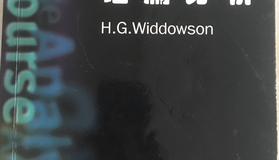
英语语篇分析

英语系 庞中兰

目录

  • 1 Introduction to Discourse Analysis
    • 1.1 Introduction of English Discourse Analysis
    • 1.2 Introduction of H.G. Widdowson'sTextbook
    • 1.3 Language in Use
      • 1.3.1 A Text
      • 1.3.2 Spoken and Written text
      • 1.3.3 Multimodal Discourse Analysis
      • 1.3.4 Analysis of Five Models
      • 1.3.5 MDA in Visual Grammatical Perspective
      • 1.3.6 Videos of Teacher's and Students'Presentation of Class One-Six
      • 1.3.7 Videos of Teacher’s and Students‘ Presentations of Class Five &Six
      • 1.3.8 Videos of Teacher’s and Students‘ Presentations of Class Three &Four
      • 1.3.9 Videos of Teacher’s and Students‘ Presentations of Class One &Two
      • 1.3.10 Videos about Conferring The Awards
      • 1.3.11 Semantic Features
      • 1.3.12 Conclusion
    • 1.4 A Test 1 for Overview of the Course
    • 1.5 A Test 2 for Langauge in Use
    • 1.6 A Test 3 for Multimodal Discourse Analysis
    • 1.7 A Test 4 for Analysis of Five Models
    • 1.8 A Test 5 for Semantic Features
    • 1.9 A Test 6 for Unit 1
    • 1.10 Unit 1 Teaching Plan
  • 2 Communication
    • 2.1 Grammar and Communication
      • 2.1.1 A Test for 2.1
    • 2.2 Grammar
      • 2.2.1 Traditional Grammar
      • 2.2.2 Universal Grammar
      • 2.2.3 SF Grammar
      • 2.2.4 M.A.K. Halliday
      • 2.2.5 A Test for SF Grammar and M.A.K.Halliday
      • 2.2.6 Structural Grammar
      • 2.2.7 Transformational-Generative Grammar
      • 2.2.8 Noam Chomsky
      • 2.2.9 A Test for Noam Chomsky
      • 2.2.10 Case Grammar
      • 2.2.11 Cognitive Grammar
      • 2.2.12 Langacker's Cognitive Grammar
      • 2.2.13 Cognitive Linguistics
      • 2.2.14 A Test for Cognitive Grammar
      • 2.2.15 Development and Schools of Linguistics
      • 2.2.16 A Test 1 for 2.2
    • 2.3 Three Kinds of Pragmatic Meaning
    • 2.4 Analysis of Examples Based on Speech Act Theory
    • 2.5 Pragmatics
    • 2.6 John Austin
    • 2.7 Communicative Competence
    • 2.8 Communicative Competence and Language Teaching
    • 2.9 A Test for Pragmatic Meaning
    • 2.10 A Test for Pragmatics and John Austin
    • 2.11 A Test for 2.6 and 2.7
    • 2.12 Unit 2 Teaching Plan
  • 3 Context
    • 3.1 Context
    • 3.2 Context and Shared Knowledge
      • 3.2.1 A Test for Context
    • 3.3 Text-activated Context
    • 3.4 Unshared Contexts
    • 3.5 Context and Shared Values
    • 3.6 A Test for 3.3, 3.4 and 3.5
    • 3.7 The Prague School
    • 3.8 A Test for The Prague School
    • 3.9 Roman Jakobson
    • 3.10 The London School
    • 3.11 A Test for The London School
    • 3.12 Unit 3 Teaching Plan
  • 4 Schematic Conventions
    • 4.1 Context And Situation
    • 4.2 Schema
      • 4.2.1 A Test for Schema
    • 4.3 Frames of Reference
    • 4.4 Frames and Cultural Assumptions
    • 4.5 Interpersonal Routines
      • 4.5.1 George Bernard Shaw
      • 4.5.2 A Test for 4.5
    • 4.6 Adjacency Pairs
    • 4.7 Genres and Conclusion
      • 4.7.1 A Bird Came Down the Walk
      • 4.7.2 An Ecological Analysis of A Bird
      • 4.7.3 A Test for 4.7
    • 4.8 A Test for Unit 4
    • 4.9 Unit 4 Teaching Plan
  • 5 Cotextual Relations
    • 5.1 Information Structure
      • 5.1.1 A Test for Information Structure
      • 5.1.2 Application of Patterns of Thematic Progression
      • 5.1.3 Meanings of "Meaning"
    • 5.2 Text Linkage; Anaphora and Pro-forms
    • 5.3 Sense Relations
    • 5.4 Cohesion
    • 5.5 Cohesion and  the least effort principle
    • 5.6 Coherence & Cohesion
    • 5.7 A Test for 5.2
    • 5.8 A Test for 5.4, 5.5 and 5.6
    • 5.9 A Test for Unit 5
    • 5.10 Unit 5 Teaching Plan
  • 6 The Negotiation of Meaning
    • 6.1 Systemic and Schematic Knowledge
    • 6.2 Communicative Convergence; Negotiating Convergence
    • 6.3 The Co-operative Principle
      • 6.3.1 A Test for CP
      • 6.3.2 Analysis of Examples Based on CP
    • 6.4 Conversational Implicature
      • 6.4.1 Characteristics of Implicature-1 and 2
      • 6.4.2 Characteristics of Implicature-3 and 4
      • 6.4.3 Language and Cognition
      • 6.4.4 Post-Gricean Developments
    • 6.5 The Maxims of Quality, Relation, and Manner
    • 6.6 The Interpersonal Grammatical Metaphor in Literary Works
    • 6.7 A Test for 6.6
    • 6.8 The Analysis of Auto Slogans
    • 6.9 A Test for 6.8
    • 6.10 Analysis of Cooperative principle in Internet Buzzwords
    • 6.11 Co-operative and Territorial Imperatives
    • 6.12 The Third Functional Linguistics Fusion, Creativity and Development Forum
    • 6.13 A Test for Unit 6
    • 6.14 Teaching Plan
  • 7 Critical Analysis
    • 7.1 Positioning; Terms of Reference
    • 7.2 Alternative Wordings and Persuasive Purpose;Critical Discourse Analysis
    • 7.3 Theories & Methods of CDA
    • 7.4 A Test for 7.2 and 7.3
    • 7.5 The Implicatures of Textual Choice, Lexical Choice
    • 7.6 Implicatures and Grammatical Choice
    • 7.7 A Test for 7.5 and 7.6
    • 7.8 A Test for Unit 7
    • 7.9 Unit 7 Teaching Plan
  • 8 Text Analysis
    • 8.1 Actually Attested Language; Norms of Usage
    • 8.2 Patterns of Collocation
    • 8.3 Semantic Prosodies
    • 8.4 The Theory and Methods of Semantic Prosody
    • 8.5 A Test for 8.3 and 8.4
    • 8.6 Conclusion
    • 8.7 A Test for Unit 8
    • 8.8 Unit 8 Teacing Plan
Patterns of Collocation


Patterns of collocation

It is not, however, only the simple frequency and range of single items that is revealed in the corpus analysis of text but also, more interestingly and significantly, the frequency and range of their patterns of co-occurrence with other items. 

there are also other connections across linguistic items, certain patterns of co-occurrence, which recur quite regularly as a property of texts in general. Thus certain items tend to keep company, or collocate, with others: there is, as it were, a kind of mutual attraction that draws them together.

formulate phrase---  A frequently recurring collocation of relatively fixed sequence and form. Some such phrases are completely fixed, e.g. by fair means or foul, Be that as it may, while others allow for varying degree of flexibility.

concordance (词汇索引)---the display of the different co-texts of occurrence of particular words, typically the result of the computer analysis of a corpus.

Corpus---A collection, often on a very large scale, of actually occurring textual data, electronically stored and analysable by computer program.

Concordance for words which are semantically related can be compared and their collocational differences identified.

So, in reference to Hymes, what is actually performed relates to what is feasible. The use of recurring patterns of language, stored ready for use in the mind, is in this case motivated by the co-operative principle. 

To deliberately disregard them would be to violate the manner maxim.