
1. Learning
Read to the structure of a comparison / contrast essay.
You already learned how to write a comparison / contrast essay in Unit 3. This unit will elaborate more on this useful writing mode. To start with, if you have two items to compare or contrast, the first step is to figure out how they are similar and how they are different. Let's go further. If you want to write about two restaurants, you first need to list the points of comparison and contrast. They might be location, price, service, menu variety, and quality of food. Likewise, if you are comparing or contrasting two professors, you might do so on these points: homework assignment, type of exam, class organization, grading system, and style of teaching. The chart below illustrates how you can list your points:
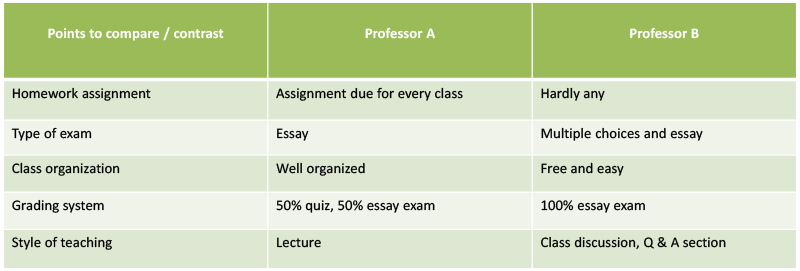
Once you have completed your list of points, the next step is to study your list and decide whether to write about similarities or differences, or both. It is usually best to concentrate on one or the other. If you see that there are more similarities on the list, you might need to omit differences, or vice versa. The way to organize your points in your essay is either point-by-point or subject-by-subject. Since in Unit 3 you already practiced the point-by-point pattern, this time you will learn how to organize your points using the subject-by-subject pattern. Please take a look at the chart below to see how you can organize the details with this pattern.
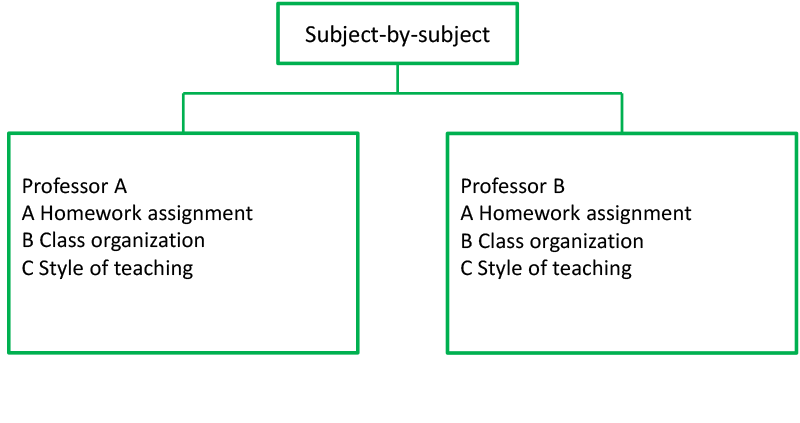
You can easily see that, unlike the point-by-point pattern, the subject-by-subject pattern needs to talk about all the points at one time regarding Professor A, and then using the same sequence of order to compare or contrast all the points about Professor B. In this way, you show your reader the similarities or differences between these two professors. There are usually two body paragraphs when using this pattern because each subject forms one body paragraph.
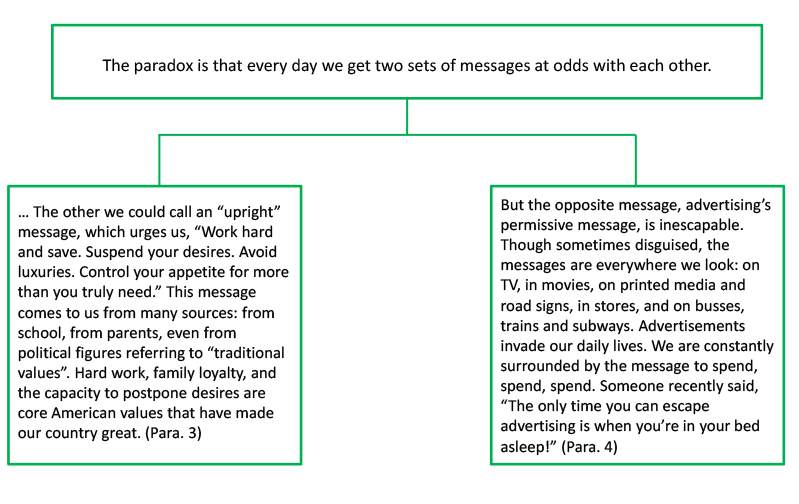
Now, let's look at Paragraphs 3 & 4 of Text A to see how comparison and contrast method is used to develop ideas:
2. Sample
Read the sample comparison / contrast essay and see how it develops with the subject-by-subject pattern.
Topic: Thrifty people vs. non-thrifty people |
Introduction: Thesis statement: It's always interesting to compare two groups of people who live in entirely different lifestyles. |
Body: Subject A: People who live thriftily • Go shopping when things are on sale • Try every means to conserve electricity • Seldom eat at restaurants Subject B: People who live lavishly • Go shopping any time they want • Never conserve electricity • Often eat at fancy restaurants |
Conclusion: People always have their own lifestyles; some are thriftier than others. |
Sample essay
While it is good to enjoy spending money, some people may prefer saving money for the future. They are grouped as thrifty people, whereas people who don't care about saving money can be called non-thrifty people. It's always interesting to compare these two groups of people who live in entirely different lifestyles.
Thrifty people tend to use their money very carefully. They often say, "A penny saved is a penny earned." So, they don't go shopping unless there is a large sale on the things they need. By doing this, they can usually save about 30 percent of money they otherwise have to spend. Similarly, they often conserve electricity. For example, they don't often use air conditioning in summer; instead, they use electric fans. Finally, they don't often eat out at restaurants. They calculate that by cooking at home they can probably save a large sum of money each month.
In contrast, non-thrifty people often spend money carelessly and lavishly. They never wait for a sale if they want to shop. They go shopping anywhere and anytime they want. Also, they never think about saving electricity to reduce their bill. They like to have their air conditioning on 24 hours a day in summer. Moreover, they often eat out and prefer going to fancy restaurants. They never care whether they can save money by eating at home or only by ordering specials offered at restaurants.
In conclusion, people always have their own lifestyles, and some are thriftier than others. The most important thing is that people should choose a lifestyle that is meaningful to them and can make them feel happy.
3. Practice
Write an essay of no less than 150 words on the topic "Bryan and Peter". You can follow the outline given below.
Topic: Bryan and Peter |
Introduction: Thesis statement: Even though Bryan and Peter are close friends, their spending habit is very different. |
Body: Subject A: Bryan • Only spends money when it's necessary • Saves money whenever he can |
Subject B: Peter • Often spends money on expensive items • Never saves any money for the future |
Conclusion: Bryan and Peter are very different in the way they spend money. |

