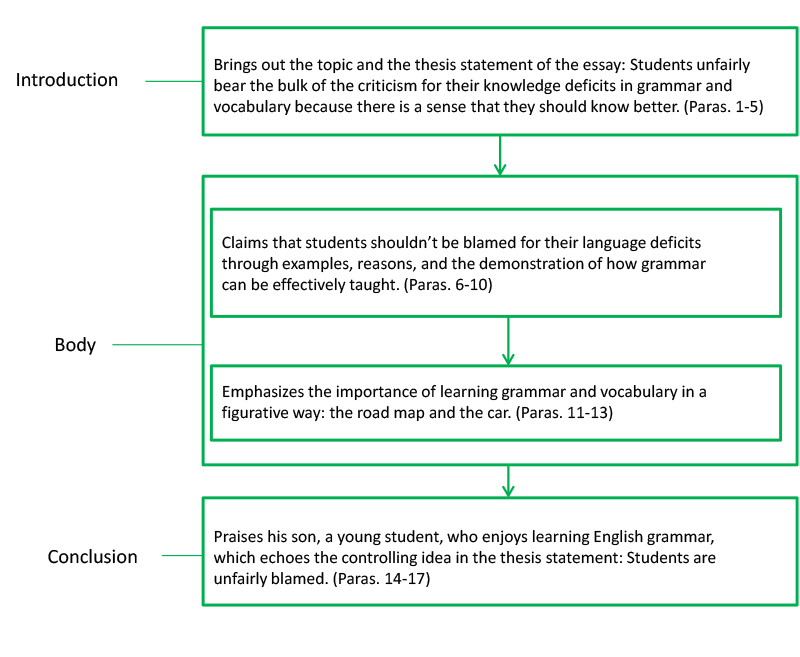
Read to learn the structure of moving from paragraph to essay.
Starting from this book, you are moving from paragraph writing to short essay writing. Precisely, students at this level will learn how to write a short essay composed of 3-5 paragraphs, with no less than 150 words. An essay has three main parts: introduction, body, and conclusion.
Introduction: The introduction part introduces the topic of an essay and usually contains a thesis statement. A thesis statement is a complete sentence that presents your opinion, attitude or position about the essay topic. The way to introduce the topic should be as interesting as possible. You can start the introduction with a dramatic incident, a famous quote, a thought-provoking question, or a general statement to interest or attract your reader.
Body: The body is the main part of an essay. It may consist of several paragraphs. Each body paragraph should address a specific point related to the thesis statement. You can develop ideas by way of examples, cause and effect, comparison and contrast, classification, narration or description, and argumentation. (Many writing methods for the paragraph writing are introduced in Book 1.)
Conclusion: To write an effective conclusion, you can either restate the thesis statement using a different structure and vocabulary or briefly summarize the main ideas, added with your final thoughts and opinions such as a suggestion, a prediction, and a warning. Use transitional words at the beginning of the conclusion to signal that you're wrapping up the essay. The common ones are in conclusion, in summary, in short, or to summarize.
Now, let's start with a brief structure analysis of the text "An impressive English lesson".