
Background Information


1. Realism in general
Realism came as a reaction against “the lie” of romanticism and sentimentalism. Literature began to pay less attention to general ideas and more to the immediate facts of life. In the broadest sense, realist literature is simply fidelity to actuality in its representation on literature”. It is based on the accurate, unromanticized observation of human experiences. It insists on precise description, authentic action and dialogue, moral honesty, and a democratic openness in subject matter and style. As a way of writing, realism has been applied in almost every literature throughout history. But as a literary movement, realism is a period concept. It refers to the approach of realist fiction occurred at the latter part of the 19th century. In part, the rise pf realism came as a protest against the falseness and sentimentality(多愁善感, 过分的情感) which the realists thought they saw in romantic literature. They were determined to create a new kind of literature that was completely and totally realistic. It expressed the concern for the world of experience, of the commonplace, and for the familiar and the low.
2. Background: From Romanticism to Realism
1. the three conflicts that reached breaking point in this period
(1) industrialism vs. agrarian
(2) culturely-measured east vs. newly-developed west
(3) plantation gentility vs. commercial gentility
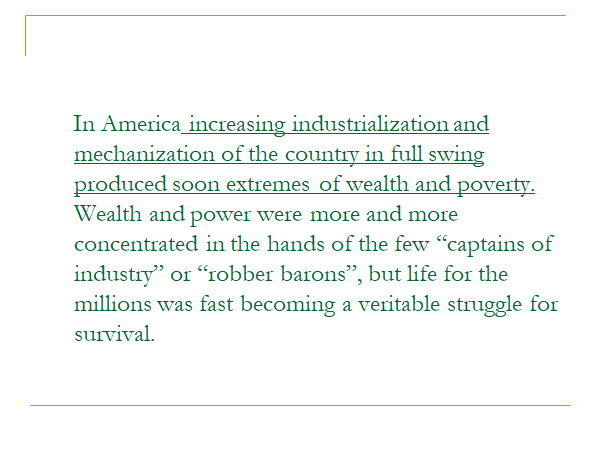
2. 1880’s urbanization: from free competition to monopoly capitalism
3. the closing of American frontier
3. Major Features:
1) Familiar aspects of contemporary life and everyday scenes are represented in a straightforward or matter-of-fact(讲究实际的, 实事求是的) manner. It stresses truthful treatment of material, without abstract interest in nature, death, etc.
2) Characters from all social levels are examined in depth. Before this time characters served some sort of allegorical (比喻的, 寓言的)or symbolic purpose. They value the individual very highly, stress the function of environment in shaping character, and take characterization as the center of the story. They have great concern for the effect of action on characters, and a tendency to explore the psychology of people in the story.
3) Open ending is also a good example of the truthful treatment of material. It may be puzzling, it tells the reader that life is complex and cannot be fully understood. Open ending leaves much room for the reader to think over the possible conclusion of the story.
4) Realism focuses on commonness of the lives of the common people who are customarily ignored by the arts. Realists are interested in the commonplace, the everyday, the average, the trivial, and the representative. These authors are not interested in characters as symbols. They were not stories about kings and queens, princes and princesses, or knights in shining armor. They were about average folks.
5) Realism emphasizes objectivity and offers an objective rather than an idealistic view of human nature and human experience. The realistic writers are detached observers of life. The author just tells the reader what the characters do. It is up to the reader to decide what it means.
6) Realism presents moral visions. Realists are ethical (伦理的,道德的)writers, interested in the problems of the individual conscience in conflict with social institutions. These writers are interested in focusing on the dilemma(困境, 进退两难).
Realists are aware of accepted social standards. They have a strong ethical sense that there are right ways to do things and wrong ways to do things. In their works they re-create real life and show the dilemmas that the people are having as they try to understand what life means in an ethical way.
1865年至1918年间的美国文学在美国文学史上称为现实主义时期。这一时期的美国文学是美国精神的表现,尤其是美国小说。现实主义是对浪漫主义的一种反动。正视现实,不尚空想。现实主义文学又为现代主义文学铺平了道路。
经过内战以后的美国社会为现实主义的兴起和发展提供了肥沃的土壤。自内战到第一次世界大战的50年,美国历史上经历了巨大变化,无论是政治、经济、文化、还是宗教。这一巨变彻底改造了美国社会的性质和观念。首先,内战给该国的社会价值观带来了很大影响。美国已从杰菲逊时期的农业国向工业化和商业化社会转变。蛮荒之地得到了文明的开发。这场战争还给美国经济带来了明显的变化。新的组织和管理方法大规模运用,促进了工业的现代化。1869年第一条洲际铁路建成。电力大量使用,电话等新的通讯给日常生活的诸多方面带来了革命。各种矿藏的开采有助于国民经济的发展。在工业生产上的投资得到了四倍以上的回报。工厂的就业率成倍增长。工业产值呈几何级数上升,农业生产也迅速上涨。迅速增长的经济和工业加速了城市化的发展。美国城市发展如雨后春笋。到第一次世界大战结束,美国有一半人口都是集中在十几座城市里。
然而,这些变化也有不利的方面。工业化和城市化带来了劳动人民的无数痛苦。在农村,越来越多的农民被挤出土地,到城里去谋生,造成劳动力过剩,工资低。资本家对男女老幼的工人的劳动条件不去改善,致使贫富两极分化。权利和财富的集中产生了冒险家、巨头。而另一头则是贫民窟。就思想意识而言,人们处于动摇的状态。他们怀疑人性和上帝的善。西部开拓的精神已经一去不回了。美国之梦已不复存在,代之而来的就是马克·吐温所称之为的"镀金时代"。
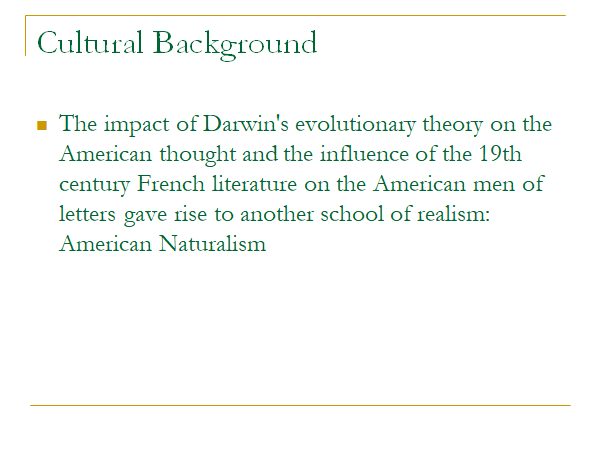
内战以后的文学界也与前大不相同。人们对内战的痛苦记忆,对英雄形象的幻灭和实际生活的无情现实使浪漫主义无立足之地。美国人对浪漫主义思想已感厌倦。新一代作家不满意于老一代的浪漫主义思想,生发了新的创作灵感。他们对现实生活产生了浓厚的兴趣,企图对生活的各个方面作出他们的解释,主张客观现实,摒弃主观偏颇、唯心主义和浪漫主义的色彩。人们的兴趣现在已转到了日常生活的方方面面,注意到现实的野蛮、肮脏,直接公开描写阶级斗争,这时的作家已能描写人物在各种条件或环境下的反映,描述远西(Far West)、新移民和劳动阶级的斗争,这些作家受到广大读者的欢迎。这一注意现实生活的创作倾向形成了美国现实主义时期的文学。
这种反映人类现实的主张在豪威尔斯(William Dean Howells)的《批评与小说》(Criticism and Fiction)一书中讲得最清楚。他说:"我承认首先关注运用反映人类现实的标准来判断一部有创造性的作品。在任何其他标准之前我们要问作品是真实的吗?"是真实地反映男女实际生活;反映他们生活的主旨、他们生活的脉搏和他们生活的原则了吗?"现实主义作家就是以这种忠实反映现实的原则来处理当时社会问题和政治问题的。他们的作品写的不是彬彬有礼、衣冠楚楚、说话斯文的中产阶级的青年,而是工人、农民、雄心勃勃的商人、流浪汉、妓女和普通士兵。他们的作品反映了内战以后的各种职业、各个阶层的社会生活现实图景,反映了人们的内心感受。
这一时期的三个代表作家是豪威尔斯(William Dean Howells),亨利·詹姆斯(Henry James)和马克·吐温。他们真实地描写了美国本地风土人情,带有浓厚乡土气息,挖掘了人们的内心生活。他们忠实地记录了美国东部地区十九世纪后半叶的生活,有行将消失的边疆地区、有农村、有小镇、还有噪动的都市。有本土的主人公、有"美国式的姑娘"、有为生活所迫的中产阶级家庭、有商人、有心理复杂的市民。总之,他们为后来的现实文学在题材、技巧和风格上都树立了典范。
虽然这三位杰出的作家基本上是同一时期写作的,但他们对"真实"的理解不尽相同。马克·吐温和豪威尔斯似乎注重生活描写,而亨利·詹姆斯则明显强调人类的"内心世界"。他认为文学家不应只停留在反映社会生活的表面上,而应运用语言深入到人类的心理和道德本质里。他就是反映人类内心生活的现实主义作家。虽然马克·吐温和豪威斯都是很注重表现美国社会的真实,但他们的强调点也有所不同。豪威尔斯讨论上升的中产阶级及其生活方式;而马克·吐温则喜欢把他自己家乡和家乡的人放在故事的最前沿。这种注重本土的描写形式形成了美国现实主义文学的一大特色。
除了马克·吐温这样的乡土作家以外,还有沙拉·奥恩·朱威特(Sarah Orne Jewett)、约瑟夫·克科兰德(Joseph Kirkland)和汉姆林·加兰德(Hamlin Garland)。这些乡土作家有意识地反映对正在消失的生活方式的怀旧情绪。虽然他们多愁善感,但他们描写乡土生活都十分细致。他们写的多是个人经历,记录的是独特环境的现实,表明一时一地的具体环境构成了乡土生活。他们写作的材料有所局限,话题也完全不同,但他们的艺术追求是共同的。

