
George Bernard Shaw(1856-1950)
Irish playwright George Bernard Shaw wrote more than 60 plays during his lifetime and was awarded the Nobel Prize in Literature in 1925.
George Bernard Shaw was born July 26, 1856, in Dublin, Ireland. In 1876 he moved to London, where he wrote regularly but struggled financially. In 1895, he became a theater critic for the Saturday Review and began writing plays of his own. His play Pygmalion /ˌpɪgˈmeɪljən/ was later made into a film twice, and the screenplay he wrote for the first version of it won an Oscar. During his lifetime, he wrote more than 60 plays and won many other awards, among them the Nobel Prize.
Early Years
Playwright George Bernard Shaw was born in Dublin, Ireland, on July 26, 1856. The third child, Shaw's early education took the form of tutoring sessions provided by his clerical uncle.
Early on, Shaw explored the worlds of the arts (music, art, literature) under his mother's guidance and through regular visits to the National Gallery of Ireland. In 1872, Shaw's mother left her husband and took Shaw's two sisters to London, and four years later Shaw followed (his younger sister had died in the meantime), deciding to become a writer. Shaw struggled financially, and his mother essentially supported him while he spent time in the British Museum reading room, working on his first novels.
The Writing Life Begins
Unfortunately, despite the time he spent writing them, his novels were dismal failures, widely rejected by publishers. Shaw soon turned his attention to politics and the activities of the British intelligentsia, joining the Fabian Society in 1884. The Fabian Society was a socialist group whose goal was nothing short of the transformation of England through a more vibrant political and intellectual base, and Shaw became heavily involved, even editing a famous tract the group published (Fabian Essays in Socialism, 1889).
The year after he joined the Fabian Society, Shaw landed some writing work in the form of book reviews and art, music and theater criticism, and in 1895 he was brought aboard the Saturday Review as its theater critic. It was at this point that Shaw began writing plays of his own.
The Dramatist
Shaw's first plays were published in volumes titled "Plays Unpleasant" (containing Widowers' Houses, The Philanderer and Mrs. Warren's Profession) and "Plays Pleasant" (which had Arms and the Man, Candida, The Man of Destiny and You Never Can Tell). The plays were filled with what would become Shaw's signature wit, accompanied by healthy doses of social criticism, which stemmed from his Fabian Society leanings. These plays would not go on to be his best remembered, or those for which he had high regard, but they laid the groundwork for the oversized career to come.
The Literary Giant
Toward the end of the 19th century, beginning with Caesar and Cleopatra (written in 1898), Shaw's writing came into its own, the product of a mature writer hitting on all cylinders. In 1903, Shaw wrote Man and Superman, whose third act, "Don Juan in Hell," achieved a status larger than the play itself and is often staged as a separate play entirely. While Shaw would write plays for the next 50 years, the plays written in the 20 years after Man and Superman would become foundational plays in his oeuvre. Works such as Major Barbara (1905), The Doctor's Dilemma (1906), Pygmalion (1912), Androcles and the Lion (1912) and Saint Joan (1923) all firmly established Shaw as a leading dramatist of his time. In 1925, Shaw was awarded the Nobel Prize in Literature.
Pygmalion, one of Shaw's most famous plays, was adapted to the big screen in 1938, earning Shaw an Academy Award for writing the screenplay. Pygmalion went on to further fame when it was adapted into a musical and became a hit, first on the Broadway stage (1956) with Rex Harrison and Julie Andrews, and later on the screen (1964) with Harrison and Audrey Hepburn.
Shaw died in 1950 at age 94 while working on yet another play.
萧伯纳,全名乔治·伯纳德·萧(George Bernard Shaw,1856年7月26日—1950年11月2日),爱尔兰剧作家。1925年因作品具有理想主义和人道主义而获诺贝尔文学奖,他是英国现代杰出的现实主义戏剧作家,是世界著名的擅长幽默与讽刺的语言大师,同时他还是积极的社会活动家和费边社会主义的宣传者。他支持妇女的权利,呼吁选举制度的根本变革,倡导收入平等,主张废除私有财产。
萧伯纳的一生,是和社会主义运动发生密切关系的一生。他认真研读过《资本论》,公开声言他“是一个普通的无产者”,“一个社会主义者”。他主张艺术应当反映迫切的社会问题,反对“为艺术而艺术”。其思想深受德国哲学家叔本华及尼采的影响,而他又读过马克思的著作,不过他却主张用渐进的方法改变资本主义制度,反对暴力革命。
萧伯纳的戏剧最突出的思想特点是,紧密结合现实政治斗争,敢于触及资本主义社会最本质的问题,把剥削阶级的丑恶嘴脸暴露在公众面前。在艺术手法上,他善于通过人物对话和思想感情交锋来表现性格冲突和主思想。萧伯纳的戏剧性语言尖锐泼辣,充满机智,妙语警名脱口而出。
萧伯纳出身于小职员家庭,并不优渥的生活境遇促使其早年奔波求职、谋求生计,这也使得其更为真实全面地接触了社会阶层的各个群体,并为其嗣后的现实主义文学创作提供了丰富多样的人物素材。在萧伯纳的大量戏剧之中,对于人物群像的展示批判显得鲜明坚决,其热情洋溢地讴歌赞美质朴善良的高尚人性,对于丑恶虚假的低劣人性则进行强烈直白地揭露讽刺,其广泛展示了工业文明高速发展期的资本主义垄断时代的工人、市民、商人、无业者等等拥有迥异不同的阶层身份的社会个体在生活之中的喜怒哀愁、悲欢别离、内心呼声、情感寄托。在肯定弱势群体善良勤劳、温和淳朴等的可贵品格的同时,也对拥有社会主导权的资产阶级贪婪自利、野蛮狡黯的群体本性进行了强烈嘲讽。
萧伯纳的戏剧语言极为精粹,往往蕴含着生活真谛。如《伤心之家》中,萧特非船长似乎又老又疯,但他的话却耐人寻味:“我们家里的人在我们跟前的时候,我们老得琢磨他们的好处,否则我们就没法跟他们在一块呆下去了。可是他们不在我们跟前的时候,我们就得净琢磨他们的坏处,因为这样一来,我们就能得到安慰,不再去想念他们了。”赫什白太太评价她丈夫时说:“一个人的好坏,总是混杂一起,不成套数的。”字里行间显示出萧伯纳对社会、人生的深刻观察。萧还常常旁征博引,化用经典。
萧伯纳的音乐批评,从简短的话语到完美杂文,颂扬了德国作曲家理查德·瓦格纳的工作。瓦格纳工作25年写成明镜环德尼伯龙根,一个巨大的由四部分组成的音乐戏剧,题材来自日尔曼神话的神,巨人,矮人和莱茵河的少女。萧伯纳认为这是一个天才的工作,并审查了各个细节。除了音乐,他认为这是一部社会工人带动“无形的饥饿鞭子”,从他们富裕的主人手中追求自由的寓言。
萧伯纳具有深厚的音乐素养。他对巴赫、海顿、莫扎特、贝多芬、瓦格纳等音乐大师的作品烂熟于心。他一度是伦敦最出色的音乐评论家,发表过很多关于音乐批评的论文。他在八十岁时写道:“音乐,一直都是我生命和艺术中不可或缺的部分。”他把音乐才华融入了戏剧创作,使之成为一种令人难忘、富丽而又生机勃勃的完美艺术。除了视觉上的表演,萧非常重视戏剧的听觉效果,赋予作品以听觉上的美感。他曾经鼓励许多年轻演员去理解重音、抑扬及节奏。萧的语言有很强的音乐感,爱拉提琴的科学家爱因斯坦曾经说过,萧的剧本里的一个字像莫扎特音乐里的一个音符。不少评论家认为萧伯纳是用写歌剧的手法去写剧本的,他的剧本中的场面安排很像是一系列的对唱、三重唱、四重唱等等的交替继续。萧伯纳在歌剧式的道白、戏剧性的对话中,通过人物声调的高低起伏、速度的快慢缓急来表达变化的情绪,从而带给人们独特的、优美的听觉感受。
Mrs. Warren’s Profession
In Victorian England, prostitution was considered the most pressing social problem facing society. It was treated as a moral problem caused by sexually deviant women who failed to follow the prohibition on sex out of wedlock. At the same time, sex was largely seen as a legitimate activity only for reproductive purposes—yet most men, including happily married ones, frequented prostitutes. The economic conditions leading women to become sex workers were not usually considered by those who railed against prostitution as a social ill. Instead, poor women were believed to become prostitutes out of laziness or boredom. At the same time, outbreaks of sexually transmitted diseases crippled the armed forces and infected married women whose husbands frequented prostitutes. Starting in 1864, the Contagious Diseases Act allowed the police to force any woman suspected of prostitution to be examined by doctors. If a woman was found to have a sexually transmitted disease, she would be imprisoned until she was cured, or for up to a year.
Shaw saw himself as writing in a tradition of plays about prostitutes. He wanted to counter the clichéd portrayal of prostitutes as immoral women who either repented of their immoral ways and became respectable or sank into poverty and disease, and killed themselves. He considered himself both positively and negatively inspired by the novella Yvette by Guy de Maupassant and the play The Second Ms. Tanqueray by Sir Arthur Wing Pinero. Shaw’s own style is widely seen as combining two very different influences. Shaw was a deep admirer of the Norwegian dramatist Heinrik Ibsen, whose characters were kept from leading fulfilling lives by the rigid dictates of a controlling society, and he wanted very much to follow in Ibsen’s footsteps. At the same time, much of Shaw’s dialogue adopted the light, satirical style of Oscar Wilde’s modern comedies of manners. It was Shaw’s ability to blend moral seriousness and light comedy that cemented his reputation as a brilliant playwright who brought popular attention to important societal issues.
plot Summary
Act I is set in a garden outside of a country cottage, rented by the determined, self-confident, and well-educated recent college graduate Vivie Warren. Vivie is approached by Mr. Praed, an artistically inclined friend of her mother’s. Vivie is a gifted mathematician and tells Praed she plans to live a practical life, going into business with her friend Honoria Fraser and working in law, insurance, and finance. Praed advocates for a life of aesthetic appreciation, but Vivie replies that she has spent time with artistic people at concerts and museums and was bored. She asks Praed if he thinks her mother will approve, explaining that she has always lived away from her mother and knows little about her. Praed refuses to tell Vivie much about her mother. Vivie predicts that her mother may try to control her life, but says that she will use her mother’s secrecy about her own life against her in any argument they have about Vivie’s future.
The loud and gaudily dressed Mrs. Kitty Warren and the rich, middle-aged playboy Sir George Crofts arrive. Vivie goes into the cottage. Praed tells Mrs. Warren that Vivie seems mature and that Mrs. Warren should treat her with respect. Mrs. Warren scoffs that she knows how to treat her own daughter. Mrs. Warren leaves the two men alone, and Crofts asks Praed if he knows who Vivie’s father is. He says he feels attracted to Vivie, but can’t be sure that he isn’t her father. Praed says he knows nothing about that side of Mrs. Warren’s life, but since Crofts is old enough to be Vivie’s father he should treat her in a parental way.
Crofts goes inside and Praed is greeted by an old acquaintance, Frank Gardner. Frank is a handsome, clever man of twenty. He confides to Praed that he is broke and living at home to save money, and that Vivie loves him. Praed invites Frank to tea, but as Frank is entering the cottage his father, the Reverend Samuel Gardner calls to him. Reverend Gardner is a pompous loudmouth who is obsessed with respectability. He demands to know the social station of the people in the house before he will enter their garden. Frank tells him that the cottage is Vivie Warren’s, and that he hopes to marry her. Vivie, he says, has both brains and money, while he has neither. Reverend Gardner says disapprovingly that it’s hard to believe anyone has enough money to support Frank. Frank refers to a story Reverend Gardner told him about his own behavior as a young man: Reverend Gardner offered a lover fifty pounds to buy back his letters to her, so that he could destroy evidence of their affair. Vivie comes outside and is introduced to Frank’s father, and then calls for Mrs. Warren to come outside. Mrs. Warren recognizes Reverend Gardner, who is shocked to see her. She says she still has the letters he wrote her.
Act II takes place inside the cottage that night. Mrs. Warren and Frank are the first to arrive back after a night stroll. Frank flirts with Mrs. Warren, and she kisses him, but then says she meant it in a motherly way. Frank tells her he is courting Vivie. Crofts and Reverend Gardner enter, and Mrs. Warren impatiently asks where Praed is. Frank says he must be enjoying walking alone at night with Vivie. Crofts and Reverend Gardner both object to Frank courting Vivie. Mrs. Warren says she sees no reason why the two young people shouldn’t marry, but when she hears that Frank has no fortune, she says it is out of the question that he marry her daughter. Frank says he will try to win Vivie’s love despite the older generation’s warnings not to. Vivie and Praed arrive and the older people go into the small kitchen to have dinner. Vivie and Frank mock the older generation. Vivie says she hopes never to live a lazy, aimless life like theirs, while Frank says he wants to be idle, but to do it in style. He tries to flirt with Vivie, but she rebuffs him. Vivie and Frank go into the kitchen to eat, and Mrs. Warren and Crofts enter the room. Mrs. Warren says she doesn’t like how Crofts is looking at Vivie. He tells Mrs. Warren that he wants to marry Vivie and suggests that few other men would accept Mrs. Warren as a mother-in-law. Mrs. Warren is disgusted at the idea. Crofts offers to pay her a check on the day of the wedding and then to leave all his money to Vivie when he dies. Mrs. Warren insults him, and he storms out of the house. Soon after, the Gardners leave, taking Praed and Crofts to stay at their home as guests.
Left alone, Mrs. Warren tells Vivie that she thinks Frank is a good-for-nothing and Vivie shouldn’t encourage him to court her. Vivie agrees, adding that Crofts also seems like a good-for-nothing. Mrs. Warren is shocked at Vivie’s self-confidence; she says Vivie will have to see Crofts frequently because he is a friend of hers. Vivie asks whether her mother expects they will be together much going forward, saying she doubts Mrs. Warren will like her way of life. Angry at Vivie’s independent attitude, Mrs. Warren proclaims that she will determine Vivie’s lifestyle. Vivie demands to know her mother’s identity and who her father is, saying she wonders what right her mother has to dictate her life. Mrs. Warren assures her Crofts is not her father, but will not say who is, nor will she say more about herself. Feeling they have reached a dead end, Vivie says they should go to bed. Mrs. Warren accuses Vivie of being heartless and a bad daughter. Vivie says she wants to be treated with respect and will respect her mother’s own choices about her life in return. Mrs. Warren scoffs at the idea that she had any choices and decides to tell Vivie about her life.
Mrs. Warren tells Vivie that she was one of four daughters of an unmarried woman with four daughters who supported herself by taking lovers. Mrs. Warren’s two half-sisters grew up to be respectable women: one died of lead poisoning from work in a factory, while the other married an alcoholic and lived in poverty. Her sister Liz ran away from their school. Years later, when Mrs. Warren was working long hours for low wages in a bar, the two sisters met again. Liz had become a prostitute and urged her sister to do the same. She lent Mrs. Warren money to start work and they eventually set up a chain of brothels across Europe together. Liz now lives the life of a respectable, upper-class woman. Mrs. Warren defends her decision to go into sex work, saying it was the only opportunity a woman like her had to earn a reasonable living. She says that while upper-class women try to marry rich men, lower-class women can only hope to sell their bodies for sex—but marriage and sex work are ultimately very similar. Despite knowing she is supposed to be ashamed of her work, she expresses pride at having kept her self-respect and managed her brothels well. Vivie admires her mother’s grit and truthfulness. Before they say goodnight, Vivie promises to treat her mother lovingly, Mrs. Warren blesses her daughter, and they embrace.
Act III takes place the next morning in the garden outside of the rectory where Reverend Gardner lives and works. Reverend Gardner comes outside and greets his son. He is hung over after staying up late telling scandalous stories with Crofts, and hardly remembers what happened the night before. Frank tells his father that he told Crofts to bring the Warrens over to the rectory, and Reverend Gardner is horrified to hear that people of questionable respectability will be coming to his home. Praed enters and he and Frank watch Crofts, Mrs. Warren, and Vivie approach. Frank is disgusted to see mother and daughter walking arm in arm. When the guests arrive, Frank suggests that his father show them the church. Once he is left alone with Vivie, he asks her why she was embracing her mother. Vivie says she now understands her mother. Frank says that, unlike Vivie, he can see that Mrs. Warren is an immoral person. He flirtatiously tells Vivie that she must not go live with her mother because it will ruin their time together. Vivie briefly falls under his spell.
Crofts approaches and asks to speak to Vivie alone. Frank leaves, but says he will return if Vivie rings a bell in the garden. Crofts makes a very unromantic proposal to Vivie, describing himself as a rich man who knows how to pay for what he wants and will leave her his fortune when he dies. When Vivie refuses him, he says that he was a good friend to her mother by lending her the money to start her business. Vivie is shocked and says she thought that her mother had wrapped up the business. Crofts scoffs at this, saying it would be stupid to wrap up a business that is doing so well. Crofts pretends that the business they are discussing is a chain of bars in Brussels and Ostend, but Vivie reveals that she knows what the business really consists of. Crofts curses Mrs. Warren for telling Vivie, then says that everyone in the upper class profits from exploitative businesses. He points out that Vivie has always lived on money earned in brothels. Vivie is conscience-stricken and tries to leave the garden, but Crofts stops her. She rings the bell, and Frank approaches with a rifle in hand. Out of spite, Crofts tells Vivie and Frank that they are both children of Reverend Gardner. Revolted, Vivie points Frank’s gun at herself, and he drops it. Vivie runs away, telling Frank she is going to her friend Honoria Fraser’s chambers in London.
Act IV takes place in the London office of FRASER AND WARREN, where Vivie is now working. Frank comes to visit Vivie and define their relationship. Vivie says she wouldn’t want to be anything more than a sister to him. Frank believes this means she has found a new boyfriend, which Vivie denies. Praed arrives to bid Vivie goodbye before going to Italy. He says he wishes he could convince her to travel and experience the world’s beauty. At his mention of Brussels, however, Vivie becomes stricken. She reveals her mother’s true profession to Praed and Frank, both of whom are shocked. Vivie goes into the next room to collect herself, and Frank tells Praed that he will no longer try to marry her: he cannot accept money earned from brothels.
Mrs. Warren arrives, looking very nervous. Praed and Frank depart, after Frank leaves a note for Vivie. Vivie has returned her allowance to her mother’s bank and says that she intends to support herself from now on. Mrs. Warren tells Vivie how rich she is and how easily she can buy Vivie a place in fashionable, respectable society. She says she thought that she and Vivie had worked everything out. Vivie asks her mother why she didn’t leave the profession once she had made enough money to live. Mrs. Warren says she needs work to keep busy and explains that since someone will always do what she does, she does no harm to anyone by continuing in her business. Vivie says she cannot respect the way her mother lives. Mrs. Warren curses Vivie, saying she stole her education and now refuses to do her duty as a daughter. She leaves, refusing to shake Vivie’s hand. Vivie sits down at her desk and, with a sigh of relief, becomes engrossed in her work.
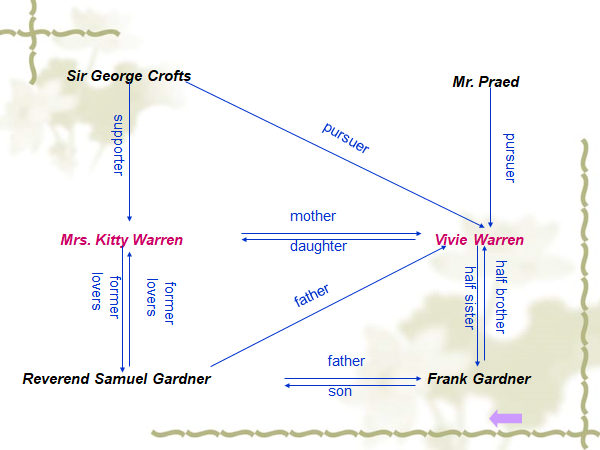
Characterization
Mrs. Kitty Warren: full of endurance and courage, devoted, domineering (专横的;盛气凌人的 ),self-deception, oppressed and oppresser.
Vivie Warren: beautiful, attractive, sensible, hardworking, highly educated, overwhelming self-confident, unconventional, asexual and "permanently unromantic“,New Women.
Sir George Crofts: powerful, “gentlemanly combination of the most brutal(野蛮的) types of city man, sporting man, and man about town” , vicious, hypocritical.
《华伦夫人的职业》是萧伯纳(George Bernard Shaw)的代表剧作。四幕剧,1894年首演。作品揭露了资本主义社会的经济基础,指出统治阶级的财富是建筑在对人民的残酷剥削上,在资产阶级社会没有道德可言。作者将此剧列入“不快意的戏剧”一类,作品批判不讲道德、贪婪、腐朽的资产阶级生活。揭发披华贵外衣者的堕落,但对华伦夫人这类卖淫从业者给予了深切同情,因为逼良为娼是社会的罪恶。1920年此剧在中国上海演出,但由于社会、中国戏剧传统、改编的脚本、演员、看客、本钱家与剧院的性质等方面原因,首次开演票房支出昏暗,尔后的三次试演也不尽善尽美,但影响对后来中国戏剧产生了一定影响。
华伦夫人有个22岁的女儿薇薇,曾经是剑桥大学女子学院的高材生,是当时妇女界屈指可数的受过高等教育的人物之一。她为人正直,富有自立的思想,毕业后在伦敦一家法律事务所工作,在度假时与富兰克交了朋友.突然,她的母亲华伦夫人带着她的两个朋友,普瑞德先生和克罗夫男爵来到这里,使薇薇感到自己像是受到了某种力量的愚弄。华伦夫人很有钱,但女儿薇薇却不知道她的身世。后来薇薇发觉母亲是靠开妓馆积累家财,对母亲非常不满,气愤地咒骂母亲堕落。华伦夫人不得不向女儿讲了自己的身世,申述她这种行为出于被迫。母亲的话使她领悟到这里面有比表面的职业的选择更深刻的原因,她对母亲表示折服。第二天在牧师家里,富兰克看准了薇薇的钱,向她大献殷勤。同时,年龄比薇薇整整大25岁的克罗夫男爵也要求她成为他的夫人,恳求中克罗夫说出了华伦夫人现在还在从事妓院行径,而自己则是股东之一。薇薇听后十分气愤,她拒绝了克罗夫的求婚。克罗夫临走之际为了报复,揭露了她同富兰克实际上是同父的姊弟,早先赛密尔牧师同华伦夫人曾有过暧昧关系。薇薇在极端痛苦之中,离开了母亲,依靠自己的奋斗,过一种正直的、有道德的生活。

