
Alexander Pope 亚历山大·薄伯(1688—1744)
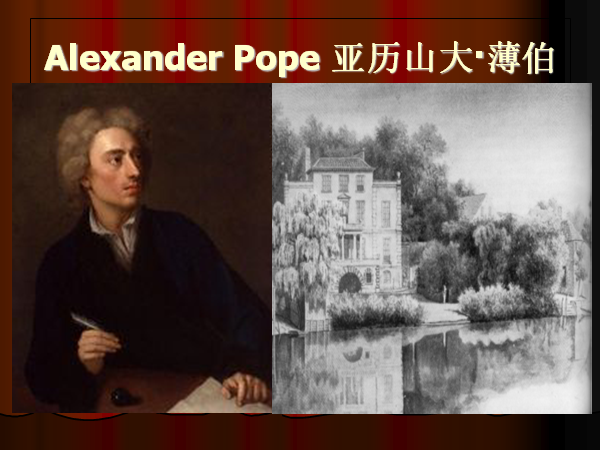
Alexander Pope, (born May 21, 1688, London, England—died May 30, 1744, Twickenham, near London), poet and satirist of the English Augustan period, best known for his poems An Essay on Criticism (1711), The Rape of the Lock (夺发记 1712–14), The Dunciad (1728), and An Essay on Man (1733–34). He is one of the most epigrammatic of all English authors.
Pope’s father, a wholesale linen (亚麻布) merchant, retired from business in the year of his son’s birth and in 1700 went to live at Binfield in Windsor Forest. The Popes were Roman Catholics, and at Binfield they came to know several neighbouring Catholic families who were to play an important part in the poet’s life. Pope’s religion procured him some lifelong friends, notably the wealthy squire John Caryll (who persuaded him to write The Rape of the Lock, on an incident involving Caryll’s relatives) and Martha Blount, to whom Pope addressed some of the most memorable of his poems and to whom he bequeathed most of his property. But his religion also precluded him from a formal course of education, since Catholics were not admitted to the universities. He was trained at home by Catholic priests for a short time and attended Catholic schools at Twyford, near Winchester, and at Hyde Park Corner, London, but he was mainly self-educated. He was a precocious boy, eagerly reading Latin, Greek, French, and Italian, which he managed to teach himself, and an incessant scribbler, turning out verse upon verse in imitation of the poets he read. The best of these early writings are the “Ode on Solitude” and a paraphrase of St. Thomas à Kempis, both of which he claimed to have written at age 12.
亚历山大·蒲柏(Alexander Pope),1688年5月22日 出生于伦敦,是18世纪英国最伟大的诗人,杰出的启蒙主义者。他推动英国新古典主义文学发展。
蒲柏出生于一个信仰天主教的商人家庭,由于当时英国法律规定学校要强制推行英国国教,因此他被剥夺进入高等学校进行教育的机会,于是他从小跟从家教学习或者在家中自学,他自学了拉丁文、希腊文、法文和意大利文的大量作品并尝试翻译这些作品。他幼年时期患有结核性脊椎炎,造成驼背,身高没有超过1.37米。蒲柏从12岁即开始发表诗作,17岁时,经戏剧家威彻利(William Wycherley,1640-1716)的引荐,结识了当时伦敦的一些著名的文人学士其中包括当时非常有影响力的约翰·德莱顿,并在斯威夫特的鼓励下以十三年功夫翻译了古希腊史诗《伊利亚特》(Iliad,译成于1720年)与《奥德赛》(Odyssey,译成于1726年)。21岁时,蒲柏发表《田园诗集》(Pastorals,1709),并在以后的几年中先后发表阐述自己文学观点的诗《批评论》(An Essay on Criticism,1711)和叙事诗《温莎林》(Windsor Forest,1713)等。
蒲柏还为牛顿写了著名的墓志铭:自然和自然的法则隐藏在黑夜之中。上帝说:生个牛顿吧,于是一切都被照亮。

