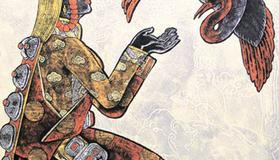
知识点一 “热巴鼓”的舞蹈文化发展和表现形式
1、“热巴鼓”的舞蹈文化发展
相传热巴舞的产生约在公元十一世纪,由藏传佛教噶(ga)举派第二代祖师米拉日巴所创建。也有人认为是由佛学家当巴桑杰传下来的,有较浓郁的宗教色彩,一般在庆丰收,驱鬼神的日子里舞蹈。热巴舞以铃鼓为主,融说唱、歌舞、杂技、气功、热巴剧于一体,2006年,被列入第一批国家级非物质文化遗产名录。2014年07月16日,云南省迪庆藏族自治州的热巴舞经国务院批准列入第四批国家级非物质文化遗产名录,编号保持不变,认可云南省迪庆藏族自治州的热巴舞也属于非物质文化遗产名录。
2、“热巴鼓”的舞蹈表现形式
热巴中的舞蹈,为了吸引观众,讲究舞姿的优美,编排难度高的动作,舞时,男女人数相等,由领舞人扮主要角色。在铃鼓声中,通过跳、转、翻动作,圆好场地,招来观众,然后男女演员上场。
热巴舞风格技巧熟练精当,节奏激烈紧张,表情丰富,情绪奔放,粗矿豪迈,英武豪放,特点稳重大方,舞姿优美多变,铃鼓是热巴的重要组成部分,分九种鼓点,根据鼓点节奏的不同来表演舞蹈。在表演中,男持铜铃,女执手鼓(因而热巴舞又名铃鼓舞),绕圈走动,翩翩起舞。铃鼓声节节奏鲜明,随着曲调和情感的变化或高或低,或急或缓。节奏徐缓,铃鼓间响,清声幽远,节奏急促,钹鼓齐鸣,轰轰烈烈。表演中,男摇铜铃女敲鼓,伴随着鼓点,应节奏而舞。舞者腰间短裙状的用羊毛或牛毛编织的染有三色或五色的辫条,随着各种强劲有力的高难度动作,裙条飘起,刚中现柔,潇洒自如。
Knowledge Point 1 The development and expression forms of the dance culture of "Reba Drum"
1.The development of the dance culture of "Reba Drum" It is said that the Reba dance originated around the 11th century AD and was created by Milarepa, the second-generation patriarch of Tibetan Buddhism. Some people also believe that it was passed down by the Buddhist scholar Dang Basangjie and has a strong religious flavor. It is usually danced on days to celebrate the harvest and drive away evil spirits. Reba dance, mainly featuring bells and drums, integrates singing, dancing, acrobatics, qigong and Reba opera. In 2006, it was included in the first batch of the National Intangible Cultural Heritage List. On July 16, 2014, the Reba dance of Diqing Tibetan Autonomous Prefecture, Yunnan Province, was approved by The State Council to be included in the fourth batch of the National Intangible Cultural Heritage List, with the number remaining unchanged. It is recognized that the Reba dance of Diqing Tibetan Autonomous Prefecture, Yunnan Province, also belongs to the list of intangible cultural heritage.
2.The dance performance form of "Reba Drum"
The dance in Reba, in order to attract the audience, emphasizes the beauty of the dance postures and arranges highly difficult movements. During the dance, the number of men and women is equal, and the lead dancer plays the main role. Amid the sound of the bell and drum, through jumping, spinning and flipping actions, the venue is rounded up, the audience is attracted, and then the male and female actors come on stage. The style and techniques of the Reba dance are proficient and precise, with intense and tense rhythms, rich expressions, unrestrained emotions, rough and bold, heroic and unrestrained. Its characteristics are steady and elegant, and the dance postures are beautiful and diverse. The tambourine is an important part of the Reba dance, which is divided into nine types of drum beats, and the dance is performed according to the different rhythms of the drum beats. During the performance, men hold copper bells and women hold hand drums (hence the Reba dance is also called the bell Drum Dance), walking in circles and dancing gracefully. The rhythm of the bell and drum is distinct, rising or falling, fast or slow as the melody and emotions change. The rhythm is slow and gentle, with bells and drums ringing alternately, clear and distant sounds. The rhythm is rapid, with cymbals and drums ringing in unison, grand and vigorous. During the performance, men ring copper bells and women beat drums, dancing to the rhythm along with the drumbeats. The dancers' waists feature short, woolen or cowhide braids dyed in three or five colors. As they perform various powerful and difficult movements, the skirts float up, presenting a blend of firmness and softness, with ease and grace.

