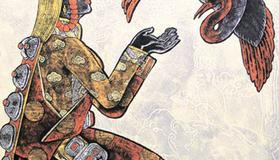
知识点(一) “卓”的舞蹈文化发展和舞蹈表现形式
导入语:在西藏,卓舞大致分为两个流派:日喀则,山南。
久河卓舞是山南市卓舞的代表。是民间震慑邪魔、祈求吉祥的舞蹈,被称为西藏的“腰鼓舞”。藏山南久河卓舞从公元七世纪形成并流传至今,已有1300多年的历史,是藏族传统舞蹈文化中的一门比较特殊的艺术,它是现存世界各民族传统文化中最为古老的形式之一。2014年久河卓舞被列入国家级非物质文化遗产名录。
1.卓舞的历史渊源
久河村位于西藏山南琼结县下水乡,距县城4公里处,海拔3600米,曾名“命墩”。西藏和平解放前,这一带通称久河沟,是五世达赖时期封给其美丹增祖辈的世袭领地。琼,在藏语中是悬起的意思;结,有发达、兴盛等解释,琼结,历史悠久,西藏历史上著名的雅砻部落就以琼结一带为大本营,向四方发展,扩充势力。直至吐蕃赞普松赞干布将政治、经济、文化中心迁移到拉萨河谷。在琼结这块古老的土地上,有吐蕃王朝第九代赞普布德贡杰到吐蕃王朝第十五代赞普菩伊肖勒先后修建的吐蕃第二宫堡——青瓦达孜六王宫;有驰名中外的藏王墓群;有西藏第一部藏戏“宾顿巴”发源地。这些都为久河卓舞的发展奠定了坚实的基础。卓舞的兴盛还与建造桑耶寺有着很深的联系。
传说第38代藏王赤松德赞时期,兴建山南桑耶寺,因工程浩大,正殿屡塌。于是从印度迎请莲花生大师,找来工布地区善鼓舞的七兄弟,夜间燃起篝火击鼓而舞,以至桑耶寺大功告成。在该寺主殿开光的大典聚会上,又表演了这种大型场面的腰鼓舞蹈,很受群众欢迎,从而逐步流入民间。慢慢的,卓舞就在西藏各地盛行开来。
琼结的久河卓舞更多表现的则是公元8世纪中叶藏王赤松德赞修建桑耶寺的故事。古时的卓舞,人们只能在重要的仪式中才能看到;而今,我们在任何的节庆或大型活动现场,都可以发现它的身影,山南市时不时会响起气势磅礴的卓舞鼓声。
2.“卓”的艺术形式
卓舞又称果卓,卓意为舞,卓舞也称鼓舞。卓舞腰鼓是藏民族古老的一种乐器,久河卓舞属于哈刚卓巴,领舞会在寺庙石阶上跳“班典谐果吉祥舞”,然后跳卓舞;一共有七天。歌曲分为两类,分别是男腔和女腔。在表演卓舞过程中,领舞者不仅自己是一位舞者,还要担当起指挥整个舞队的舞蹈动作和节奏。卓舞鼓手头戴圆帽,头发扎一根辫子,长袖衬衣和短袖马褂各一件,下穿多折式围裙,藏语叫“门热”,身背五彩哈达或绸带,腰一串狮嘴铃,左侧系扁形圆鼓,手持鹰毛鼓槌。卓舞领队的服饰是头戴山羊皮做的白面具,穿长袖衬衣,短袖黑色马褂,大肥裤,藏语称“多鲁”,右手持五彩棒。
3.“卓”的表现形式
卓舞是一种集体群舞,表演者分领舞,藏语中叫做“阿热”;群舞,藏语中叫做“卓巴”两类。在整个表演队伍中,领舞者人数2~6名不等,他们不带腰鼓,主要是提醒动作变换顺序,控制节奏速度。其动作韵律性强,姿势基本上同于群舞,但难度较小。领舞者均由熟知整个卓舞的动作、顺序,有较长表演经历的人员担任;群舞表演者边击鼓边按鼓点节奏起舞。同时,舞蹈动作把长发辫子挥舞成圆形等形状,动作粗犷豪放,刚劲威武,节奏感强,变化多端。
卓舞的唱词除礼赞佛、菩萨、寺院之外,更多的是歌咏山川景色,赞美家乡、倾吐爱情、歌颂幸福生活等。
Knowledge Point 1 The development and expression forms of "Zhuo" dance culture
1.The meaning of "Zhuo" : In Tibetan, Zhuo is the general term for dance and can also be called Guozhuo. We usually refer to it as Guozhuang. Guozhuang is derived from a homophonic variation and mainly refers to a kind of dance in the form of a circle.
2.Distribution areas of Zhuo: Zhuo is a form of dance used by Tibetans for self-entertainment or entertaining others. It is widely present in Tibetan areas such as Sichuan, Yunnan, Gansu, and Qinghai. It mainly showcases the characteristics of the Tibetan people, such as diligence, bravery, and wisdom, through diverse lyrics and graceful dance movements. The names vary in different regions. In the Sakya region, it is called "So", while in the Gombu region, it is called "Bo" or "Bo Qiang". The pastoral area in northern Tibet is called Zhuo or Guozhuang.
3. The dance performance form of Zhuo: Zhuo is a circular self-entertaining dance and song performed by ancient people around bonfires and POTS, which includes dance vocabulary such as animal-like expressions and love. In agricultural and pastoral areas, the styles of dance are different and each has its own characteristics. During the performance, there is no accompaniment of any Musical Instruments. The venue is chosen to be Guozhuangfang or a courtyard. Men and women form two rows and dance hand in hand in a circle. Guozhuang is divided into large Guozhuang and small Guozhuang. Daguozhuang is a kind of ceremonial dance, mostly performed when chanting scriptures or welcoming guests in temples. It has strict requirements. For instance, the pre-designated lead dancers are mostly respected male elders, and uniform costumes are required, etc. It has certain dance routines. Its characteristics are steady dance steps, dignified dance skills and rich expression. Xiaoguozhuang is a kind of self-entertainment dance. It is not bound by form and can be performed anytime and anywhere. It can be in a Guozhuang room, a courtyard, or even a workplace. The lead dancer of Xiaoguozhuang can be either male or female without any restrictions. The content of Xiaoguozhuang often expresses love, labor, flowers, birds, nature, etc. Therefore, it is lively, free and easy, with long sleeves waving and steps moving freely and joyfully.

