-
1 课程内容
-
2 课件
-
3 教案
-
4 练习
-
5 拓展
Step 1. Revision
1.Revision of Unit 15
2. Revision of Unit 5---Dealing with errors
Step 2. Lead-in
Much L2 variation has to do with learner factors. It is obvious that learners vary in their achievement and proficiency, but when SLA researchers in the West talk about individual differences, they do not mean this. Rather, they are interested in the cognitive, affective and personality variables that affect the route, rate and ultimate attainment of SLA.
Admittedly many of the learner factors are extremely important for achieving success in school and for language learning, eg. one's self-image as a successful or unsuccessful person, motivation to learn and to achieve, attitudes towards the school and the teacher, learning anxiety and so on. Many of these, nevertheless, are in fact sociological or social psychological factors.
Can you list some of these personal variables?
Step 3. New Text
I. Understanding learner differences
Lavery(2001:13) points out some people have an instinctive ear and like learning from hearing and listening, while others prefer action such as making things with their hands, and walking about. This is because different people have different learning style. Based on Reid(1998a), there are eight different types of learners.
Visual learners, auditory learners, tactile learners, kinesthetic learners, group learners, individual learners, authority oriented learners, reflective learners.
Different learners have different styles. In fact, most of us are, more or less, a mixture of different learning styles, but some styles are preferred more than others. Good language learners use a combination of styles in learning. They adopt different ways of learning styles for different learning purposes.
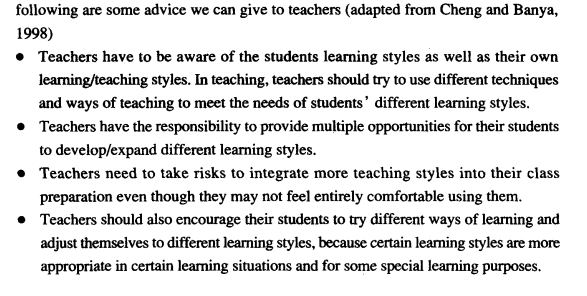
Some advice about how teachers meet the needs of different learners (P265)
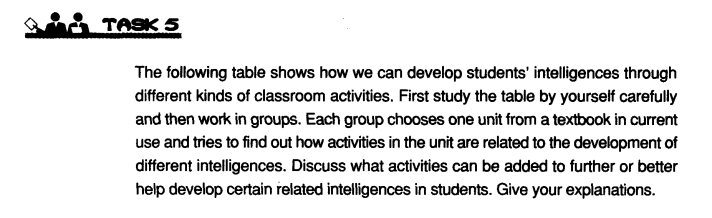
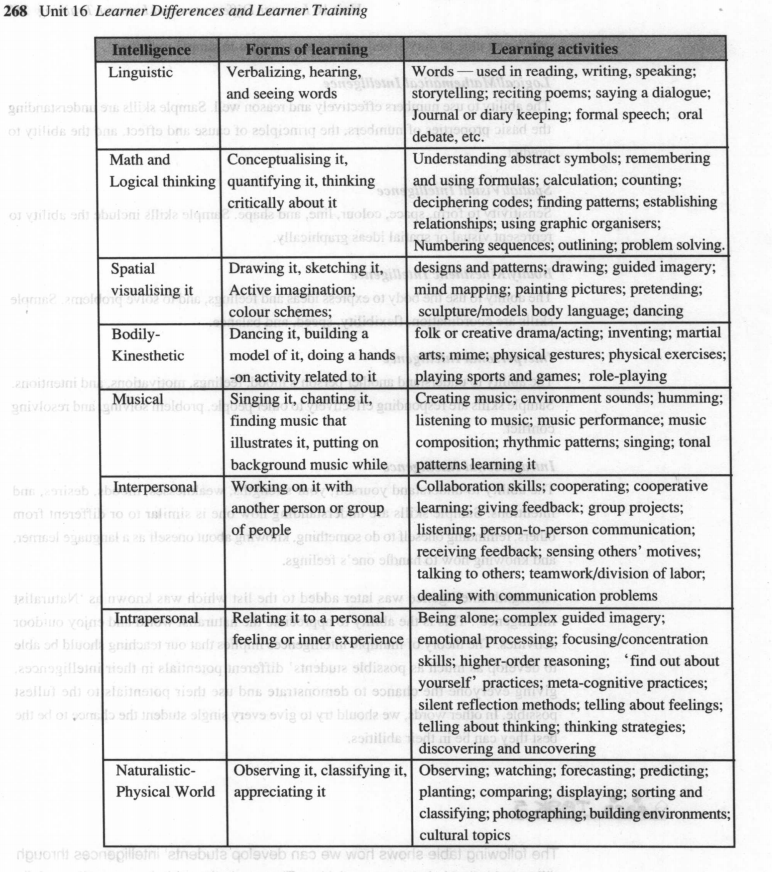
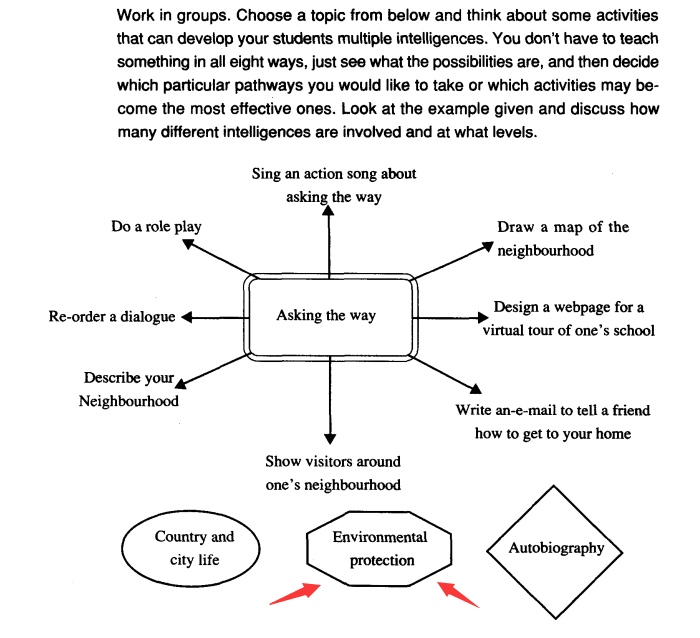
American psychologist Howard Gardener(1983, 1993) proposed theory of multiple-intelligence. This theory implies that our teaching should be able to develop as much as possible students' different potentials in the intelligences, giving everyone the chance to demonstrate and use their potentials to the fullest possible. In other words, we should try to give every single student the chance to be the best they can be in their abilities.
People's intelligences can exist in many different forms and can develop and be developed over a life time. Gardner proposed seven intelligences(Based on Christison, 1996:11): verbal/ linguistic intelligence, musical intelligence, logical/ mathematical intelligence, spatial/visual intelligence, bodily/ kinesthetic intelligence, interpersoal intelligence, intrapersonal intelligence, (8. naturalist intelligence) (P268)
II. Learner training in language teaching
1) Learner autonomy and learning strategies:
2) Contents of learner training:
First, awareness raising on different ways of learning.
Second, skills training on the use of learning strategies.
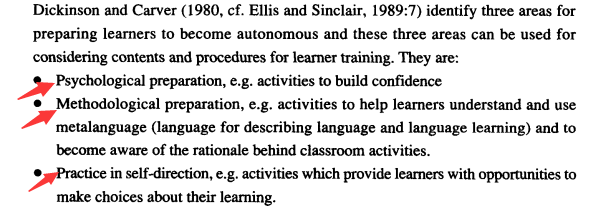
3) Preparations for learners autonomy(Dickinson and Carver:1980):