-
1 教学内容
-
2 课件
-
3 教案
-
4 练习
-
5 拓展
IV. Criteria for Assessment
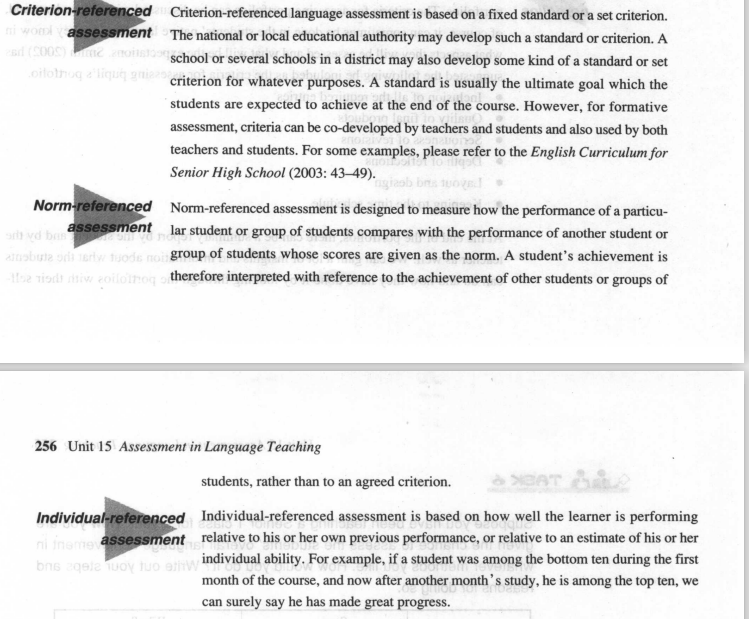
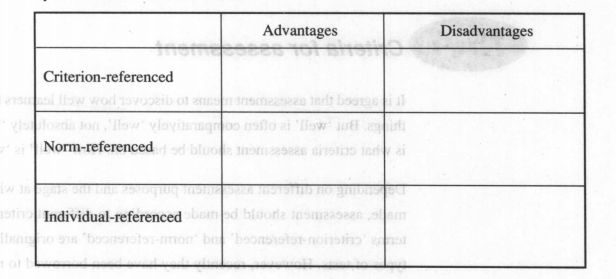
Criterion-referenced assessment 标准参照型(测试或评估)
Norm-referenced assessment 常模参照型(测试或评估)
3. Individual-referenced assessment 个体参照型(测试或评估)
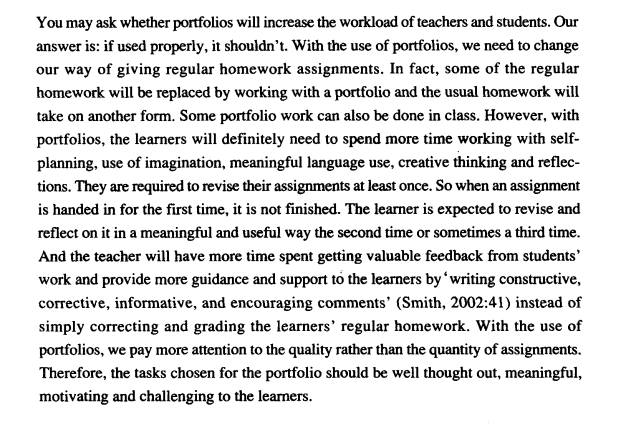
How to assess portfolios (according to Smith, 2002)
a. inclusion of all the required entries b. quality of final products
c. seriousness of revisions d. depth of reflections
e. layout and design f. keeping to the time schedule
V. Assessment Principles
1. Assess authentic use of language iin reading, writing, speaking, and listening.
2. Assess literacy and language in a variety of contexts.
3. Assess the environment, the instruction, and the students.
4. Assess processes as well as products.
5. Analyse patterns of errors in language and literacy.
6. Base assessment on normal developmental patterns and behaviour in language and literacy acquisition.
7. Clarify and use standards when assessing reading, writing, and content knowledge.
8. Involve students and parents, as well as oter personnel such as the ESL or mainstream teacher, iin the assessment process.
9. Make assessment an ongoing part of every day.
(Taken from Law and Eches, 1995:9)
VI. Tests in Assessment
Testing does not equate with assessment, but testing is, at least now, the most widely used method to collect information for the purpose of assessment.
Drawbacks: not necessarily a fair sample of the learner's overall proficiency; not always valid or reliable; extremely stressful for crucial evaluation
Lower-order thinking skill (memorisation and recall) VS. higher-order skill (inferencing and synthesising)
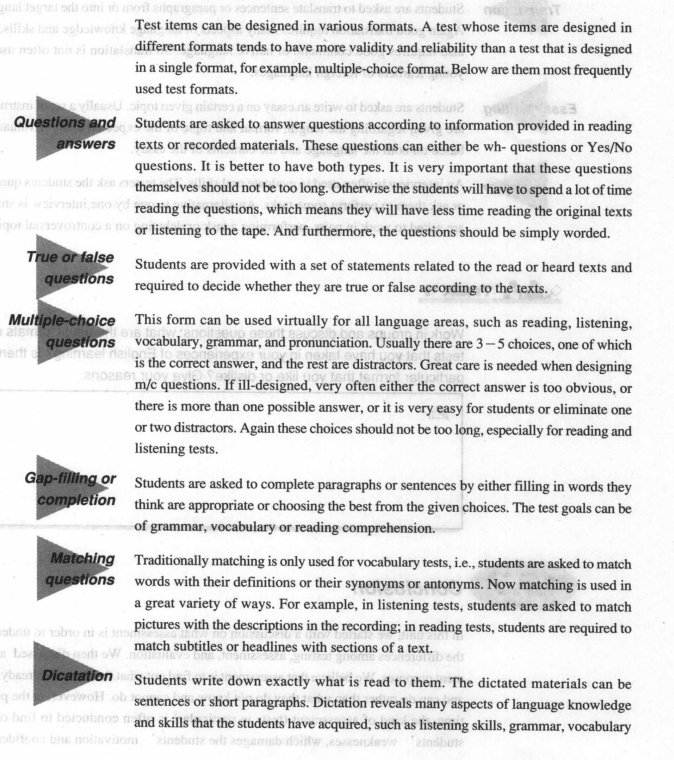
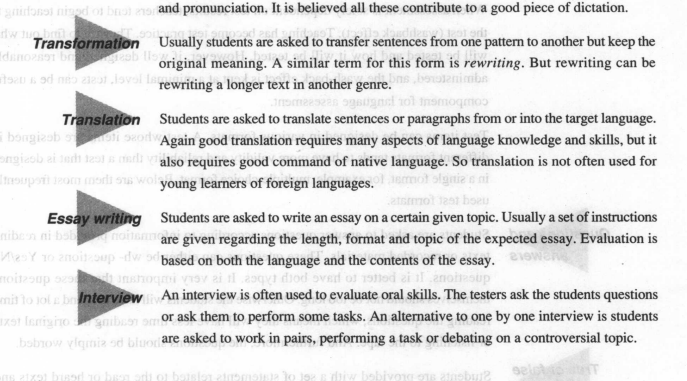
Test formats: questions and answers; true or false questions; multiple-choice questions; gap-filling or completion; matching questions; dictation; transformation; transiation; essay writing; interview
Step 4. Consolidation
1. The difference between testing, assessment, and evaluation
2. The purposes of assessment: assessment is to find out what the students already know and can do rather than what they do not know and cannot do.
3. Methods and formats of assessment,
4. Principles to follow in assessment.
Step 5. Work Assignments
1. Review the details of Unit 15
2. Preview Unit 16
3. Unit 15. Task 9 (P260)