
-
1
-
2 课件
-
3 教案
-
4 练习
-
5 拓展
IV. Discipline in the
language classroom
1.What does discipline mean
in language classroom?
Discipline does not mean a series of punishment meted
out to badly behaved students. Here it refers to a code of conduct which binds a
teacher and a group of students together so that leaning can be more effective. It is important to realise that the code of conduct that determines the behavior
of a class is as necessary for the teacher as it is for the students
The possible characteristics of disciplined classrooms as following.
(1) The class is under the
teacher’s control.
(2) The class is quiet.
(3) The teacher and students are cooperating smoothly.
(4) The teacher and students show repent to each other.
(5) The lesson is proceeding according to a plan.
(6) Learning is taking place.
2. How do we maintain discipline in the classroom? What should we do when indiscipline occurs?
Practical hints for teachers on classroom disciplines P.80 Task 7
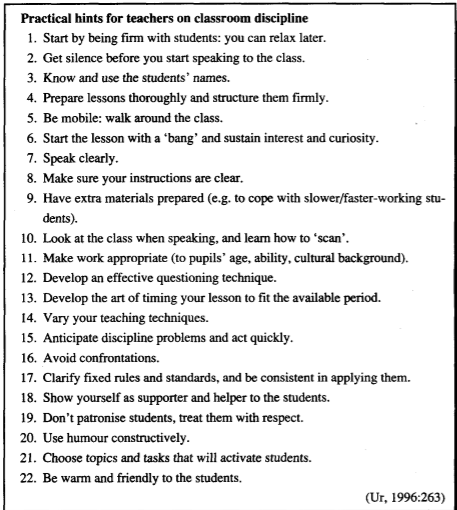

When indiscipline occurs we should do the following:
(1) Act immediately.
(2) Stop the class.
(3) Rearrange the seats.
(4) Change the activities.
(5) Talk to students after class.
(6) Create code of devoir.
(7) Deal with it quietly.
(8) Don’t take things personally.
(9) Don’t use threats.
V. Questioning in the classroom
1.What are questions for?
Work in groups and discuss the functions or purposes of questions in teaching.
a. Teachers use questions to focus students attention
b. To invite thinking and imaginaries
c. To check understanding
d. To stimulate recall of information
e. To challenge students and to assess learning in adulation proper questioning can extend students thinking from the concrete and factual to the analytical and evaluative; can lead students through a planned sequence which progressively establishes key understands; can remodel reasoning, problem solving, evaluation; and can promote students thinking about the way of their own learning.
※Questions should be wise and purposeful, contributing to the overall objectives of the lesson stimulating the development of knowledge and thinking.
2. Classification of question types
Questions have been classified using different criteria mainly based on the
level of thinking involved in answering the quietisms.
a. Closed and open questions (single answer different).
b. Display and genuine questions (know reflect real context) more communicative.
c.Lower-order and higher-order questions.(Simply require recalling of information or emendation require more reasoning analysis and evaluation.
d.Taxonomy /tækˈsɒnəmi/生物分类学
Knowledge: recalling facts terms and basic
concepts.
Comprehension: understanding of fact and ideas by
organizing comparing translating interpreting describing and stating the main
ideas.
Application: applying acquired
knowledge facts teahouse and rules in a different context.
Analysis: identifying relationships,
causes or motives and finding evidence to support main ideas.
Synthesis: combining elements in a different way and
proposing alternative solutions
creative thinking.
Evaluation: present and defend opinions by making an
informed judgment about
information or ideas based on a set of criteria
布鲁姆教育目标分类法(请打开网页浏览)
3. How do we make students ask question?
It’s a skill. Teachers need to create a meaningful context and motivate students to ask genuine question on the basis of the limited language available to them.
VI. Dealing with errors
It is important
for both teachers and learners to accept the fact that errors are an inevitable
part of the learning process. Through learners’ errors, we can see what they
are struggling to master, what concerts they have misunderstood and what extra
work they might need.
First let’s make a distinction between an
error and a mistake.
According to Brown (2000) mistakes and language errors
are two different phenomena in language learning.
※ A mistake refers to a performance error that is either a random guess or a slip of tongue and it is a failure performance to a known system (it has nothing to do with the language competence when give enough attention ) (it can be self-corrected)
※An error has direct relation with the learners
language competence. Errors do not result from carelessness nor hesitation but
lack of knowledge in the target language (no matter how much attention is given
language errors cannot be self -corrected)
In dealing with errors and mistakes we need to be clear whether the task or activity is focusing on accuracy or fluency. In designing classroom activities, there needs to be a balance between accuracy-based activities and fluency-based activities.
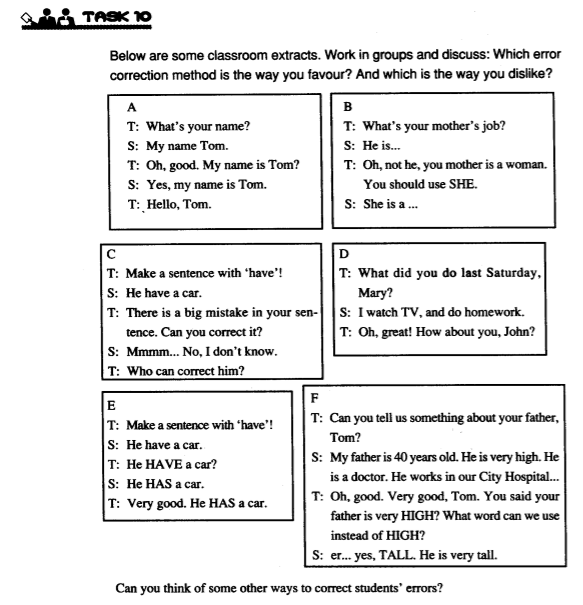
When to correct P.87.
— during fluency work …?
— during accuracy work…?
How to correct
— direct teacher correction
— indirect teacher correction
— peer correction
— whole class correction
Step 3. Conclusion
In this unit, we discussed how language teachers can
manage the classroom more effectively and efficiently. Different assumptions about the teacher's roles will stiputlate different classroom management policies; and different methodologies entail the adoption of different teacher roles. Regarding classroom instructions, we discussed their different functions. Another important issue we discussed in this unit was maintaining discipline. However, teacheres should be careful when judging what behaviour is disciplined and wht is in disciplined. Questioning and error correction were also discussed in this unit. A distinction was made between an error and a mistake. We believe that once teachers have formed the right attitude towards errors and developed appropriate strategies in dealiing with them, students will be helped and motivated in producing language more actively and this will untimately lead to higher language proficienc with both accuracy and fluency.
Step 4. Homework:
1.Task 3, 5, 6, 7, 10.
2. How to deal with spoken errors?
When to correct ?
How to correct ?