-
1 课程内容
-
2 课件
-
3 教案
-
4 练习
-
5 拓展
Step 1. Revision
Step 2. New Text
| 授课章节 | Unit 5 Classroom Management | ||||
| 授课学时 | 2学时 | 讲授方法 | 讲练法 | 教学条件 | 多媒体,网络平台,应用软件 |
教学目标: 要求学生学习和了解如何进行课堂教学的管理,采取何种方法和手段达到最佳的教学效果;理解和掌握课堂教学中教师扮演的角色、如何组织课堂用语、组织学生进行语言交际活动、维持课堂纪律的方法和原则以及课堂提问的科学方法等。并要求学生写 出学习笔记,并在今后的训练中理论联系实际地加以运用。 | |||||
教学重点、难点: 1.重点:(1)Classroom management (2)Roles of teachers in the classroom 2. 难点: Classification of question types | |||||
教学要点: 第一节 The role of the teacher 1. What roles do teachers play in the classroom? 2. Classroom instruction; 3. Student grouping; 第二节 Discipline and questioning in the language classroom 1. Discipline vs. indiscipline 2. Maintaining discipline 3. Classification of question types 4. Dealing with errors …… | |||||
思考题/作业: Task 3, 4,5,6,7,10 | |||||
| 教学小结: | |||||
Unit 5 Classroom Management
Classroom management is the way teachers organize what goes on in the classroom. It contributes directly to the efficiency of teaching and learning as the most efficiently. Good managerial skill on the part of the teacher are very essential component of good teaching, as the goal of classroom management is to create an atmosphere conductive to interacting in English in meaningful ways. Efficient classroom management can be achieved when the following six conditions are met.
1. What roles do teachers play in theclassroom?
2. How to give effective classroom instructions?
3. What are the different ways for students grouping?
4. How to maintain disciplines in the classroom?
5. Howto ask effective questions?
6. How to treat students’ errors in the classroom?
I. The roles of the teacher
What roles do teachers play in the classroom?
Before class: a planner
What to teach…/ How to teach…/What result to achieve…
After class: an evaluator
How successfully he has conducted the class…
How efficient the learning activities have been…
an assessor
During the class:
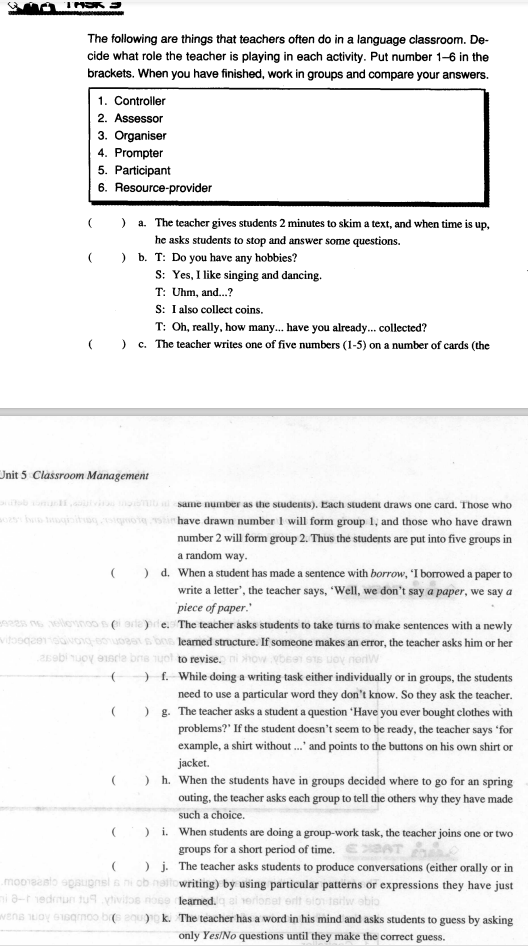
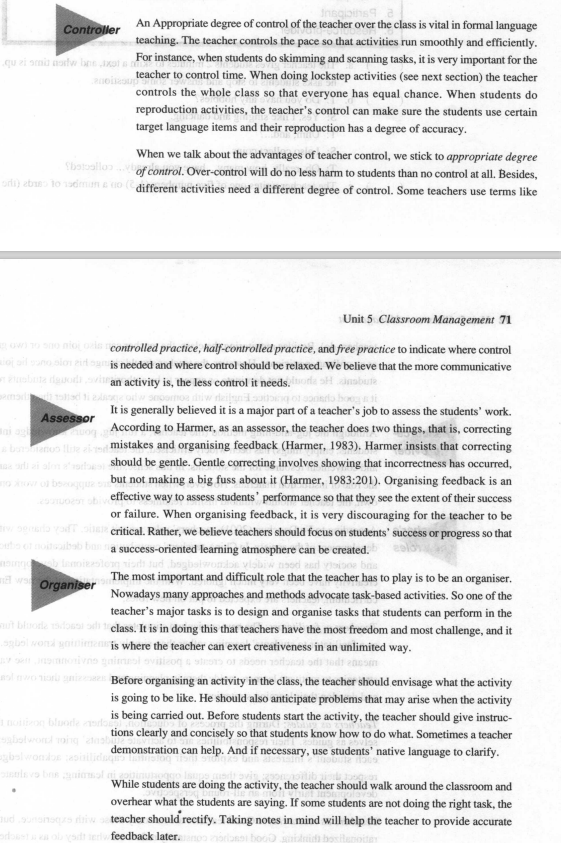
an organizer, a controller, a prompter,
a participant, a resource-provider
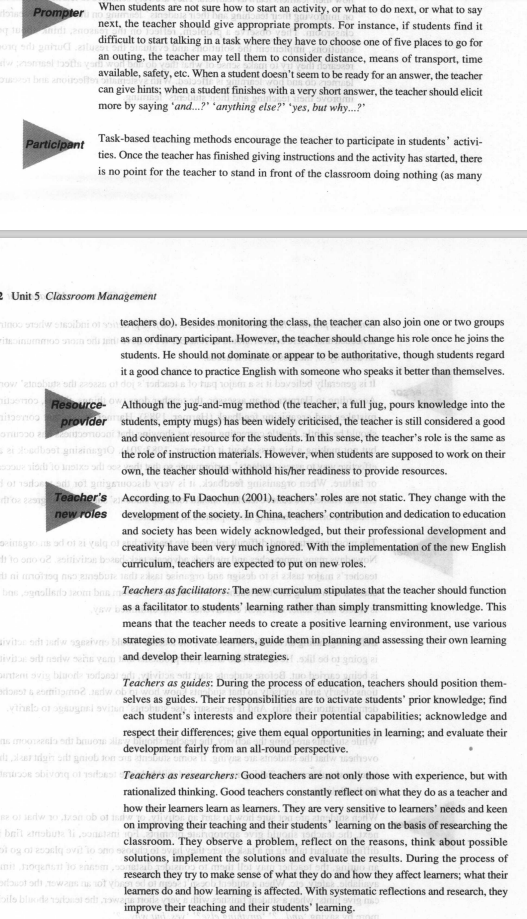
※ Teacher's new roles
Teachers’ roles are not static. They change with the implementation of the
new English curriculum. Teachers are expected to put on new roles
Teachers facilitators (helper)
Teachers as guides
Teachers as researchers
II. Classroom instruction
Classroom instructions refer to the type of language teachers use to organize
or guide learning. They include
(1) giving directions to tasks oractivities
(2) providing explanations concept or language structure
(3) settling requirements
(4) checking comprehension
(5) drawing attention
(6) motivating learners
(7) giving feedback
(8) assigning homework
※Generally they include all classroom language that teachers may use for
teaching purpose as well as for managing teaching.
Rules for making clear instructions:
(1) The first is to use simple instructions and make them suit the comprehension level of the students.
(2) The second rule is to use the mother-tongue only when it is necessary.
(3) Give students time to get used to listening to English instructors and help
them make an effort to understand them (use body language, guess or deduce meaning from context).
(4) Sometimes it can be quite complicated to give instructions in English for a
complicated task. The best thing to do is to model the task/activity before letting students move into groups or pairs.
(5) Be careful not to do all the talking in class. Try to avoid lengthy explanations. Remember demonstration is usually more effective than words. keep your own talking to a minimum during the activities.
III. Student grouping
An important feature of today's language classroom is that students do not always as one biggroup. Rather for much of the class time students are put into groups of different sizes. The most common student groupings are whole class work, pairwork, group work and individual study
(1)What is whole class work? P.74
Pair work?
Group work?
Individual work?
(2)When de we use these work?
(3)What are the advantages and disadvantages (task4)of these four types of student grouping?
(4)Grouping methods
Different grouping methods have different values in language teaching
classroom. There are some suggest on student grouping methods.P76