
-
1 课程内容
-
2 课件
-
3 教案
-
4 练习
-
5 拓展
IV. Components of a lesson plan
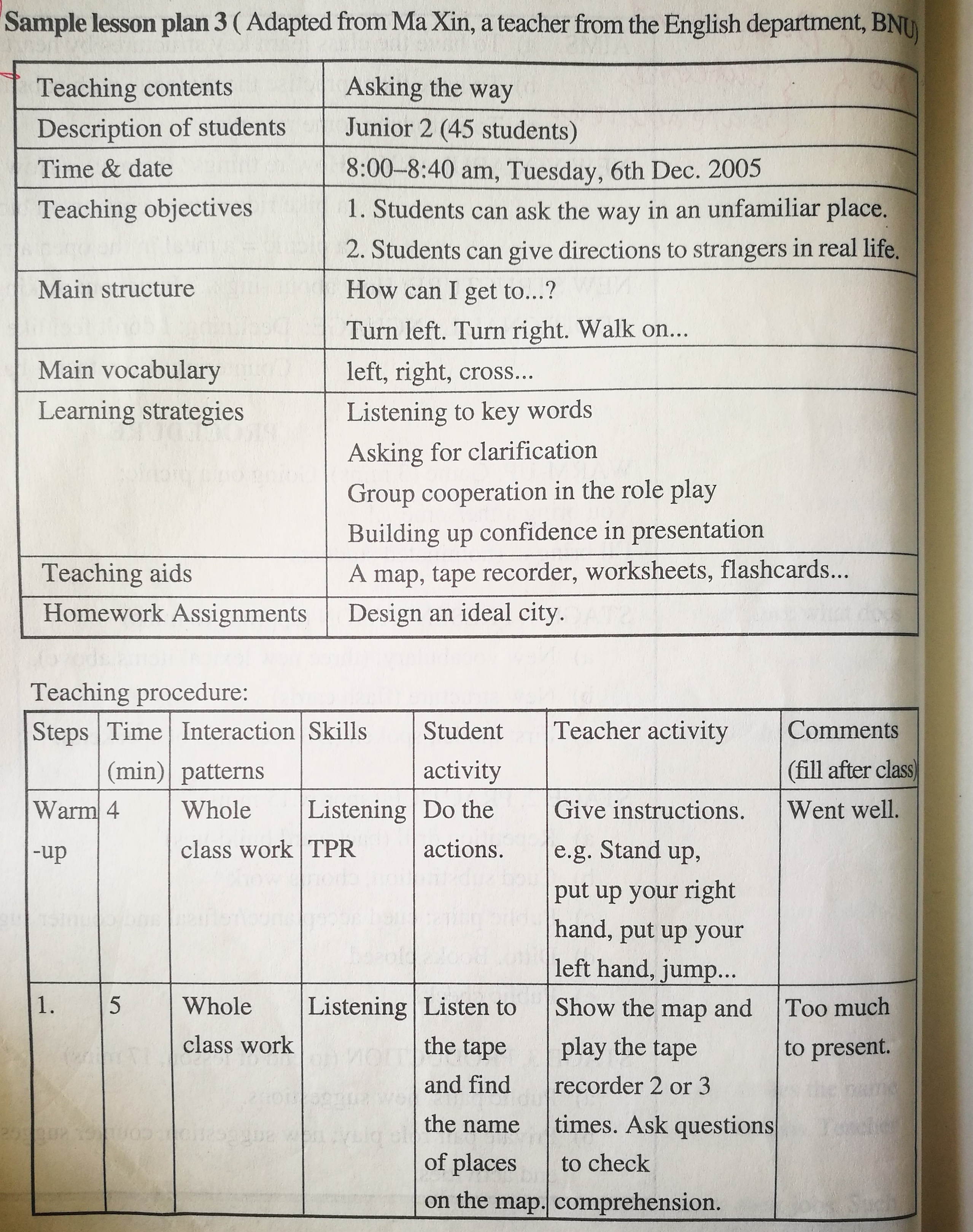
1. Background information
The first thing the teacher needs to detail is who the students are: how many are there inclass? What ages? Which grade they are in? What genders? What are they like? The teacher also needs to specify the time and the date of the lesson as well as the time duration of the lesson
2.Teaching aims
The important thing to do in lesson planning is to decide the aims of a lesson which inclued.
---What language component to present
---What communicative skills to practice
---What activities to design
---What materials and teaching aids to be used
※ Teaching objectives should. focus on the learners’ performance rather than the teachers’
※ In order to lay a good foundation for continuing development, the language objectives in lesson planning should reflect the overall objectives described in the new English curriculum(indicate), emphasize language skills, knowledge affects,strategies and culture awareness.
3. Language contents and skills
By language contents, we mean structures (grammar), vocabulary, functions
topics and so on.
By language skills we mean communication skills involved in listening, speaking, reading and writing.
※ Teachers should be careful when deciding what vocabulary items and structures to focus on in the class. Not all new words in a lesson are equally important
4. Stages and procedures
Teaching stages refer to the major part of activities that teachers go through in a lesson suchas PPP and Five Step Models.
Procedures are the detailed steps in each teaching stage such as in five step model we use step 1-organization, step 2-revision, step 3- new lesson, step 4 -summary, step 5 - homework, etc.
※for almost every lesson a warm up or a starter isnecessary. A starter (organization) can take many forms: a song, questions and answers; a daily conversation, a story, a guessing game, a picture, description, homework checking etc. It’s importantto bear in mind that it should directly contribute to the overall lesson objectives.
※ Models of lessons
① A new structure based lesson
(Speaking lesson):
presentation, practice, production
②A skill-oriented lesson
(Reading and listening lesson): Pre-reading/listening, while-reading/listening, post-reading/listening
5. Teaching aids
6. End of lesson summary
At the end of a lesson the teacher will take some time to summarize what is
learned in the lesson
7. Optional activities and assignments
8. After lesson reflection
V.Sample lesson plans
Lesson Plan
1. Background information(School- grade- class)
2. Time and date
3. Textbook (including teaching contents)
4. Teaching time(Period/ duration)
5. Lesson type
6. Aims and requirements
a. Knowledge, b. Ability, c. Moral education
7. Main points
8. Difficultpoints
9. Teaching method
10. Teaching aids
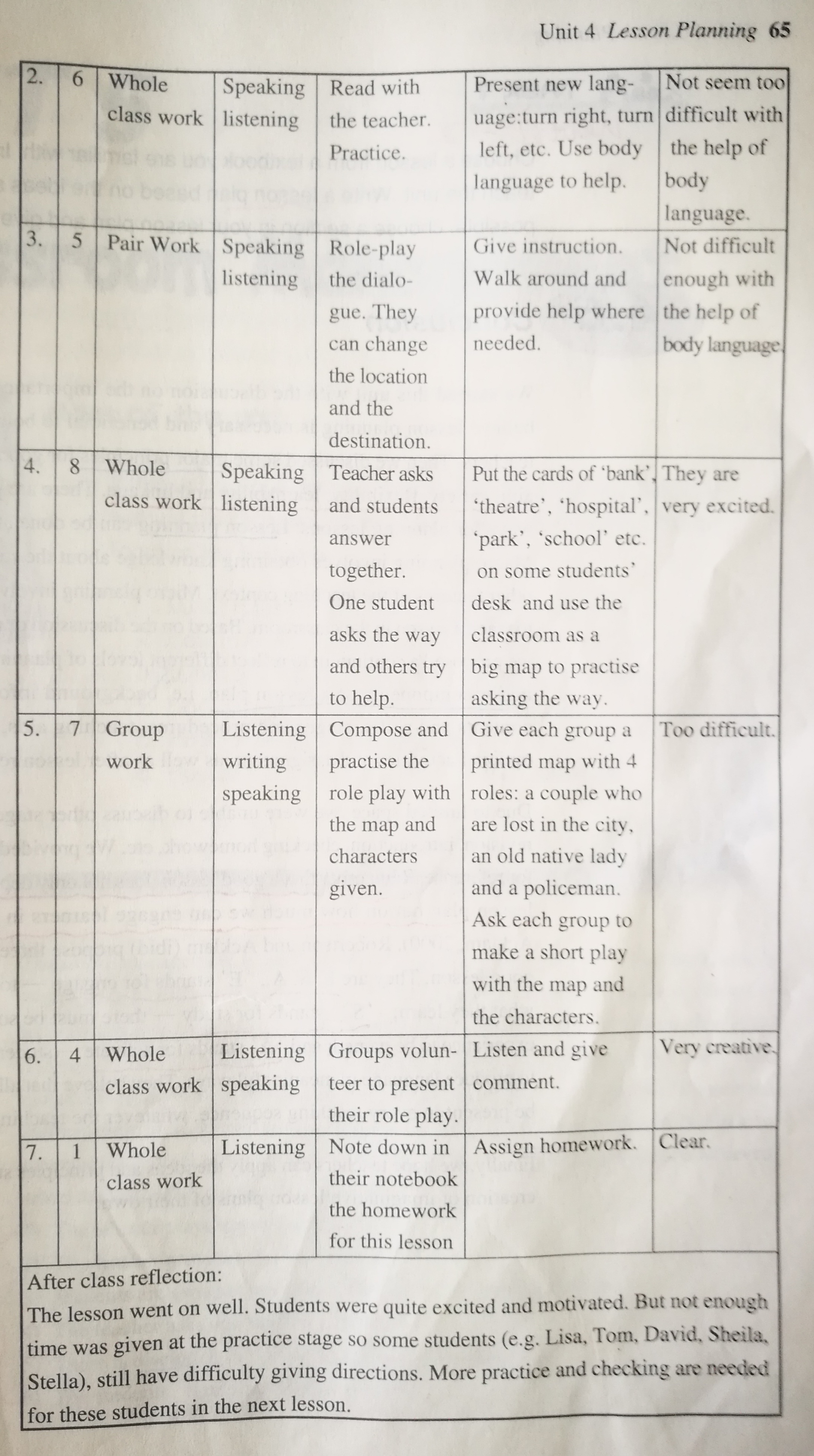
Teaching Procedure(PPP)(for a new structure-based lesson)
Step.1 Organization
Step 2. Revision
Step 3. Presentation
Step4. (Drill) Practice
Step 5. Production/ Consolidation
Step 6. Homework
Blackboard Design(omitted)
Postscript (a reflection of thelesson to the original plan)
Step 3. Conclusion
1. Lessonplanning is necessary and beneficial to both experienced teachers and new teachers.
2. Then some major principles for good lesson planning, namely, variety, flexibility, learnability and linkage.
3. Lesson planning can be done at macro and micro levels. Macro planning involves obtaining knowledge about the students, the institution and other features of the teaching context.Micro planning involves deciding what and how to teach in the classroom.
4. We discussed the major components of a lesson plan ( aims,language contents and skills, and stages and procedures.
Step 4. Homework
Try to make a lesson plan according to the text books of middle school.
A speaking lesson and a reading lesson