-
1 课程内容
-
2 课件
-
3 教案
-
4 练习
-
5 拓展
Step 1 Revision
1. Can you say out the "three, four, five, six" we learned in Unit Two?
2.The challenges teachers meet as regards TBLT
Step 2. New Text
授课章节 | Unit 3 The National English Curriculum | ||||
授课学时 | 2学时 | 讲授方法 | 讲练法 | 教学条件 | 多媒体 |
教学目标: 学习和了解我国基础英语新课程标准制定的历史背景,理解和掌握英语新课程标准教 学的总体目标、中小学一条龙英语教学的思路、设计原则以及英语教师所面临的挑战。
| |||||
教学重点、难点: 1.重点;(1)What is the main aim of English language teaching? ( (2)2001 National English Curriculum for None-year Compulsory Education 2. 难点: What are the relations among all the components? | |||||
教学要点: 第一 第一节 Goals and objectives of English language teaching under the National English Curriculum 1. What is the main aim of English language teaching? 2. What is it composed of? 3. What are the relations among all the components?
第二节Designing principles for the National English Curriculum
1. 2001 National English Curriculum for None-year Compulsory Education 2. Performance standards for different levels of competence; 3. Challenges facing English language teachers
| |||||
思考题/作业: 1. What is the main aim of English language teaching? 2. What is it composed of? 3. What are the relations among all the components? 4. What are the major characteristics compared with the 1992 Syllabus? | |||||
教学小结: | |||||
Unit 3 The National English Curriculum
In this unit, We shall introducethe new English curriculum. We started by offering a brief overview of the history of Englishlanguage teaching in
1. The goals and objectives of Englishlanguage teaching
2. The designing principles for thenational English Curriculum
3. The design of the National English Curriculum
4. The standards for different levels of competence
5. The implementation of the national curriculum
6. Challenges facing English languageteachers
I. A brief history of foreign language teaching in China
A brief historyof foreign language teaching in China.There are two major periods.That are foreignlanguage teaching before 1978 and the development of ELT since 1978
1. Foreign language teaching before 1978
The study of foreign language has been regarded asone of the fundamental
subjects in the curriculum of middle schools.
1949~1965
Since the founding of the People’s Republic ofChina, the first 15 years saw
Russian as the predominant foreign language in both secondary schoolsand colleges. in the early 1960 due to the diplomatic breakdown between
1966~1976
Ourcountry launched a great movement called The Cultural Revolution, Due to thepolitical and social unrest, foreign language teaching were sopped in manyschools. When schools resumed teaching in the early years of 1970s, Englishreplaced Russian as the required foreign language in secondary schools and waslater formally restored into the national curriculum in 1978.
2. The Development of ELT since 1978
1978 -1985 (A phase ofrestoration)
(1)A national syllabus was issued by the Ministry Education (MOE) in 1978.
(2)Following the syllabus a new textbook waspublished by the people’s
Education Press (PEP).
(3)From1978-1982, English was restored into the secondary curriculum
and the teaching quality beganto be given more attention. During this period, a national foreign language teachers' organization The NationalForeign Language Teaching and Research Association (NFLTRA) was established.
(4)Two journals for school teachers of English wereinaugurated. one was Foreign Language Teaching in Schools by Beijing Normal University, theother was English Teaching and Research at Primary and Secondary Schools byeast-China Normal University
(5)In1983, a foreign language became a requirementfor admission into the university.
1986-1992 (A phase of rapiddevelopment)
A revised English syllabus for secondary schoolswas issued in the autumn of 1986 followed by the rewriting of the text books by the People’s Education Press (PEP)As far as pedagogy is concerned, it was stated that teaching should focus more on use of the language to improve the quality oflearning.
1993-2000 (A phase ofreform)
With the rapid social and economic development, the development in the policy of nine year compulsory education, and also with the introduction of the communicative approach in language teaching, the 1986 syllabus and textbooks could no longer adequately address the changes. Therefore. a new syllabus issued in 1993 and also a number of textbooks produced.
2000
This phase from 2000 is characterized by a firm andurgent call from the government for quality-oriented education. As faras English language learning is concerned, there remain significant problems for further improvement.
(1) Overemphasis on knowledge, ignoring the development of students' Language ability.
(2) Lackingof connection between different stages of schooling.
(3) Ignoring individual learner differences.
(4) Assessment was done mainly using paper-andpencil tests focusing mainly
on language knowledge, giving little attention to the assessment oflanguage ability, and affective gains, Both teachers and students feltoverburdened by examinations.
Following the government’s Strategic Plans for Reviving Education for the 21st Century issued in early 1999 and the third national Conference education in June the same year, the Ministry of education(MOE) launched the nationwide curriculum innovation projects.---The NewNational English Curriculum in 2005
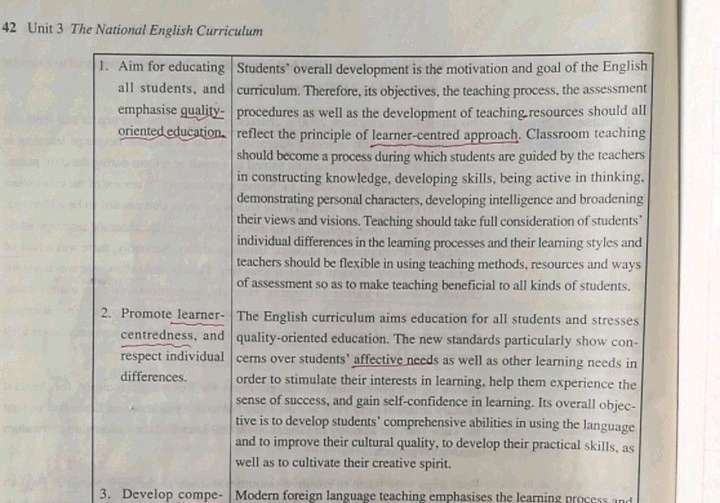
II. Designing principles for the National English Curriculum
1. Principles:
(1 (1)Aim for educating all students, and emphasizes quality-oriented education;
(2) Promote learner- centeredness, and respect individual differences;
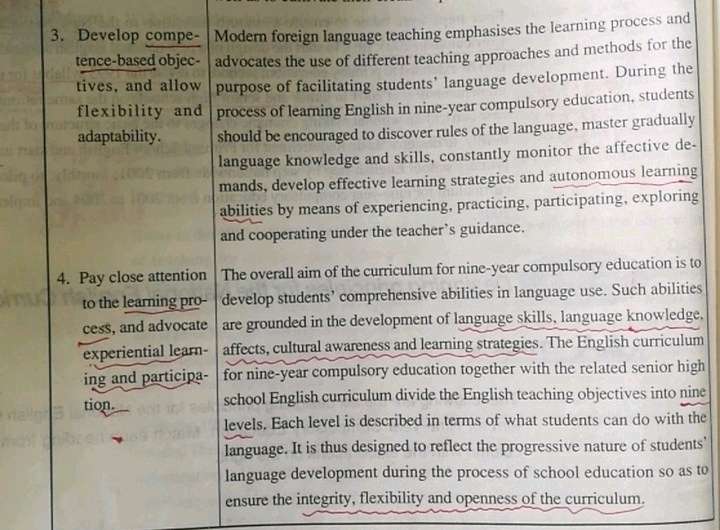
(3) Develop competence-based objectives and allow flexibilityand adaptability;
(4) Pay close attention to the learning process,and advocate experiential learning and participation;
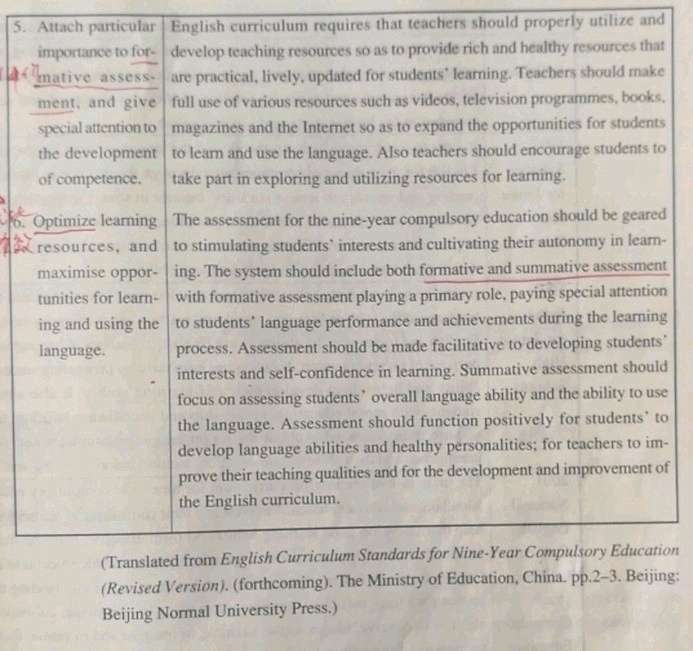
(5) Attach particular importance toformative assessment and give special attention to the dove elopement ofcompetence.
(6) Optimize learning resources, and maximizefor learning and using the language.