-
1 课程内容
-
2 课件
-
3 教案
-
4 练习
-
5 拓展
Step 1. Revision
Revision about the important points in Unit One at first. You can answer them by speaking out or typing down.
Step 2. New Text
授课章节 | Unit 2 Communicative Principles and Task-based Language Teaching | ||||
授课学时 | 2学时 | 讲授方法 | 讲授法 | 教学条件 | 多媒体 |
教学目标: 通过本课的学习,使学生了解什么是语言交际的能力,理解和掌握在英语教学中贯彻交际性原则的方法,并在任务型课堂教学活动中加以实施。 | |||||
教学重点、难点: 1.重点: (1)Communicative principles (2)Task-based Language Teaching 2. 难点: (1)Task-based Language Teaching (2)Differences between PPP and TBL | |||||
教学要点: 第一节 Communicative principles 1. What is communicative competence? 2. Principles and main features of communicative language teaching. 第二节 Task-based Language Teaching
1. Definitions of a task 2. Components of a task 3. Differences between PPP and TBL 4. How to design tasks in the classroom | |||||
思考题/作业: Task 2, Task 11 | |||||
教学小结: | |||||
Objectives: In this unit we are going to discuss one ofthe most important trends in second /foreign language teaching in the pastthree decades, that is, the practice of communicative language teaching(CLT)and task-based language teaching . We will focus on the following:
1.How is language learned in classrooms different from language used in real life?
2. What is communicative competence?
3. What are the implications of CLT to Teaching and learning?
4. What are the main features of communicative activities?
5. What is Task-based language teaching?
6. How is Task-based language teaching different from PPP?
7. Are there imitators of CLT and TBLT?
I. Language use in real life vs. traditional pedagogy
What is the ultimate goal of foreign language teaching?
The ultimate goal of foreign language teaching is to enable students to use the foreign language in work or life when necessary. Thus we should teach that part of the language that will be used (rather than all parts of the language) in the real world. However, this is not always the case in foreign language teaching. Very often there is a big gap between the language used in real life and the language learned in classroom.
Task 1 Work in groups and brainstorm any differences between language used in real life and language learned in the classroom under the traditional teaching pedagogy.
(1)In real life
a. language is used to perform certain communicativefunctions
b. use all skills: receptive skills (listening reading) productive skills (speaking and witty)
c. language is used in a certain context
(2)In the classroom (in traditional pedagogy)
a. The teaching focus is on forms (not furcating)
b.(tends to) focus on one or two language skills (Reading writing)
c. (tends to) isolate language from its context
How can we solve the problems between classroom language teaching and
language used in real life? The better way is the adoption of Communicative Language Teaching (CLT).
II. What is communicative competence?
The goal of CLT is to develop students’communicative competence which
includes both the knowledge about the language and the knowledge about how to use the language appropriately in communicative situations.
Task2、3、4 P16-17(knowledge and usage)
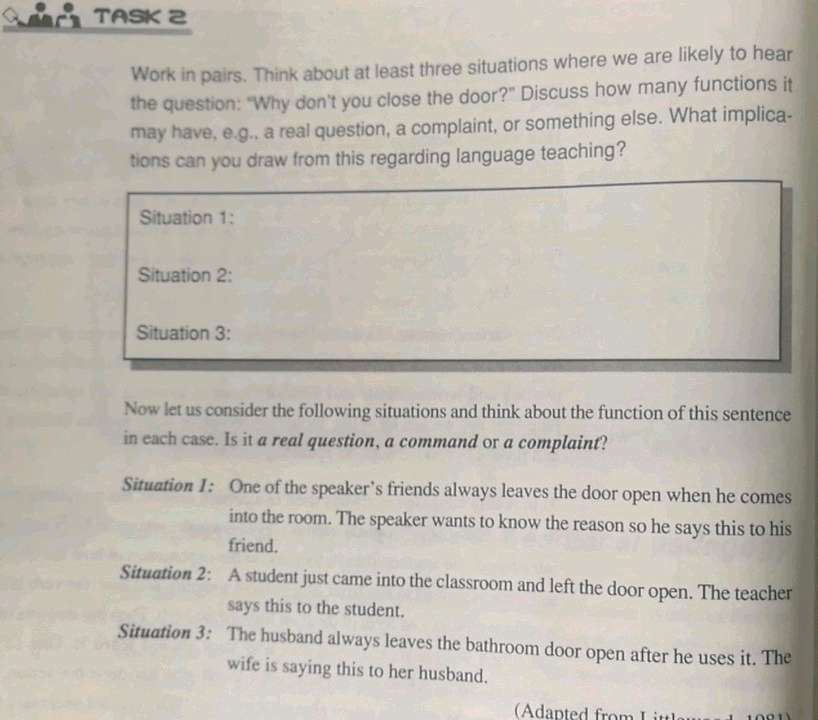
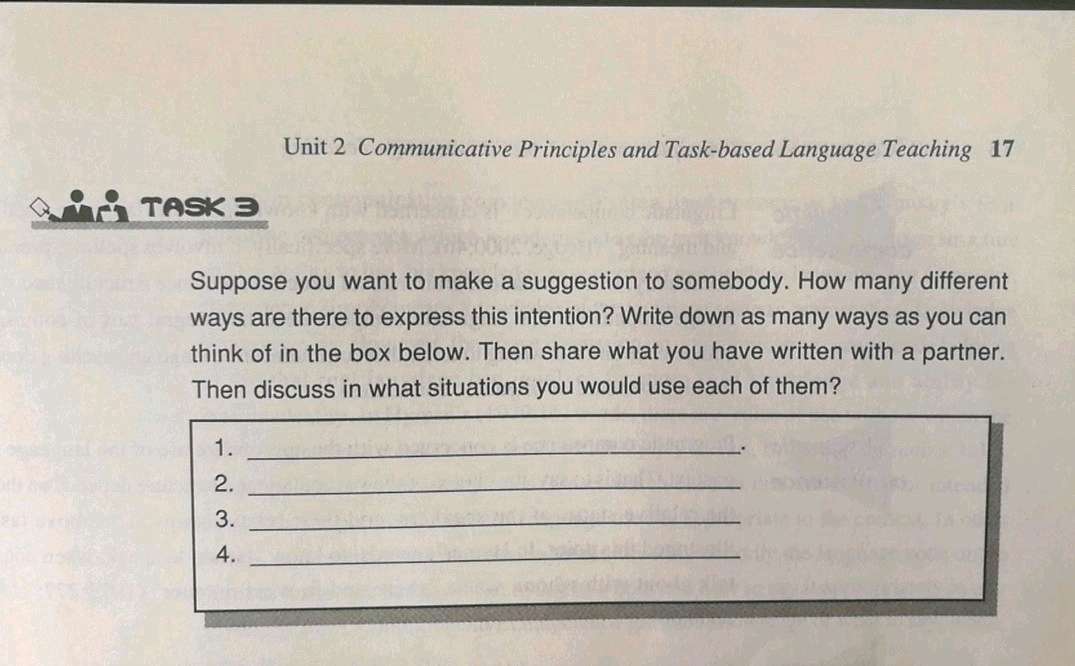
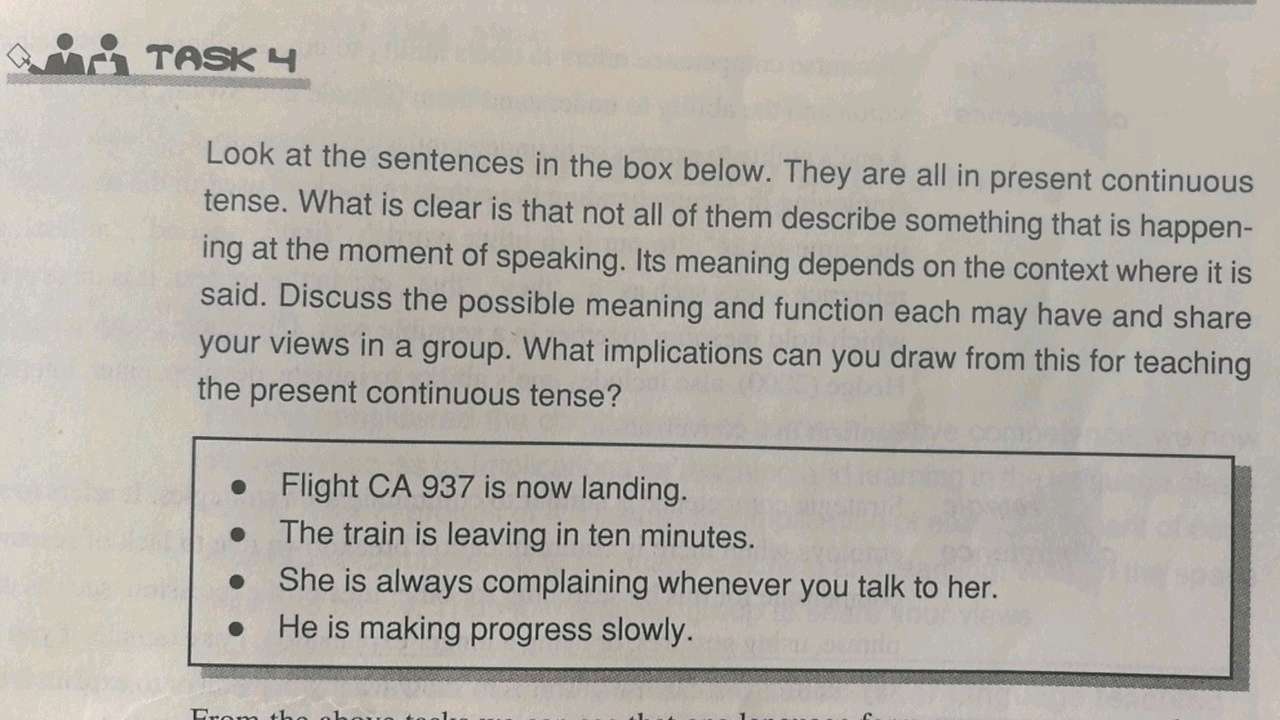
From the above tasks we can see that one language form may express a number of communicative functions and one communicative function can also be expressed by a variety of language forms. So when we are talking to other people, we need to choose the most appropriate form for that particular situation. This means that speakers not only have to know functional meaning of the language but also the social context where the message is given. P17
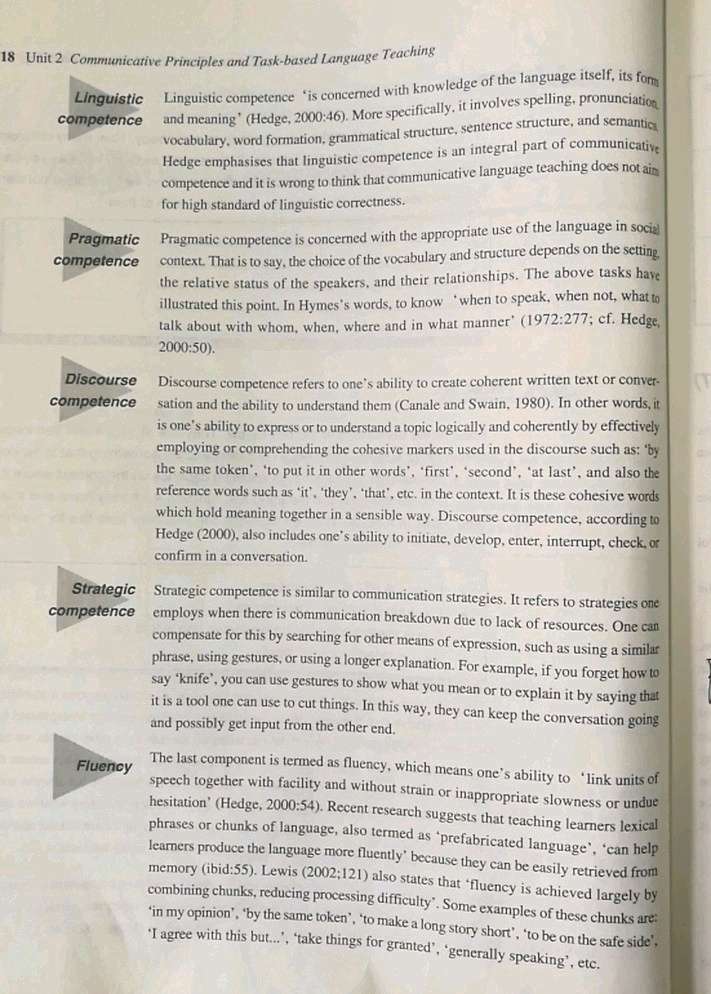
※ Five main components of communicative competence namely (based on Hedge)
(1)Linguistic competence (2) Pragmatic competence
(3)Discourse competence (4)Strategic competence
(5)Fluency
※ Conclusion:
The above discussion on communicative competence helps us to see that real language use involves far more than knowledge and ability for grammaticality. In Hymes’s words, there are ‘rules of use without which the rules of grammar would be useless’, which simply means, besides grammatical rules, language use is governed by rules of use, which ensures that the desired or intended functions are performed and the language used is appropriate to the context.
III.Implicationsfor teaching and learning Task. 5. P308
IV.Principlesof communicative language teaching (CLT)
(1)Communication principle: Activities that involve real communization promote learning
(2)Task principle: Activities in with languageis used for carrying out meaningful tasks promote learning.
(3)Meaningfulness principle: Language that is meaningful to the learner supports the learning process.
V. CLT and the teaching of language skills (We will learn it later in unit 9-12)
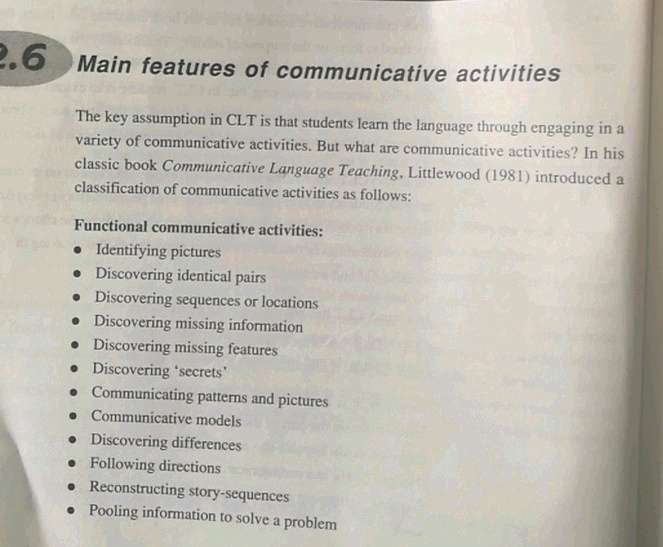
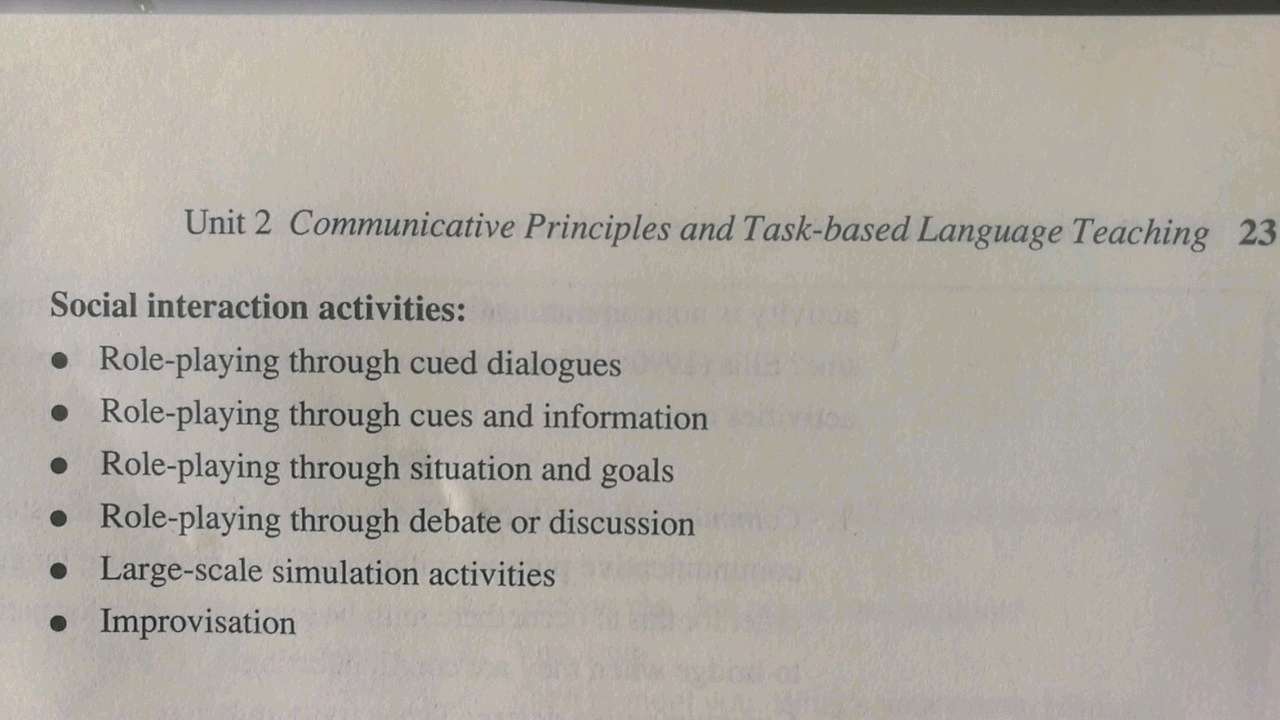
VI.Main features of communicative activate. P22
(Read by students themselves)The translation of communication competence in language teaching practice is to develop learners’ language skills namely listening, speaking, reading and writing.