
-
1 课程内容
-
2 视频
-
3 课件
-
4 教案
-
5 练习
-
6 拓展
Step 1. Introduction:
1. What is methodology?
(1) The SFLEP. COLINS’ English-Chinese Student’s Dictionary
A methodology is a system of methods and principles for doing something.
(2)The Longman Dictionary of AppliedLinguistics defines methodology
as …
① …the study of the practices and procedures used in teaching, and the principles and beliefs that underlie them .
② … a study of the nature of the language skills. e.g.
③ …the study of the preparation of plans, materials and textbooks for:
a. teaching language skills ;
b. the evaluation and comparison of language teaching methods.
e.g. practices, procedures, principles, and beliefs themselves.
2. Curriculum Components
Curriculum has three main subcomponents
(1)Syllabus design: It has to do with selecting, sequencing and justifying content.
Focus: content.
Defining Questions:
a. What contents should we teach?
b. In what order should we teach the contents?
c. What is the justification for selecting the content?
(2) Methodology: It has to do with selecting, sequencing, and justifying learning tasks and experiences.
Focus: classroom techniques and procedures
Defining Questions:
a.What exercises, tasks, and activities should we use in the classroom?
b. How should we sequence and integrate these?
(3) Evaluation: It has to do with how well students have mastered the objectives of the course and how effectively the course has met their needs.
Focus : learning outcomes
Defining Questions:
a. How well have our students done ?
b. How wellhas our program served our students’
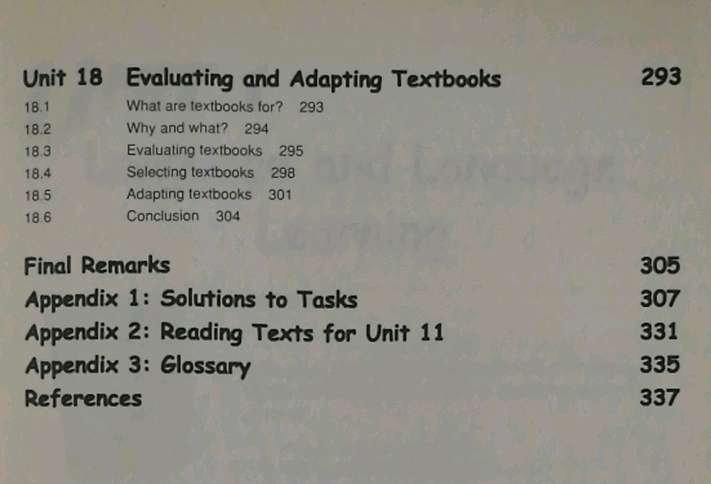
3. Contents of this textbook
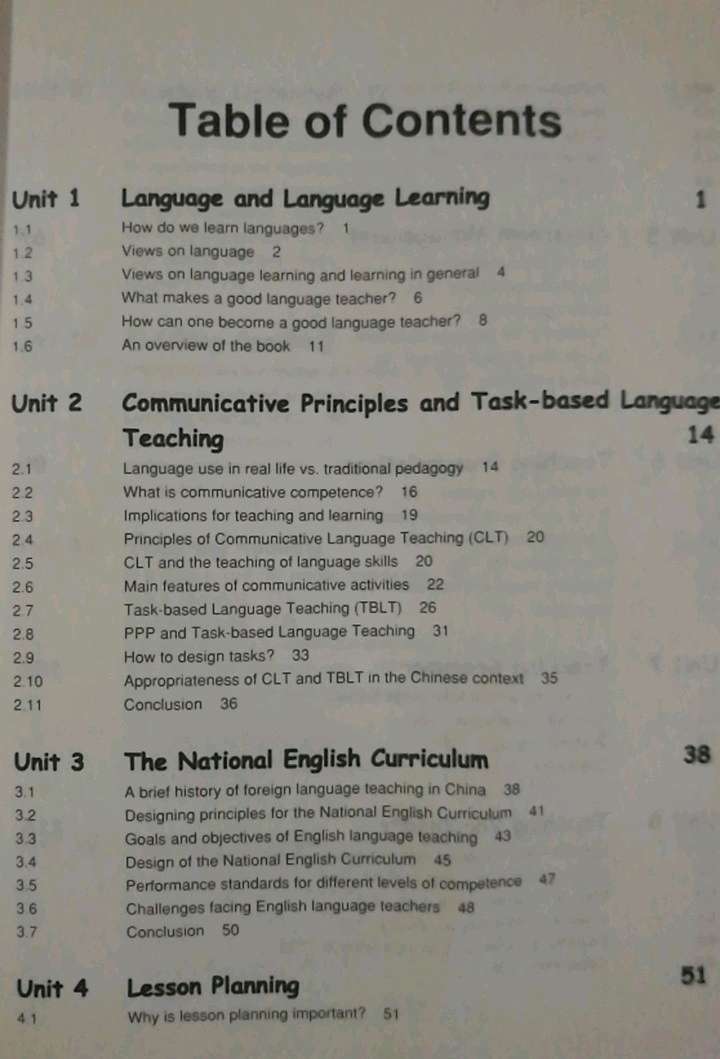
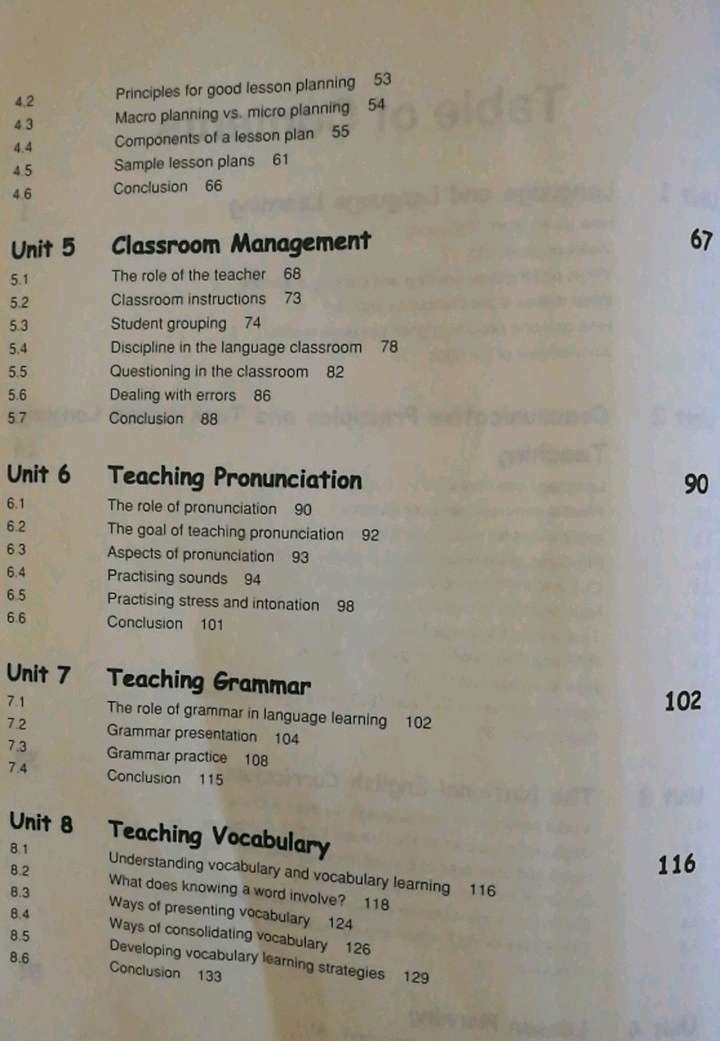
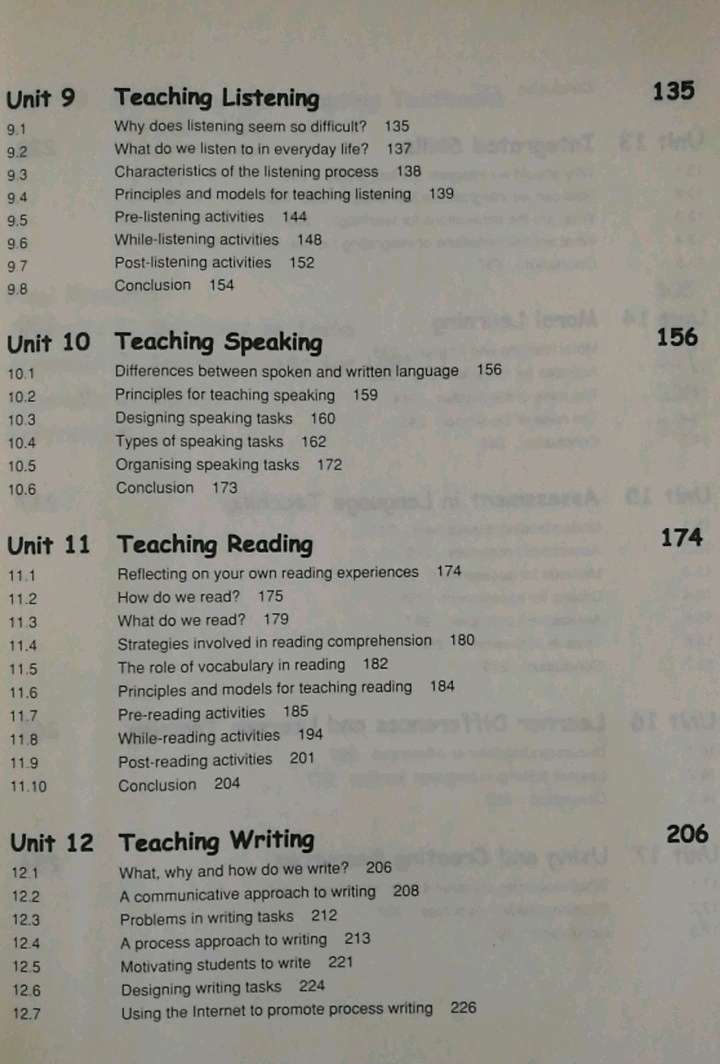
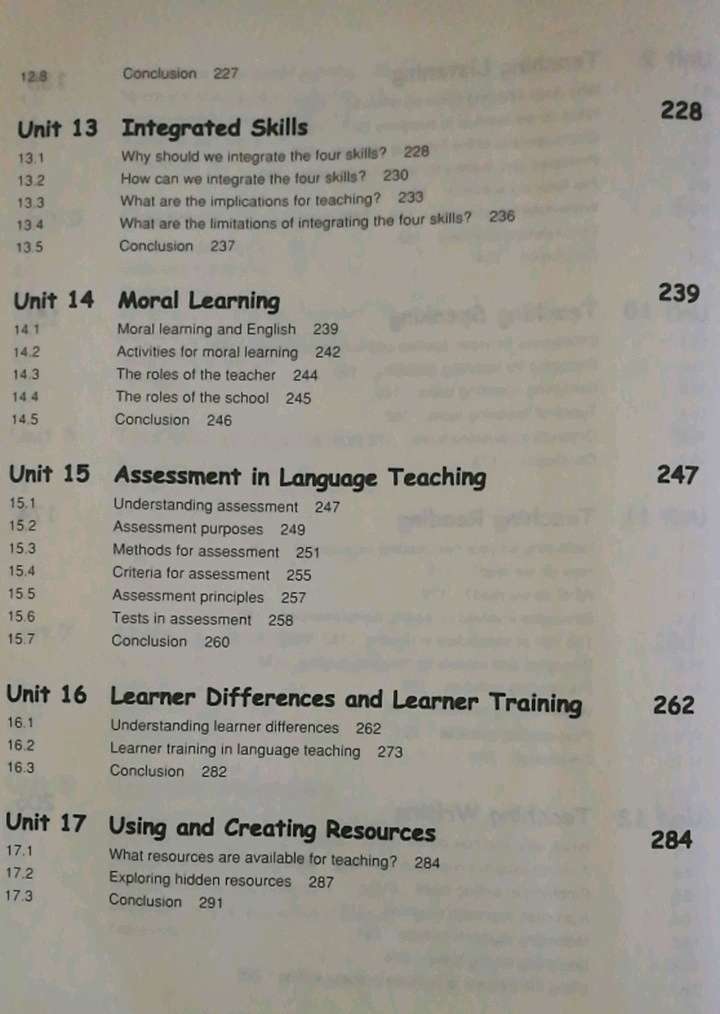
Step 2. New Text
授课章节 | Unit 1 Language and language learning | ||||
| 授课学时 | 2学时 | 讲授方法 | 讲授法 | 教学条件 | 多媒体 |
| 教学目标: 通过本课的学习,使学生初步了解人类学习语言的方法和途径,理解和掌握语言的性质、外语教与学的相关理论以及如何成为一名优秀的英语教师。 | |||||
| 教学重点、难点: 1.重点:Views on language 2. 难点: Views on language learning | |||||
| 教学要点: 第一节How do people learn language? 1.Views on language ( (1) Structural view ( (2) Functional view (3) Interactional view2. Views on language learning (1) Behaviorist theory (2) Cognitive theory (3) Constructive theory (4) Socio-constructivist theory
第二节Teacher’s professional development 1. What elements can contribute to the qualities of a good language teacher? 2. How can one become a good language teacher? | |||||
| 思考题/作业: | |||||
| 教学小结: | |||||
Unit 1 Language and Language Learning
In this unit we are going to discuss the following five questions:
1. How do we learn languages?
2. What are the common views on language?
3. What are the common views on language learning?
4. What are the qualities of a good language teacher?
5. How can we become a good language teacher?
I. How do we learn language?
Most of us learn languages at schools. The ways welearn languages in the classroom is influenced by our teachers’ personal experiences and methodologies. That islanguage learning is according to what teaching methodologies a teacher can providefor the learners. However, different people learn languages indifferent ways. Why? There are mainly eight reasons.
--- started learning languages at different ages;
--- have different experiences in learning languages;
--- learn language for different reasons;
---learn language in different ways;
--- have different understandings about languages;
--- have different capabilities in learning;
--- Learning can be affected by the way how language is taught;
-- Learning is affected by the degree of successone is expected to achieve.
As a would-be teacher (you) ‘the challenge the language teachers are confronted with is how teaching methodology can cater for the learners who have more differences than commonalities.
II. Views on language
Before we learn the views on language, first we should understand what language is.
What is language? The answer to this question is the basis for syllabus design, teaching methodology, teaching and assessment procedures in the classroom. Different views on language generate different teaching methodologies. So what is language? It is very difficult to give a concise definition, although linguists and philologists have been researching it for many years. There is no authoritative answer to ‘What is language?’ Why? Because it is decided by the properties of languag
has a system;
is vocal;
is arbitrary;
Language is ahuman activity;
is non-instinctive;
is a social activity;
is related to culture;
is changing.
Now we’ve understood why people have different viewson language. So in the past century language teaching and leaning practice hasincluded by three different views of language, namely, the structural view, thefunctional view and the international view.
(1)Structural view
The structure view of language seeslanguage as a linguistics system made up of various subsystems:
a. phonology: the sound system 音位学
b. morphology: the discrete units of mainly produced by sound combination
c. syntax: the system of combining unitsof meaning for communication句法、语句结构
※Learners learn a language means to learn these structural items, such as pronunciation, vocabulary and grammatical rules. The representative method is the audio-lingualapproach which involves endless “listen and repeat” drilling activities. The ideaof this method is that language is learned by constant repetition and reinforcementof the teacher. Mistakes were immediately corrected and correct utterances were immediately praised. This method we call it traditional one and is still usedin many parts of the world today.
(2) Functional view
The functional view not only sees languageas a linguistic system but also a means for doingthings. Learners learn a language in order to able to do things with it. It focuses on communicative functions. In order to perform the functions, learnersneed to know how to combine the grammatical rules and vocabulary to expressnotions that perform the functions:
※ Function:
A function is what you do with the language when you interact with people, such as giving directions, buy goods, ask aprice, claim ownership of smoothing, state how often you do something, say how long a film lasts, describe an object, etc. A function could be expressed by many different language forms.
Task 1. Imagination:
If you want the windows open, how would you ask the following people to do it?
a. your child b. your teacher c. your friend d. a stranger on a train
(1) John, open the window forMummy.
(2) Sir, do you think wecould have the window open please?
(3) Mary, could you open thewindow please?
(4) Excuse me, would you mindopening the window?
All these different expressions carry the samefunction” asking someone to open the window”, butin different forms.
(3) Interactional view
It considers language to be a communication tool whosemain use is to build up and maintain social relations between people.
Learners not only need to know the grammar andvocabulary of the language but as importantly they need to know the rules forusing them in a whole range of communicative contexts.
Conclusion: P. 4.
III. Views on language learning and learning in general.
A language learning theory underlying anapproach or method usually answers two questions:
(1)What are the psycholinguistic andcognitive processes involved in language learning?
(2) What are the conditions that need to bemet in order for these learning processes to be activated?
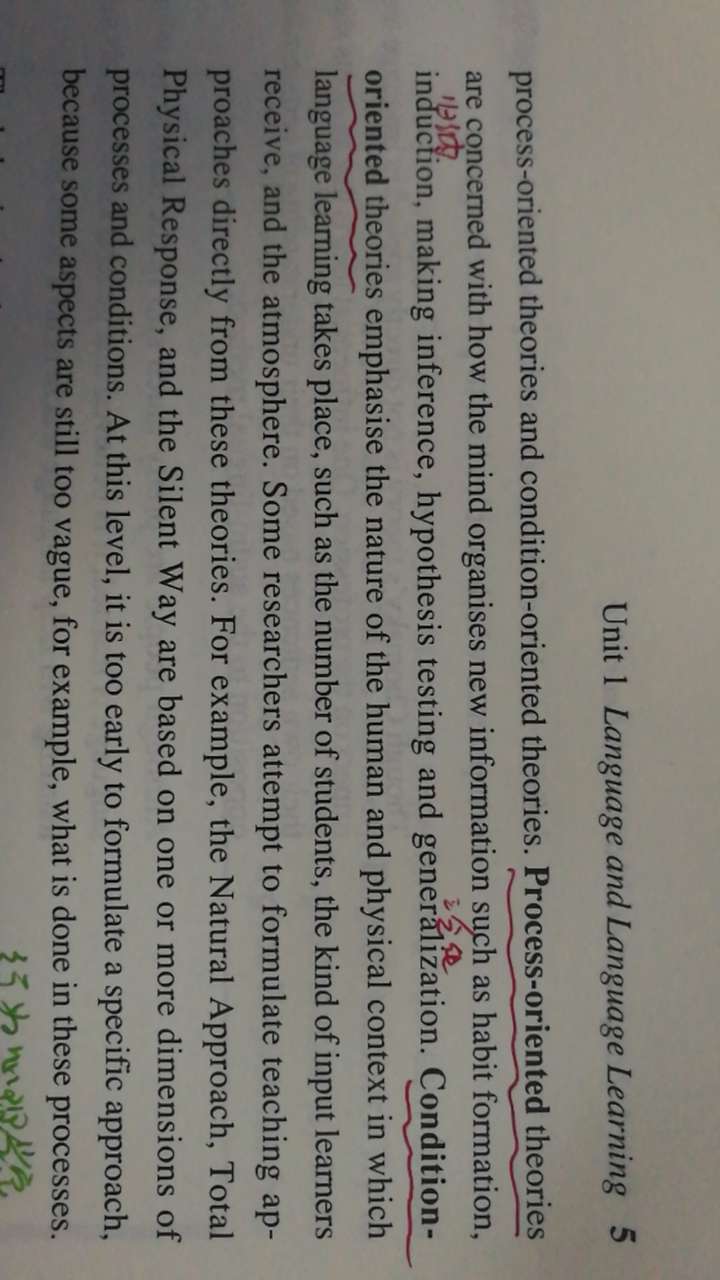
To answer these questions, a vast amount of researchhas been done from all aspects and produced many theories (that) mainly divided into two approaches:
Main theories:
①Process-oriented theories P.5
②Condition-oriented theories
1. Behaviorist theory (Skinner).
It's belonging to Condition-oriented theory. This theory based on a stimulus-response theory of psychology formulated by Watson and Radnor’s-theory of conditioner. The key point of the theory of condition is that “You can train an animal to do anything (within reason) if you follow a certain procedure which has three major stages.
Stimulus→ response → reinforcement
Based on the theory of conditioning, Skinner suggested that language is also a form of behavior, it can be learned the sameway as an animal is trained to respond to stimuli (audio-lingual method. It is on the view of structure).
Behaviorist theory (Skinner)—the Natural Approach and Physical Response
2. Cognitive theory (Norm Chomsky). It is belonging to Process-oriented theories. The term cognitive is often used todescribe methods in which students are asked to think rather than simply repeat. The key point of Chomsky’s theory is “if all language is a learned behavior, how can a child produce a sentence that has never been said by othersbefore”.
Cognitive theory (Norm Chomsky) →the Silent Way
To answer the second question, there are two new theories.
3. Constructivist theory (John Dewey)
Constructivist theory is a current theory. It believes that learning is a process in which the learner constructs meaning based on him/her own experiences and what he/she already knows. It also believed that education is used to develop the mind, not just to rote recall what is learned. John Dewey provided a foundation for constructivism. He believed that teaching should be based on what learners already knew and engage learner in learning activities. Teachers need to design environments and interact with learners to foster inventive, creative, critical learners.
4. Socio-constructivist (Vygotsky)
It emphasizes interacting and engagement with thetarget language in a social context based on the concept of “Zone of Proximal Development”(ZPD) and scaffolding. In other words, learning is best achieved throughthe dynamic interaction between teacher and the learner and between learners.

