
Unit 8 Protecting Our Environment
Text A A Fable of Tomorrow
Before Reading
Lead- in
I. Discussion

Do you PEEL OR NOT TO PEEL if give you an apple?
What can be contaminated by pesticide?
II. About the author
Rachel Carson
★Born: May 27, 1907
★Birthplace: Springdale, Pennsylvania
★Occupation: marine biologist, writer
★Nationality: American
★Writing Period: 1937–1964
★Subjects: marine biology, ecology, pesticides
★Notable work(s):Silent Spring
★Died: April 14, 1964 (aged 56)
Ⅲ. Background Information
ⅰ. Environmental Protection Organizations
1. The United Nations Environment Programme (UNEP) coordinates United Nations environmental activities, assisting developing countries in implementing environmentally sound policie sand practices. It was founded as a result of the United Nations Conference on the Human Environmentin June 1972 and has its headquarters in Nairobi, Kenya. UNEP also has six regional offices and various country offices.
2. Green Peace: a large international pressure group that aims to protect the environment. Its members are well known for protecting the environment. They often go out in small boats to stop people from killing whales or throwing poisonous material into the sea.
3. The Environmental Protection Agency: a US government organization that established rules and standards for protecting the environment, e.g. against pollution.
Global Reading
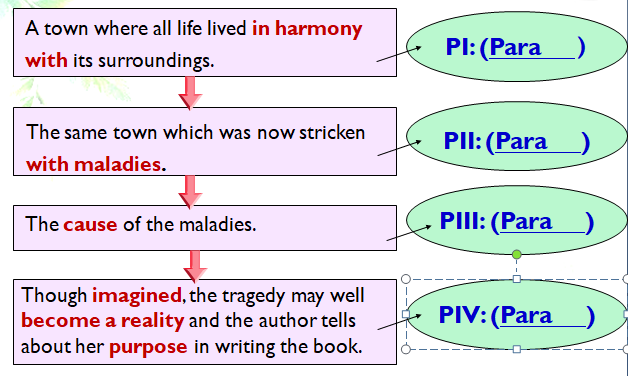
I. Text structure:
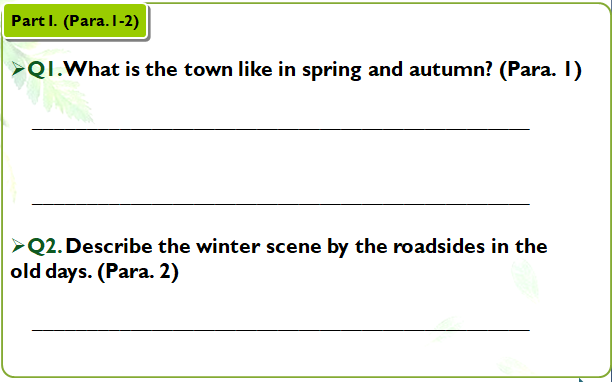
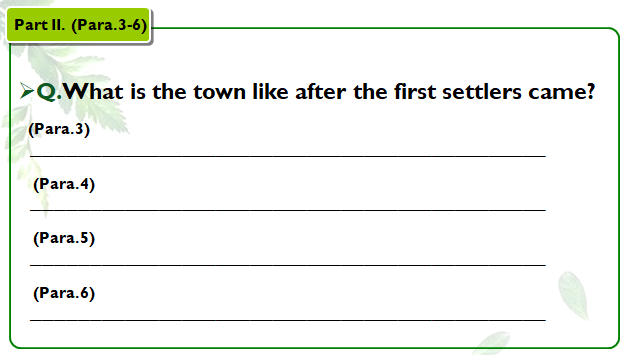
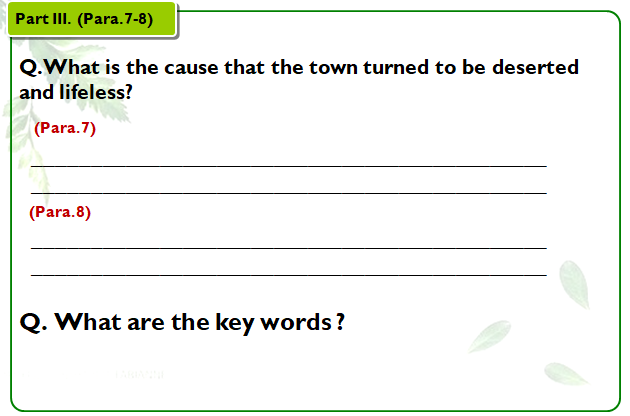
II. Further Exploring:
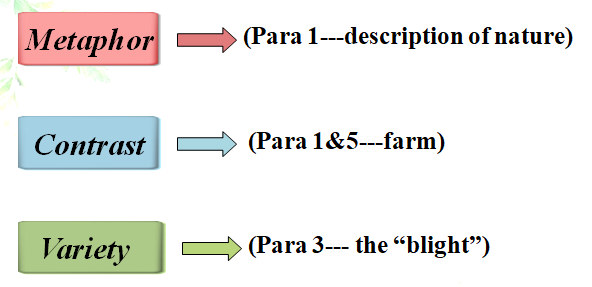
III. Writing strategies:
After Reading
Ⅰ. Text Analysis — fable
A fable is a shorttale used to teach a moral lesson. Fables are used to teach humans a lessonabout recognizing and overcoming their foibles (小缺点,小癖好). The maincharacter in the fable displays the foible being criticized. As the fableunfolds the foible brings downfall to the character. In this text human beingsbring destruction upon themselves by neglecting the environment. The morallesson often comes near the end of the fable, as is the case in the text.
Fables are usually brief. Remember Aesop’sFables you read as a child? This text contains only 680 words, shorter thanall other texts in Book II. They are not complicated, either. As a resultthey are easy to remember and to tell, grabbing audience attention right to theend of the story.
Fablesrelate to everyday problems people face, such as the education of the young andthe protection of the environment.
Readersmust pay attention to the title of a fable, which will cue who or what to payattention to. The title A Fable forTomorrow implies that the invented story will turn out to be true in thefuture if nothing is done today.
Ⅱ. Useful Expressions
1. 在…的腹地 in the heart of…
2. 与…和谐相处 live in harmony with
3. 富足的农场 prosperous farm
4. 默默地穿越 silently cross
5. 在…中 in the midst of
6. 令…人目不暇接 delight sb’s eye
7. 以…为食 feed on
8. 蜂拥而至 pour through
9. 悄悄蔓延 creep over
10. 死亡的阴影 a shadow of death
11. 对…迷惑不解 be puzzled by
12. 莫名其妙突然死去 sudden and unexplained deaths
13. 出奇地安静 a strange stillness
14. 许许多多 scores of
15. 开花 come into bloom
16. 几处斑痕 a few patches
17. 遭遇灾难的世界 the stricken world
18. 经历…的不幸 experience the misfortune
19. 多个 a substantial number of
20. 想像的悲剧 imagined tragedy
21. 严酷现实 stark reality
22. 使…鸦雀无声 silence the voices of
III. Writing Practice
How to write a persuasive essay
A. A brief introduction
The purpose of persuasive writing is tostate an opinion which you are going to defend and to offer supporting evidencein order to convince the reader to accept your point of view.
Threesteps you should take to produce a good persuasive essay.
Step1:
Write your thesis clearly at thebeginning of the essay. The thesis is your statement of purpose and it willserve to guide you in writing the entire paper. For the sake of unity, a shortessay needs only one thesis.
Step2:
Give facts, examples, statistics or theopinions of reliable authorities to support your thesis.
Step3:
By tying together what has beendiscussed, conclude your essay with a restatement of the thesis or a forcefulsentence that helps to drive your thesis home.
B. A sample
Pollution is harmful to human beings.Polluted water causes many kinds of diseases such as diarrhea, enteritis, etc.And sometimes these diseases even take man’s life. Dirty air or air-bonegarbage causes stinging eyes and running nose.
Nowadayspollution problems have not been completely solved. Pesticides are widely usedalmost everywhere. They pollute soil, water and food. They have the power tomake our streams fishless and our gardens and woodlands silent and birdless.Some factories are still dirty. Quite a few chimneys are still pouring smokeinto air and noise pollution remains serious.
Measuresshould be taken to control pollution. Legislative steps should be introducedand pollutants should be trapped before they are poured out of chimney.
C. Homework
Directions: For this part, you are allowed thirty minutes to write a composition on thetopic Environmental Protection. You must base your composition on thefollowing instructions (given in Chinese). Your composition should be no lessthan 120 words. Remember to write it clearly.
1. 目前环保中还存在许多问题
2. 为了保护环境,政府做了大量的工作
3. 应采取有效措施保护环境

