Unit 6 Women, Hlaf the Sky
Text A A Woman Can Learn Anything a Man Can
Before Reading
Lead-in Activities
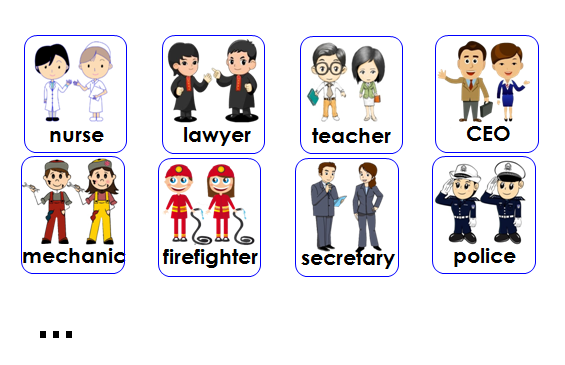
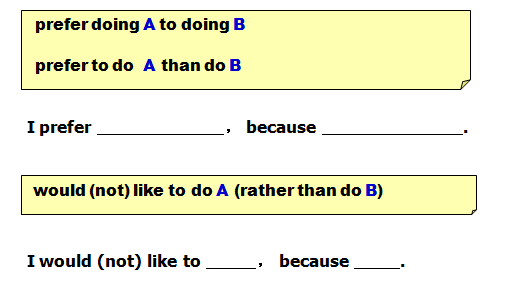
I. Choose one job that you are likely or prefer to do and one that you are unlikely to do, and give your reasons. The following patterns may help you to organize ideas.
II. Watch the Ted speech and answer the following questions.
1) In your opinion, why do the two assistants refused to sit at the table?
2) What are the different attributions of men and women when getting succeed?
3) What can we learn from the study of changing the name of the case from
Heidi to Howard?
Background Konwledge
I. Feminism and Women’s Liberation
ⅰ. A brief introduction to Feminism
1: The term feminism can be used to describe a political, cultural or economic movement aimed at establishing equal rights and legal protection for women.
2: It is also a movement that advocates gender equality for women and campaigns for women's rights and interests
3: The first feminist wave was in the nineteenth and early twentieth centuries, which refers mainly to women's suffrage movements of the nineteenth and early twentieth centuries (mainly concerned with women's right to vote).
4: The second was in the 1960s and 1970s, which refers to the ideas and actions associated with the women's liberation movement beginning in the 1960s (which campaigned for legal and social rights for women).
5: The third extends from the 1990s to the present.
ii. International Women’s Day
International Women's Day is marked on the 8th of March every year. It is a major day of global celebration of women. In different regions the focus of the celebrations ranges from general celebration of respect, appreciation and love towards women to a celebration for women's economic, political and social achievements.
II.Wiffle-ball
Wiffle-ball is a variation of the sport of baseball designed for indoor or outdoor play in confined areas. The game is played using a perforated, light-weight, rubbery plastic ball and a long, plastic bat. The Wiffle ball was invented by David N. Mullany of Fairfield, Connecticut in 1953 when he designed a ball that curved easily for his 12-year old son.
Global Reading
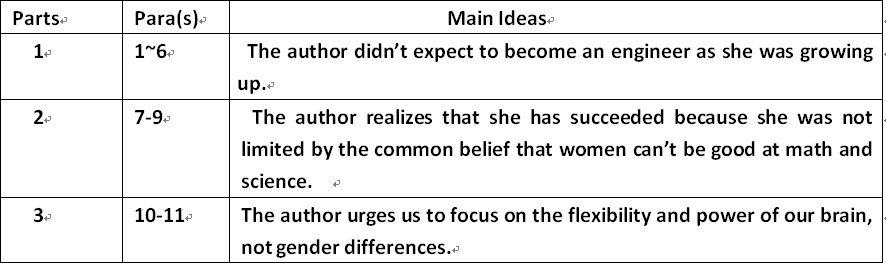
Part Division of the Text
Further understanding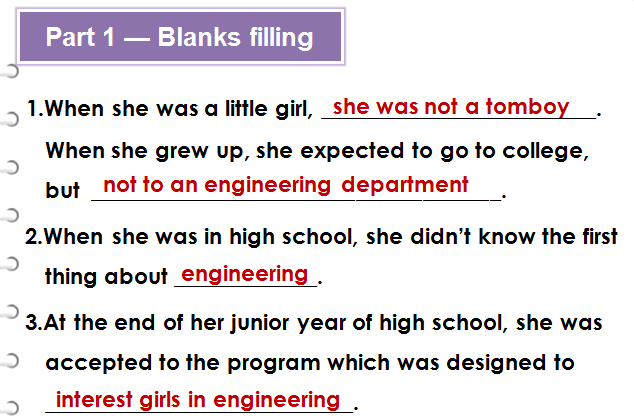
For Part 2: Scanning & dicsussion
1. Scan para.7-9 to find out thefocused thesis and facts/examplesthat used to explain the thesis.
2. Discuss: how these facts or examples helpto explain the thesis.
For Part 3: Blank Filling
In this part, there are several comparisons or contrasts. Fill in the blanks with necessary information to make logic sentences showing comparison or contrast.
1. Little girls loving dolls is just the same to _________________. (little boys loving videogames.)
2. Some people favor the right side of the brain, while others _____________. (the left side)
3. We should ignore ______________________. (hard and fast conclusions about the human brain) Instead, incredible flexibility should be focused on.
4. In spite of agreeing that women can’t learn physics well, _____________________ should be considered. (the possibility that our brains are more powerful than imagined.)
After Reading
1. Useful Expressions:
1. 把…改成 convert… into…
2. 对…一无所知 don’t know the first thing about…
3. 把…区分开来 distinguish… from…
4. 渴望独立 be craving independence
5. 不禁不寒而栗 can’t help shuddering
6. 处于劣势 at a disadvantage
7. 在…方面 when it comes to…
8. 偶然闯进 stumble into
9. 轻而易举地把它学好 it comes easily to somebody
10. 咬紧牙学好它 grit your teeth to get good at it
11. 极有可能 there’s a strong chance that
12. 把成绩提高到A pull the grade up to an A
13. 恐惧的时候 moments of panic
14. 基于 be based on
15. 文化熏陶 cultural cues
16. 人不是孤岛。 No man is an island
17. 毫无疑问, 不可否认 There’s no denying that…
18. 与…相关联 be relevant to
19. 不容改变的结论 hard and fast conclusions
20. 生来就懂 be born knowing
21. 有敢冒风险而为的精神 take a leap of faith
22. 有所选择地听别人的话 have a selective hearing
2. Writing practice
ⅰ. A Brief Introduction
A questionnaire is a series of questions asked to individuals to obtain statistically useful information about a given topic. When properly constructed and responsibly administered, questionnaires become a vital instrument by which statements can be made about specific groups or people or entire populations.
There are no hard-and-fast rules about how to design a questionnaire, but there are a number of points that can be borne in mind:
1. A well-designed questionnaire should meet the research objectives.
2. It should obtain the most complete and accurate information possible.
3. A well-designed questionnaire should make it easy for respondents to give the necessary information and for the interviewer to record the answer.
4. It would keep the interview brief and to the point and be so arranged that the respondent(s) remain interested throughout the interview.
ⅱ. Several Steps to Follow
There are several steps involved in the development of a questionnaire:
1. Decide the information required.
2. Define the target respondents.
3. Choose the method(s) of reaching your target respondents.
4. Decide on question content.
5. Put questions into a meaningful order and format.
6. Develop the final survey form.
ⅲ. Sample
Please answer the following questions related to your experience with a self-access language learning program. Circle the number that can best describe your opinion:
1. This statement is completely not suitable for me.
2. This statement is always not suitable for me.
3. This statement is somewhat not suitable for me.
4. This statement is somewhat suitable for me.
5. This statement is generally suitable for me.
6. This statement is completely suitable for me.
After participation in this program, I find:
1. This program helps me improve my listening ability a lot. (
2. After this program, listening is much easier for me. (
3. I can see my improvement in listening ability clearly. (
4. I can do better at catching and following what teachers say in class. (
5. I can do better at catching what my classmates say in class. (
6. I can do better at listening to some English broadcasting programs. (
ⅳ. Homework
Design a questionnaire about the social status of women in your part of the country.

