
Marketing channel management calls for selecting, managing, and motivating individual channel members and evaluating their performance over time.
Selecting Channel Members
When selecting intermediaries, the company should determine what characteristics distinguish the better ones.
Managing and Motivating Channel Members
The company must sell not only through the intermediaries but to and with them.
Most companies practice strong partner relationship management (PRM) to forge long-term partnerships with channel members.
Evaluating Channel Members
The company should recognize and reward intermediaries who are performing well and adding good value for consumers.
Those who are performing poorly should be assisted or replaced.
Companies need to be sensitive to their channel partners.
PUBLIC POLICY AND DISTRIBUTION DECISIONS
Exclusive distribution occurs when the seller allows only certain outlets to carry its products.
Exclusive dealing occurs when the seller requires that these dealers not handle competitors’ products.
Exclusive arrangements exclude other producers from selling to these dealers. This brings exclusive dealing contracts under the scope of the Clayton Act of 1914.
Exclusive territorial agreements occur when the producer agrees not to sell to other dealers in a given area, or the buyer may agree to sell only in its own territory.
Full-line pricing occurs when producers of a strong brand sell it to dealers only if the dealers will take some or all of the rest of the line. This is also known as a tying agreement.
In general, sellers can drop dealers “for cause.”
MARKETING LOGISTICS AND SUPPLY CHAIN MANAGEMENT
Nature and Importance of Marketing Logistics
Marketing logistics—also called physical distribution—involves planning, implementing, and controlling the physical flow of goods, services, and related information from points of origin to points of consumption to meet customer requirements at a profit.
Marketing logistics involves outbound distribution (moving products from the factory to resellers and ultimately to customers), inbound distribution (moving products and materials from suppliers to the factory) and reverse distribution (moving broken, unwanted, or excess products returned by consumers or resellers).
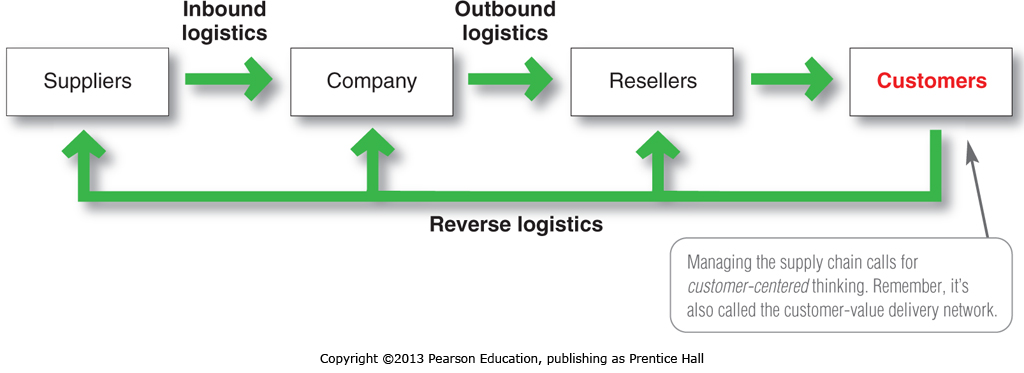
It involves the entirety of supply chain management—managing upstream and downstream value-added flows of materials, final goods, and related information among suppliers, the company, resellers, and final consumers (Figure 10.5).
Companies today are placing greater emphasis on logistics for several reasons.
1. Companies can gain a powerful competitive advantage by using improved logistics to give customers better service or lower prices.
2. Improved logistics can yield tremendous cost savings to both the company and its customers.
3. The explosion in product variety has created a need for improved logistics management.
4. Improvements in information technology have created opportunities for major gains in distribution efficiency.
5. Logistics affects the environment and a firm’s environmental sustainability efforts (the development of a green supply chain).
Goals of the Logistics System
The goal of marketing logistics should be to provide a targeted level of customer service at the least cost.
Major Logistics Functions
Warehousing
A company must decide how many and what types of warehouses it needs and where they will be located.
Storage warehouses store goods for moderate to long periods.
Distribution centers are designed to move goods rather than just store them.
Inventory Management
Just-in-time logistics systems: Producers and retailers carry only small inventories of parts or merchandise, often only enough for a few days of operations.
Transportation
Trucks have increased their share of transportation steadily and now account for 40% of total cargo ton-miles.
80% of American communities depend solely on trucks for their goods and commodities.
Trucks are highly flexible in their routing and time schedules, and they can usually offer faster service than railroads.
They are efficient for short hauls of high-value merchandise.
Railroads account for 40% of total cargo ton-miles moved.
They are one of the most cost-effective modes for shipping large amounts of bulk products—coal, sand, minerals, and farm and forest products—over long distances.
Water carriers account for less than 5% of cargo ton-miles and transport large amounts of goods by ships and barges on U.S. coastal and inland waterways.
Although the cost of water transportation is very low for shipping bulky, low-value, nonperishable products, it is the slowest mode and may be affected by the weather.
Pipelines account for less than 1% of cargo ton-miles and are a specialized means of shipping petroleum, natural gas, and chemicals from sources to markets.
Air carriers transport less than 1 percent of the nation’s goods. Airfreight rates are much higher than rail or truck rates.
The Internet carries digital products from producer to customer via satellite, cable, or phone wire.
Multimodal transportation: Combining two or more modes of transportation.
· Piggyback: Rail and trucks;
· Fishyback: Water and trucks;
· Trainship: Water and rail;
· Airtruck: Air and trucks.
Logistics Information Management
Electronic data interchange (EDI) is the computerized exchange of data between organizations.
Vendor-managed inventory (VMI) systems or continuous inventory replenishment systems, is the customer sharing real-time data on sales and current inventory levels with the supplier. The supplier then takes full responsibility for managing inventories and deliveries.
Integrated Logistics Management
Integrated logistics management is a concept which recognizes that providing better customer service and trimming distribution costs require teamwork, both inside the company and among all the marketing channel organizations.
Cross-Functional Teamwork inside the Company
The goal of integrated supply chain management is to harmonize all of the company’s logistics decisions.
Close working relationships among departments can be achieved in several ways.
· Permanent logistics committees, made up of managers responsible for different physical distribution activities
· Supply chain manager positions that link the logistics activities of functional areas
· System-wide supply chain management software
Building Logistics Partnerships
Cross-functional, cross-company teams: For example, Nestlé’s Purina pet food unit has a team of dozens of people working in Bentonville, AR, the home of Wal-Mart. They work jointly with their counterparts at Wal-Mart to find ways to squeeze costs out of their distribution system.
Shared projects: For example, Home Depot allows key suppliers to use its stores as a testing ground for new merchandising programs.
Third-Party Logistics
Third-party logistics (3PL) providers help clients tighten up overstuffed supply chains, slash inventories, and get products to customers more quickly and reliably. (Also called outsourced logistics or contract logistics.)
Companies use third-party logistics providers for several reasons.
1. These providers can often do it more efficiently and at lower cost.
2. Outsourcing logistics frees a company to focus more intensely on its core business.
3. Integrated logistics companies understand increasingly complex logistics environments.

