
The supply chain consists of “upstream” and “downstream” partners.
Upstream from the company is the set of firms that supply the raw materials, components, parts, information, finances, and expertise needed to create a product or service.
Marketers have traditionally focused on the “downstream” side of the supply chain—on the marketing channels (or distribution channels) that look forward toward the customer.
A better term would be demand chain because it suggests a sense-and-respond view of the market.
Under this view, planning starts with the needs of target customers, to which the company responds by organizing a chain of resources and activities with the goal of creating customer value.
As defined in Chapter 2, a value delivery network is made up of the company, suppliers, distributors, and ultimately customers who “partner” with each other to improve the performance of the entire system.
THE NATURE AND IMPORTANCE OF MARKETING CHANNELS
Producers try to forge a marketing channel (or distribution channel)—a set of interdependent organizations that help make a product or service available for use or consumption by the consumer or business user.

How Channel Members Add Value
Figure 10.1 shows how using intermediaries can provide economies.
The role of marketing intermediaries is to transform the assortments of products made by producers into the assortments wanted by consumers.
Members of the marketing channel perform many key functions. Some help to complete transactions:
· Information: Gathering and distributing marketing research and intelligence information about actors and forces in the marketing environment needed for planning and aiding exchange.
· Promotion: Developing and spreading persuasive communications about an offer.
· Contact: Finding and communicating with prospective buyers.
· Matching: Shaping and fitting the offer to the buyer’s needs, including activities such as manufacturing, grading, assembling, and packaging.
· Negotiation: Reaching an agreement on price and other terms of the offer so that ownership or possession can be transferred.
Others help to fulfill the completed transactions:
· Physical distribution: Transporting and storing goods.
· Financing: Acquiring and using funds to cover the costs of the channel work.
· Risk taking: Assuming the risks of carrying out the channel work.
Number of Channel Levels
A channel level is each layer of marketing intermediaries that performs some work in bringing the product and its ownership closer to the final buyer.
The number of intermediary levels indicates the length of a channel. (Figure 10.2)

A direct marketing channel has no intermediary levels; the company sells directly to consumers.
An indirect marketing channel contains one or more intermediaries.
From the producer’s point of view, a greater number of levels means less control and greater channel complexity.
CHANNEL BEHAVIOR AND ORGANIZATION
Channel Behavior
A marketing channel consists of firms that have partnered for their common good. Each channel member depends on the others.
Each channel member plays a specialized role in the channel. The channel will be most effective when each member assumes the tasks it can do best.
Disagreements over goals, roles, and rewards generate channel conflict.
Horizontal conflict occurs among firms at the same level of the channel.
Vertical conflict occurs between different levels of the same channel.
Vertical Marketing Systems
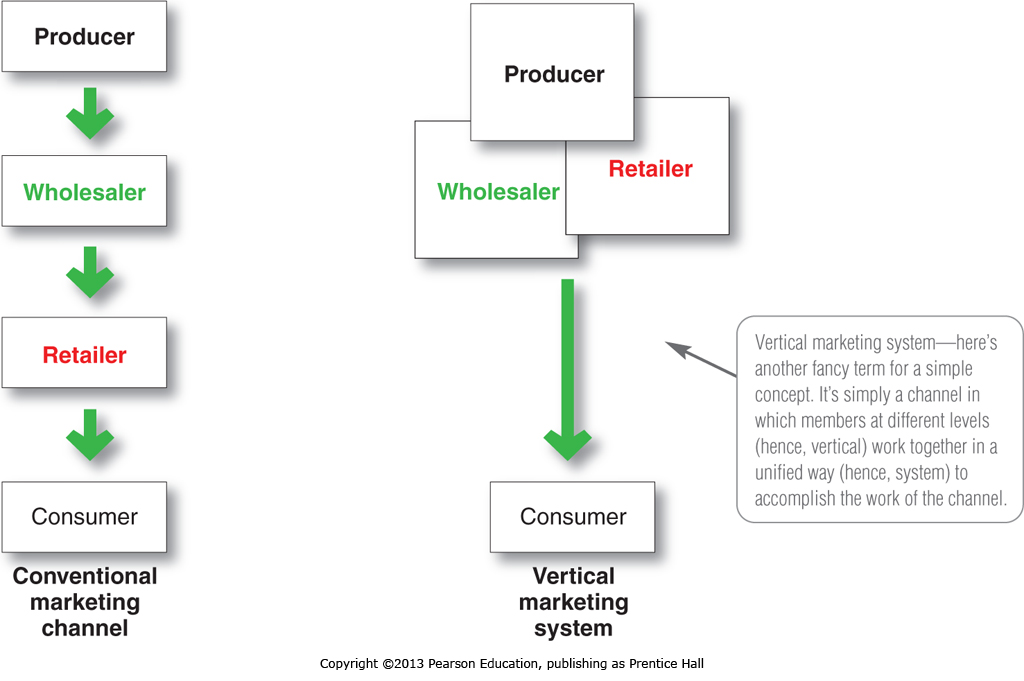
A conventional distribution channel consists of one or more independent producers, wholesalers, and retailers. Each is a separate business seeking to maximize its own profits, perhaps even at the expense of the system as a whole.
A vertical marketing system (VMS) consists of producers, wholesalers, and retailers acting as a unified system. One channel member owns the others, has contracts with them, or wields so much power that they must all cooperate. (Figure 10.3)
A Corporate VMS integrates successive stages of production and distribution under single ownership.
A Contractual VMS consists of independent firms at different levels of production and distribution, who join together through contracts to obtain more economies or sales impact than each could achieve alone.
The franchise organization is the most common type of contractual relationship—a channel member called a franchisor links several stages in the production-distribution process.
There are three types of franchises.
1. The manufacturer-sponsored retailer franchise system—for example, Ford and its network of independent franchised dealers.
2. The manufacturer-sponsored wholesaler franchise system—Coca-Cola licenses bottlers (wholesalers) in various markets who buy Coca-Cola syrup concentrate and then bottle and sell the finished product to retailers in local markets.
3. The service-firm-sponsored retailer franchise system—examples are found in the auto-rental business (Avis), the fast-food service business (Burger King), and the motel business (Holiday Inn).
In an Administered VMS, leadership is assumed not through common ownership or contractual ties but through the size and power of one or a few dominant channel members.
Horizontal Marketing Systems: Two or more companies at one level join together to follow a new marketing opportunity.
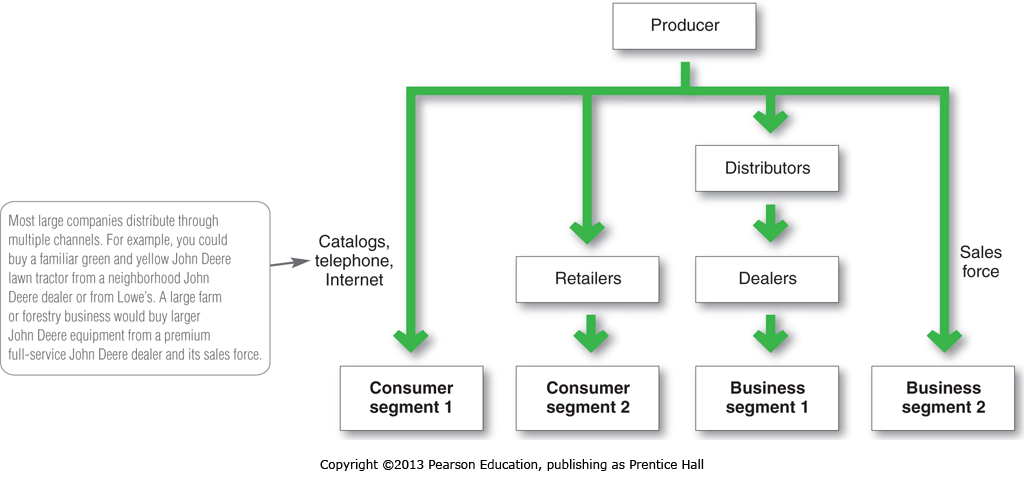
Multichannel Distribution Systems: Occurs when a single firm sets up two or more marketing channels to reach one or more customer segments. (Figure 10.4)
Changing Channel Organization
Disintermediation occurs when product or service producers cut out intermediaries and go directly to final buyers, or when radically new types of channel intermediaries displace traditional ones.

