
Companies today face a fierce and fast-changing pricing environment.
Yet, cutting prices is often not the best answer.
WHAT IS A PRICE?
In the narrowest sense, price is the amount of money charged for a product or service.
More broadly, price is the sum of all the values that customers give up in order to gain the benefits of having or using a product or service.
Price is the only element in the marketing mix that produces revenue.
Price is one of the most flexible marketing mix elements.
MAJOR PRICING STRATEGIES
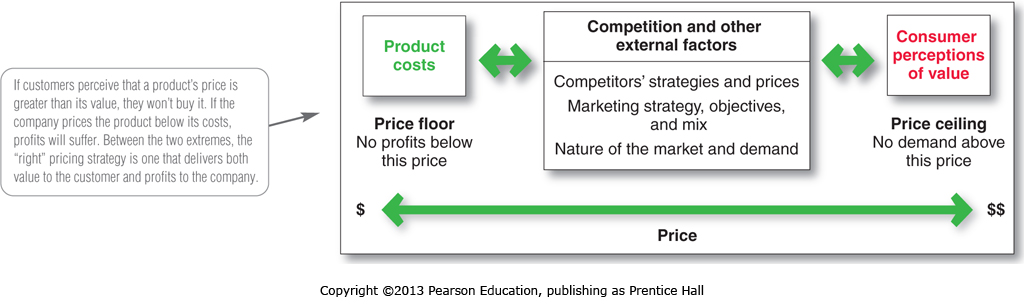
Figure 9.1 summarizes the major considerations in setting price.
Customer Value-Based Pricing
In the end, the customer will decide whether a product’s price is right.
Figure 9.1 suggests three pricing strategies: customer value-based pricing, cost-based pricing, and competition-based pricing.
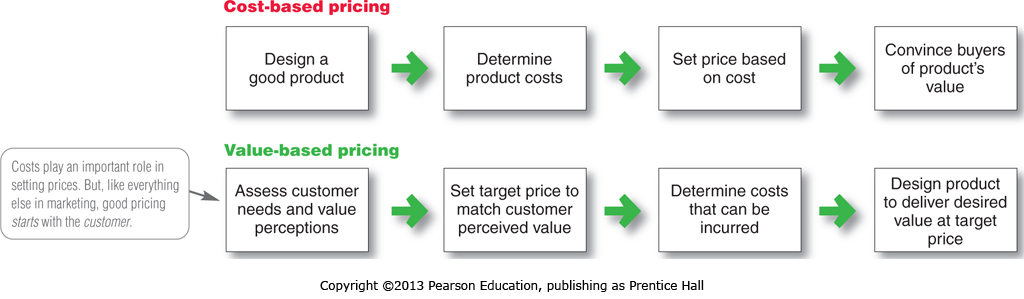
Customer value-based pricing uses buyers’ perceptions of value, not the seller’s cost, as the key to pricing.
Price is considered along with the other marketing mix variables before the marketing program is set.
Figure 9.2 compares value-based pricing with cost-based pricing.
Cost-based pricing is product driven.
“Good value” is not the same as “low price.”
Two types of value-based pricing are good-value pricing and value-added pricing.
1. Good-value pricing involves offering just the right combination of quality and good service at a fair price.
Everyday low pricing (EDLP). EDLP involves charging a constant, everyday low price with few or no temporary price discounts.
High-low pricing involves charging higher prices on an everyday basis but running frequent promotions to lower prices temporarily on selected items.
2. Value-added pricing is the strategy of attaching value-added features and services to differentiate their offers and thus support higher prices.
Cost-Based Pricing
Whereas customer-value perceptions set the price ceilings, costs set the floor for the price that the company can charge.
Cost-based pricing involves setting prices based on the costs for producing, distributing, and selling the product plus a fair rate of return for effort and risk.
Types of Costs
Fixed costs (also known as overhead) are costs that do not vary with production or sales level.
Variable costs vary directly with the level of production. They are called variable because their total varies with the number of units produced.
Total costs are the sum of the fixed and variable costs for any given level of production.
Cost-Plus Pricing
The simplest pricing method is cost-plus pricing (markup pricing) – adding a standard markup to the cost of the product.
Does using standard markups to set prices make sense? Generally, no.
Markup pricing remains popular for many reasons.
1. Sellers are more certain about costs than about demand.
2. When all firms in the industry use this pricing method, prices tend to be similar and price competition is thus minimized.
Another cost-oriented pricing approach is break-even pricing, or a variation called target profit pricing. The firm tries to determine the price at which it will break even or make the target profit it is seeking.
Target return pricing uses the concept of a break-even chart, which shows total cost and total revenue expected at different sales volume levels.
The major problem with this analysis is that it fails to consider customer value and the relationship between price and demand.
Typically, as the price increases, demand decreases.

Competition-Based Pricing
Competition-based pricing involves setting prices based on competitors’ strategies, costs, prices, and market offerings.
What principle should guide decisions about what price to charge relative to those of competitors? The answer is simple in concept but difficult in practice.
Be certain to give customers superior value for the price.
Other Internal and External Considerations Affecting Price Decisions
Overall Marketing Strategy, Objectives, and Mix
Price is only one of the marketing mix tools that a company uses to achieve its marketing objectives.
Price decisions must be coordinated with product design, distribution, and promotion decisions to form a consistent and effective integrated marketing program.
Companies often position their products on price and then tailor other marketing mix decisions to the prices they want to charge.
Target costing starts with an ideal selling price based on customer-value considerations, and then targets costs that will ensure that the price is met.
Companies may deemphasize price and use other marketing mix tools to create nonprice positions.
Organizational Considerations
In small companies, prices are often set by top management rather than by the marketing or sales departments.
In large companies, pricing is typically handled by divisional or product line managers.
In industrial markets, salespeople may be allowed to negotiate with customers within certain price ranges.
In industries in which pricing is a key factor, companies often have pricing departments to set the best prices or to help others in setting them.
The Market and Demand
Pricing in Different Types of Markets
Pure competition: The market consists of many buyers and sellers trading in a uniform commodity. No single buyer or seller has much effect on the going market price.
In a purely competitive market, marketing research, product development, pricing, advertising, and sales promotion play little or no role. Thus, sellers in these markets do not spend much time on marketing strategy.
Monopolistic competition: The market consists of many buyers and sellers who trade over a range of prices rather than a single market price. A range of prices occurs because sellers can differentiate their offers to buyers.
Oligopolistic competition: The market consists of a few sellers who are highly sensitive to each other’s pricing and marketing strategies.
There are few sellers because it is difficult for new sellers to enter the market.
Pure monopoly: The market consists of one seller. The seller may be a government monopoly, a private regulated monopoly, or a private nonregulated monopoly.
Analzing the Price-Demand Relationship
The relationship between the price charged and the resulting demand level is shown in the demand curve (Figure 9.4).

In a normal case, demand and price are inversely related; that is, the higher the price, the lower the demand.
In a monopoly, the demand curve shows the total market demand resulting from different prices.
If the company faces competition, its demand at different prices will depend on whether competitors’ prices stay constant or change with the company’s own prices.
Price Elasticity of Demand
Price elasticity: How responsive demand will be to a change in price.
If demand hardly changes with a small change in price, we say demand is inelastic.
If demand changes greatly with a small change in price, we say the demand is elastic.
The Economy
Economic conditions can have a strong impact on the firm’s pricing strategies.
In the aftermath of the recent Great Recession, consumers have rethought the price-value equation. Many consumers have tightened their belts and become more value conscious.
The most obvious response to the new economic reality is to cut process. Rather than cutting prices, many companies are shifting their marketing to focus on more affordable items in their product mixes.
Remember, even in tough economic times, consumers do not buy based on price alone.
The key is to offer great value for the money.
Other External Factors
The company must also consider what impact its prices will have on other parties in its environment, such as resellers and the government.
Social concerns may have to be taken into account.

