
Figure below shows a typical product life cycle (PLC), the course that a product’s sales and profits take over its lifetime.
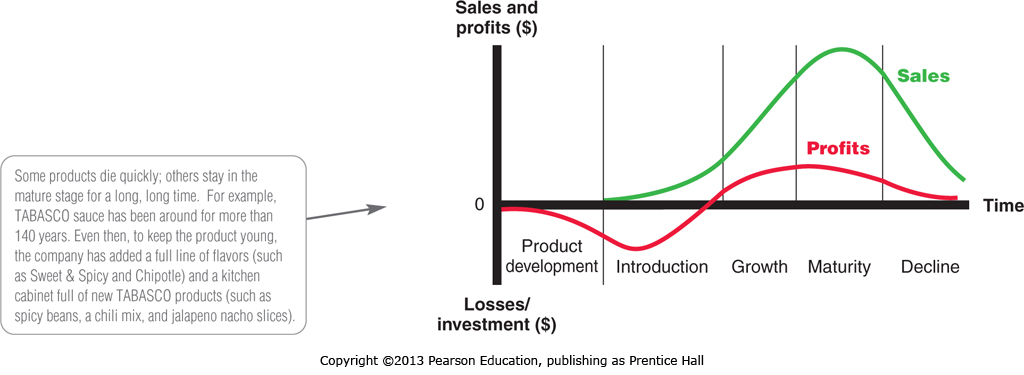
The product life cycle has five distinct stages:
1. Product development begins when the company finds and develops a new-product idea. During product development, sales are zero, and the company’s investment costs mount.
2. Introduction is a period of slow sales growth as the product is introduced in the market. Profits are nonexistent in this stage because of the heavy expenses of product introduction.
3. Growth is a period of rapid market acceptance and increasing profits.
4. Maturity is a period of slowdown in sales growth because the product has achieved acceptance by most potential buyers. Profits level off or decline because of increased marketing outlays to defend the product against competition.
5. Decline is the period when sales fall off and profits drop.
The PLC concept can describe a product class (gasoline-powered automobiles), a product form (SUVs), or a brand (the Ford Escape).
Product classes have the longest life cycles.
Product forms have the standard PLC shape.
Product brand PLC can change quickly because of changing competitive attacks and responses.
The PLC can be applied to styles, fashions, and fads (Figure 8.3).
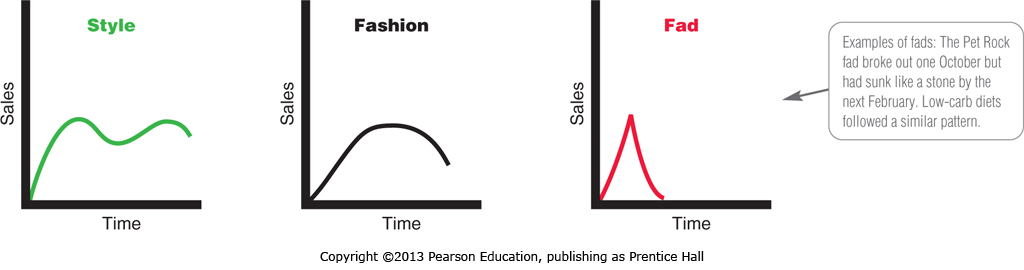
• A style is a basic and distinctive mode of expression.
• A fashion is a currently accepted or popular style in a given field.
• Fads are temporary periods of unusually high sales driven by consumer enthusiasm and immediate product or brand popularity.
Strategies for each of the other life-cycle stages:
Introduction Stage
The introduction stage starts when the new product is first launched.
In this stage, profits are negative or low, promotion spending is relatively high, and only basic versions of the product are produced.
A company, especially the market pioneer, must choose a launch strategy that is consistent with the intended product positioning.
Growth Stage
The growth stage is where sales begin to climb quickly.
New competitors will enter the market. They will introduce new product features, and the market will expand.
The increase in competitors leads to an increase in the number of distribution outlets.
Prices remain stable.
Profits increase during the growth stage.
Maturity Stage
The maturity stage is characterized by slowing product growth.
The slowdown in sales growth results in many producers with many products to sell.
Competitors begin marking down prices, increasing their advertising and sales promotions, and upping their product-development budgets to find better versions of the product.
These steps lead to a drop in profit.
Product managers should consider modifying the market, product, and marketing mix.
In modifying the market, the company tries to increase the consumption of the current product.
In modifying the product, the company tries changing characteristics such as quality, features, style, or packaging to attract new users and to inspire more usage.
In modifying the marketing mix, the company tries changing one or more marketing mix elements.
Decline Stage
The sales of most product forms and brands eventually dip. This is the decline stage.
Management may decide to maintain its brand without change in the hope that competitors will leave the industry.
Management may decide to harvest the product, which means reducing various costs (plant and equipment, maintenance, R&D, advertising, sales force) and hoping that sales hold up
Management may decide to drop the product from the line. (Table 8.2)

