
Some analysts see brands as the major enduring asset of a company.
Brand equity is the differential effect that knowing the brand name has on customer response to the product or its marketing.
Young & Rubicam’s Brand Asset Evaluator measures brand strength along four consumer perception dimensions:
1. differentiation (what makes the brand stand out),
2. relevance (how consumers feel it meets their needs),
3. knowledge (how much consumers know about the brand), and
4. esteem (how highly consumers regard and respect the brand).
Brand valuation is the process of estimating the total financial value of a brand.
High brand equity provides a company with many competitive advantages.
• High level of consumer brand awareness and loyalty
• More leverage in bargaining with resellers
• Greater ability to launch line and brand extensions
• Defense against fierce price competition
• Basis for building strong and profitable customer relationships
The fundamental asset underlying brand equity is customer equity—the value of the customer relationships that the brand creates.
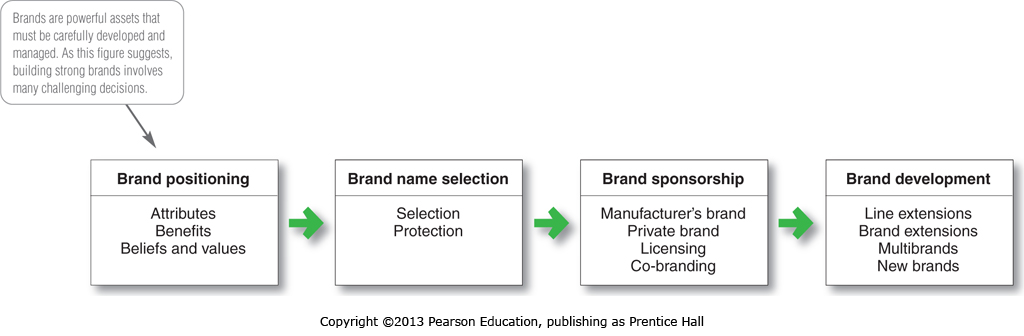
Building Strong Brands (Figure 7.5)
Brand Positioning
Marketers can position brands at any of three levels.
1. They can position the brand on product attributes.
2. They can position the brand with a desirable benefit.
3. They can position the brand on beliefs and values.
Brand Name Selection
Desirable qualities for a brand name include the following:
(1) It should suggest something about the product’s benefits and qualities.
(2) It should be easy to pronounce, recognize, and remember.
(3) The brand name should be distinctive.
(4) It should be extendable.
(5) The name should translate easily into foreign languages.
(6) It should be capable of registration and legal protection.
Brand Sponsorship
A manufacturer has four sponsorship options:
(1) The product may be launched as a manufacturer’s brand (or national brand).
(2) The manufacturer may sell to resellers who give it a private brand (also called a store brand or distributor brand).
(3) The manufacturer can market licensed brands.
(4) Two companies can join forces and co-brand a product
National Brands versus Store Brands
National brands (or manufacturers’ brands) have long dominated the retail scene. In recent times, an increasing number of retailers and wholesalers have created their own store brands (or private brands).
Private brands yield on average a 25 percent savings.
Private-label apparel captures a 50 percent share of all U.S. apparel sales.
In the battle of the brands between national and private brands, retailers have many advantages.
• Retailers often price their store brands lower than comparable national brands.
• Store brands yield higher profit margins for the reseller.
• Store brands give resellers exclusive products that cannot be bought from competitors.
Licensing
Name and character licensing has grown rapidly in recent years.
Annual retail sales of licensed products in the United States and Canada have grown from only $4 billion in 1977 to $55 billion in 1987 and more than $182 billion today.
Co-branding
Co-branding occurs when two established brand names of different companies are used on the same product.
Co-branding offers many advantages.
• The combined brands create broader consumer appeal and greater brand equity.
• Co-branding also allows a company to expand its existing brand into a category it might otherwise have difficulty entering alone.
Co-branding also has limitations.
• Such relationships involve complex legal contracts and licenses.
• Co-branding partners must carefully coordinate their advertising, sales promotion, and other marketing efforts.
• Each partner must trust that the other will take good care of its brand.
Brand Development

A company has four choices when it comes to developing brands (see Figure 7.6).
(1) Line extensions occur when a company extends existing brand names to new forms, colors, sizes, ingredients, or flavors of an existing product category.
(2) Brand extensions extend a current brand name to new or modified products in a new category.
(3) Multibrands introduce additional brands in the same category.
(4) New brands
Megabrand strategies involve weeding out weaker brands and focusing marketing dollars only on brands that can achieve the number-one or number-two market share positions in their categories.
Managing Brands
Brand position must be continuously communicated to consumers.
The brand experience involves customers coming to know a brand through a wide range of contacts and touch points.
Companies need to periodically audit their brands’ strengths and weaknesses.

