
Value proposition: How a company will create differentiated value for targeted segments and what positions it wants to occupy in those segments.
A product’s position is the way the product is defined by consumers on important attributes.
Positioning Maps
Perceptual positioning maps show consumer perceptions of their brands versus competing products on important buying dimensions.
Choosing a Differentiation and Positioning Strategy
The differentiation and positioning task consists of three steps:
1. Identifying a set of differentiating competitive advantages upon which to build a position,
2. Choosing the right competitive advantages, and
3. Selecting an overall positioning strategy.

1.Identifying Possible Value Differences and Competitive Advantages
To the extent that a company can differentiate and position itself as providing superior customer value, it gains competitive advantage.
It can differentiate along the lines of product, services, channels, people, or image.
2.Choosing the Right Competitive Advantages
How Many Differences to Promote
Ad man Rosser Reeves believes a company should develop a unique selling proposition (USP) for each brand and stick to it.
Other marketers think that companies should position themselves on more than one differentiator.
Which Differences to Promote
A difference is worth establishing to the extent that it satisfies the following criteria:
· Important: The difference delivers a highly valued benefit to target buyers.
· Distinctive: Competitors do not offer the difference, or the company can offer it in a more distinctive way.
· Superior: The difference is superior to other ways that customers might obtain the same benefit.
· Communicable: The difference is communicable and visible to buyers.
· Preemptive: Competitors cannot easily copy the difference.
· Affordable: Buyers can afford to pay for the difference.
· Profitable: The company can introduce the difference profitably.
3.Selecting an Overall Positioning Strategy
The full positioning of a brand is called the brand’s value proposition. (See Figure below)
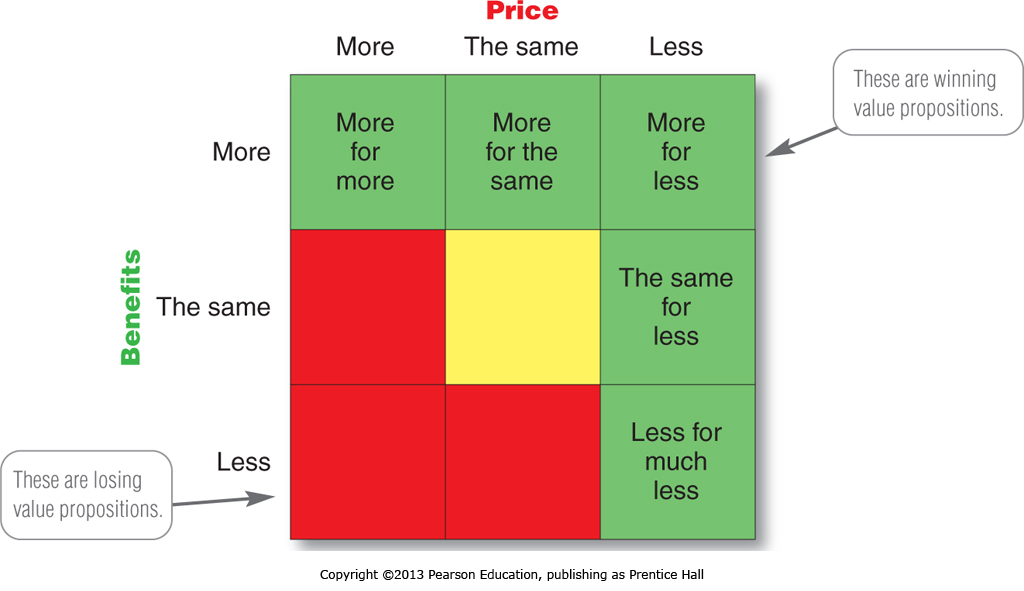
More for More positioning involves providing the most upscale product or service and charging a higher price to cover the higher costs.
More for the Same positioning involves introducing a brand offering comparable quality but at a lower price.
The Same for Less positioning can be a powerful value proposition—everyone likes a good deal.
Less for Much Less positioning is offering products that offer less and therefore cost less.
“Less-for-much-less” positioning involves meeting consumers’ lower performance or quality requirements at a much lower price.
More for Less positioning is the winning value proposition.
In the long run, companies will find it very difficult to sustain such best-of-both positioning.
Developing a Positioning Statement
Company and brand positioning should be summed up in a positioning statement.
The statement should follow the form: To (target segment and need) our (brand) is (concept) that (point of difference).
Communicating and Delivering the Chosen Position
Once it has chosen a position, the company must take strong steps to deliver and communicate the desired position to target consumers. All the company’s marketing mix efforts must support the positioning strategy.
What Chinese women want? You may find some ideas in the following video for positioning this selected group.

