
Evaluating Market Segments
In evaluating different market segments, a firm must look at three factors:
1. Segment size and growth,
2. Segment structural attractiveness, and
3. Company objectives and resources.
The largest, fastest-growing segments are not always the most attractive ones for every company.
The company also needs to examine major structural factors that affect long-run segment attractiveness.
· A segment is less attractive if it already contains many strong and aggressive competitors.
· The existence of many actual or potential substitute products may limit prices and the profits.
· The relative power of buyers also affects segment attractiveness.
· A segment may be less attractive if it contains powerful suppliers who can control prices.
Selecting Target Market Segments
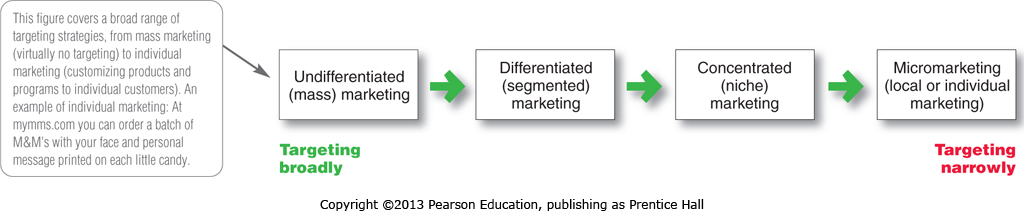
A target market consists of a set of buyers who share common needs or characteristics that the company decides to serve. (Figure below)
Undifferentiated Marketing
Using an undifferentiated marketing (or mass-marketing) strategy, a firm might decide to ignore market segment differences and target the whole market with one offer.
This mass-marketing strategy focuses on what is common in the needs of consumers rather than on what is different.
Differentiated Marketing
Using a differentiated marketing (or segmented marketing) strategy, a firm decides to target several market segments and designs separate offers for each.
Concentrated Marketing
When using a concentrated marketing (or niche marketing) strategy, instead of going after a small share of a large market, the firm goes after a large share of one or a few smaller segments or niches.
It can market more effectively by fine-tuning its products, prices, and programs to the needs of carefully defined segments.
It can market more efficiently, targeting its products or services, channels, and communications programs toward only consumers that it can serve best and most profitably.
Micromarketing
Micromarketing is the practice of tailoring products and marketing programs to suit the tastes of specific individuals and locations.
Micromarketing includes local marketing and individual marketing.
Local marketing involves tailoring brands and promotions to the needs and wants of local customer groups—cities, neighborhoods, and even specific stores.
Local marketing has drawbacks.
· It can drive up manufacturing and marketing costs by reducing economies of scale.
· It can create logistics problems.
· The brand’s overall image might be diluted if the product and message vary too much in different localities.
Individual marketing is the tailoring of products and marketing programs to the needs and preferences of individual customers.
Individual marketing has also been labeled one-to-one marketing, mass customization, and markets-of-one marketing.
Choosing a Targeting Strategy
Which strategy is best depends on:
· Company resources;
· Product variability;
· Product’s life-cycle stage;
· Market variability; and
· Competitors’ marketing strategies
Socially Responsible Target Marketing
Target marketing sometimes generates controversy and concern. Issues usually involve the targeting of vulnerable or disadvantaged consumers with controversial or potentially harmful products.
Problems arise when marketing adult products to kids, whether intentionally or unintentionally.
The growth of the Internet and other carefully targeted direct media has raised concerns about potential targeting abuses.
The issue is not so much who is targeted, but how and for what. Controversies arise when marketers attempt to profit when they unfairly target vulnerable segments or target them with questionable products or tactics.
Socially responsible marketing calls for segmentation and targeting that serve not just the interests of the company, but also the interests of those targeted.
How to market to Chinese mothers? As a targeted consumer group, the following video will show you something about targeting strategy.

