
Market segmentation
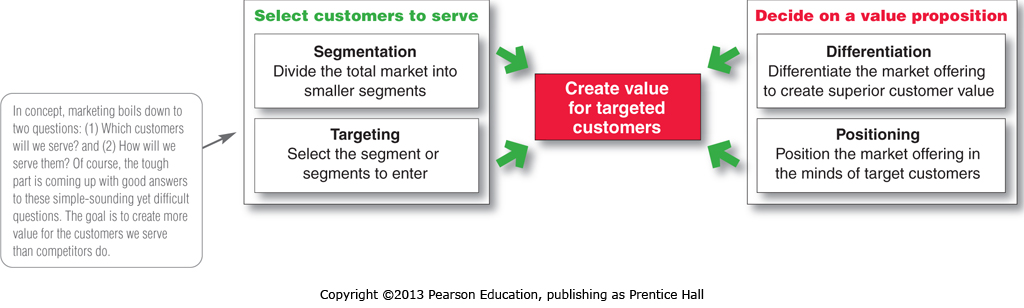
involves dividing a market into smaller groups of buyers with distinct needs, characteristics, or behaviors that might require separate marketing strategies or mixes.
Market targeting (or targeting) consists of evaluating each market segment’s attractiveness and selecting one or more market segments to enter.
Differentiation involves actually differentiating the firm’s market offering to create superior customer value.
Positioning consists of arranging for a market offering to occupy a clear, distinctive, and desirable place relative to competing products in the minds of target consumers.
MARKET SEGMENTATION
Through market segmentation, companies divide large, heterogeneous markets into smaller segments that can be reached more efficiently and effectively with products and services that match their unique needs.
Segmenting Consumer Markets
Table 6.1 (you can find it in your coursebook) outlines the major variables that might be used in segmenting consumer markets.
Geographic Segmentation
Geographic segmentation calls for dividing the market into different geographical units such as nations, regions, states, counties, cities, or even neighborhoods.
Demographic Segmentation
Demographic segmentation divides the market into groups based on variables such as age, gender, family size, family life cycle, income, occupation, education, religion, race, generation, and nationality.
Demographic factors are the most popular bases for segmenting customer groups.
With age and life-cycle segmentation, firms offer different products or use different marketing approaches for different age and life-cycle groups.
Gender segmentation has long been used in clothing, cosmetics, toiletries, and magazines.
Income segmentation has long been used by the marketers of products and services such as automobiles, clothing, cosmetics, financial services, and travel.
Psychographic Segmentation
Psychographic segmentation divides buyers into different groups based on social class, lifestyle, or personality characteristics.
Marketers use personality variables to segment markets.
Behavioral Segmentation
Behavioral segmentation divides buyers into groups based on their knowledge, attitudes, uses, or responses concerning a product.
Occasion segmentation involves grouping buyers according to occasions when they get the idea to buy, actually make their purchase, or use the purchased item.
Benefit segmentation is grouping buyers according to the different benefits that they seek from the product.
User status refers to segmenting markets into nonusers, ex-users, potential users, first-time users, and regular users of a product.
Usage rate involves grouping markets into light, medium, and heavy product users.
Loyalty status is dividing buyers into groups according to their degree of loyalty.
Using Multiple Segmentation Bases
Marketers rarely limit their segmentation analysis to only one or a few variables.
PRIZM (one of the leading segmentation systems) classifies every American household based on a host of demographic factors.
Segmenting Business Markets
Consumer and business marketers use many of the same variables to segment their markets.
Business marketers also use some additional variables, such as customer operating characteristics, purchasing approaches, situational factors, and personal characteristics.
Segmenting International Markets
Companies can segment international markets using one or a combination of several variables.
· Geographic factors: Nations close to one another will have many common traits and behaviors.
· Economic factors: Countries may be grouped by population income levels or by their overall level of economic development.
· Political and legal factors: Type and stability of government, receptivity to foreign firms, monetary regulations, and the amount of bureaucracy should be considered.
· Cultural factors: Markets can be grouped according to common languages, religions, values and attitudes, customs, and behavioral patterns.
Intermarket segmentation is segmenting consumers who have similar needs and buying behaviors even though they are located in different countries.
Requirements for Effective Segmentation
To be useful, market segments must be:
· Measurable: The size, purchasing power, and profiles of the segments can be measured.
· Accessible: The market segments can be effectively reached and served.
· Substantial: The market segments are large or profitable enough to serve.
· Differentiable: The segments are conceptually distinguishable and respond differently to different marketing mix elements and programs.
· Actionable: Effective programs can be designed for attracting and serving the segments.
You can find more information in the following book from Chapter 3-5:
The following video shows five things marketers get wrong about China. It will help you to have a better understanding in segmenting Chinese market.

