
Figure below shows a model of business buyer behavior.

Within the organization, buying activity consists of two major parts:
1. The buying center and
2. The buying decision process.
Major Types of Buying Situations
Straight rebuy: the buyer reorders something without any modifications.
Modified rebuy: the buyer wants to modify product specifications, prices, terms, or suppliers.
New-task buy: the company is buying a product or service for the first time.
Systems selling (solutions selling) is often a key business marketing strategy because many business buyers prefer to buy a packaged solution to a problem from a single seller.
In this situation, a buyer may ask sellers to supply the components and assemble the package or system.
Participants in the Business Buying Process
A buying center consists of all the individuals and units that play a role in the business purchase decision-making process.
The buying center is not a fixed and formally identified unit within the buying organization.
Major Influences on Business Buyers
Most B-to-B marketers recognize that emotion plays an important role in business buying decisions.
When suppliers’ offers are very similar, buyers can allow personal factors to play a role in their decisions.
However, when competing products differ greatly, business buyers tend to pay more attention to economic factors.
Figure below lists various groups of influences on business buyers.
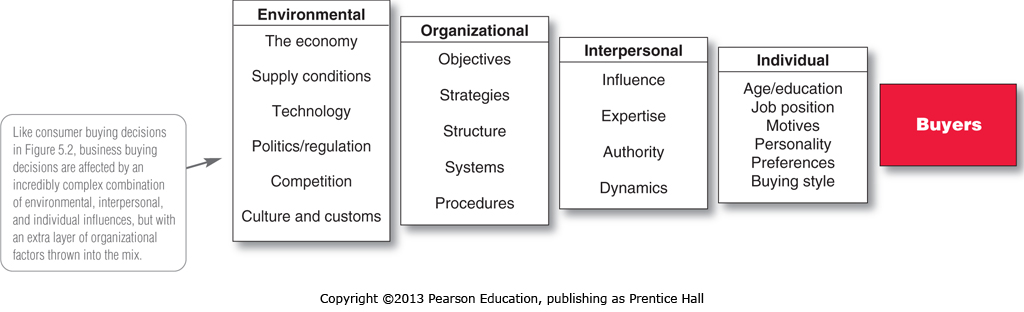
Environmental factors include the current and expected economic environment, as well as shortages of key materials.
Technological, political, and competitive developments can also affect business buyers.
Culture and customs can also influence buyer reactions to the marketer’s behavior and strategies.
Organizational factors are important because each buying organization has its own objectives, policies, procedures, structure, and systems.
Interpersonal factors influence the business buying process. These can be very difficult to ascertain.
Individual factors are involved as well. Each participant in the business buying process brings in personal motives, perceptions, and preferences.
Individual factors are, in turn, influenced by personal characteristics such as age, income, education, professional identification, personality, and attitudes toward risk.
The Business Buying Process (Figure below)
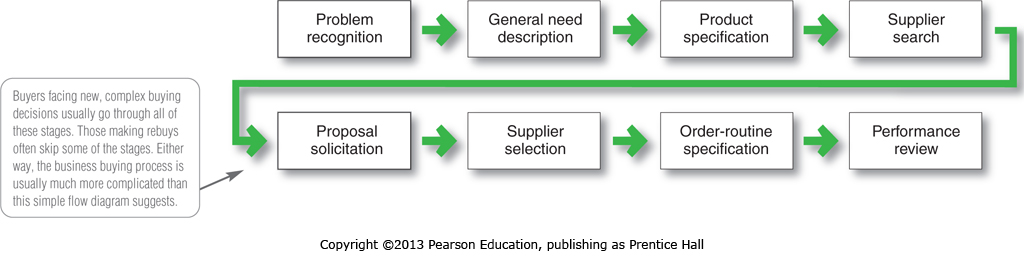
1. Problem recognition: The buying process begins when someone in the company recognizes a problem or need that can be met by acquiring a specific product or service.
2. A general need description is generated to describe the characteristics and quantity needed of an item.
3. The product specification includes the technical product specifications. Product value analysis is an approach to cost reduction in which components are studied carefully to determine if they can be redesigned, standardized, or made by less costly methods of production.
4. A supplier search is conducted to find the best vendors. The newer the buying task, and the more complex and costly the item, the greater the amount of time the buyer will spend searching for suppliers.
5. The proposal solicitation is the stage in which the buyer invites qualified suppliers to submit proposals.
6. Supplier selection occurs after the buying center reviews the proposals.
7. An order-routine specification includes the final order with the chosen supplier or suppliers. Many large buyers now practice vendor-managed inventory, in which they turn over ordering and inventory responsibilities to their suppliers.
8. Buyers conduct a performance review. This review may lead the buyer to continue, modify, or drop the arrangement with the seller.
E-Procurement and Online Purchasing
Online purchasing (e-procurement) has grown rapidly in recent years.
Companies can do e-procurement in any of several ways.
· They can conduct reverse auctions, in which they put their purchasing requests online and invite suppliers to bid for the business.
· They can use online trading exchanges, through which companies work collectively to facilitate the trading process.
· Companies can set up their own company buying sites.
· They can create extranet links with key suppliers.
Business-to-business e-procurement yields many benefits.
1. It shaves transaction costs and results in more efficient purchasing for both buyers and suppliers.
2. It reduces the time between order and delivery.
3. It frees purchasing people to focus on more-strategic issues.
The use of e-purchasing presents some problems.
1. It can erode decades-old customer-supplier relationships.
2. It can create potential security disasters.

