
Consumer buyer behavior refers to the buying behavior of final consumers—individuals and households who buy goods and services for personal consumption.
All of these consumers combine to make up the consumer market.
The American consumer market consists of more than 314 million people.
Model of Consumer Behavior
The central question for marketers is: How do consumers respond to various marketing efforts the company might use?
The starting point is the stimulus-response model of buyer behavior shown in Figure below.
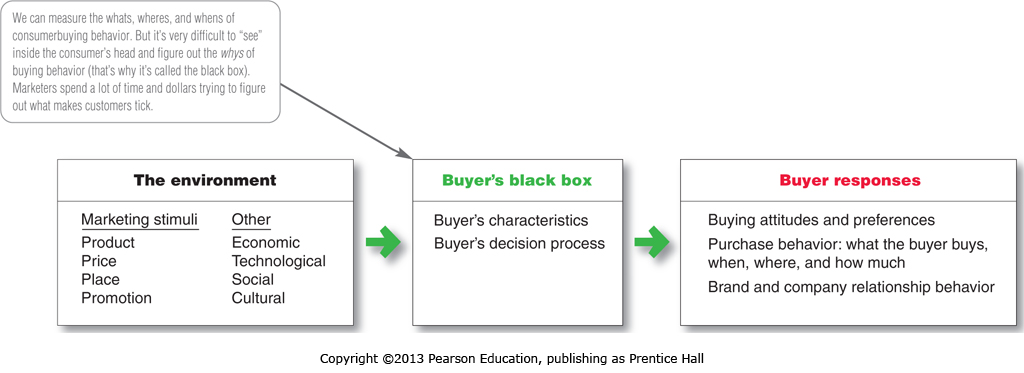
Marketing stimuli consist of the Four Ps.
Other stimuli include major forces and events in the buyer’s environment: economic, technological, political, and cultural.
The marketer wants to understand how the stimuli are changed into responses inside the consumer’s black box, which has two parts.
1. The buyer’s characteristics influence how he or she perceives and reacts to the stimuli.
2. The buyer’s decision process itself affects the buyer’s behavior.
Characteristics Affecting Consumer Behavior
Cultural Factors
Culture is the most basic cause of a person’s wants and behavior.
Marketers are always trying to spot cultural shifts.
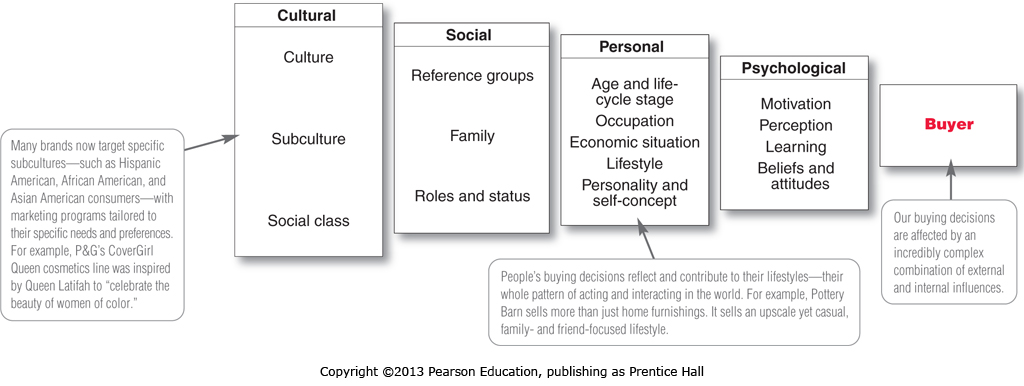
Subcultures are groups of people with shared value systems based on common life experiences and situations.
The U.S. Hispanic market consists of more than 50 million consumers.
The African American market is growing in affluence and sophistication.
Asian Americans are the most affluent U.S. demographic segment.
By targeting segments such as Hispanics, African Americans, and Asian Americans with specially tailored efforts, marketers now embrace cross-cultural marketing—the practice of including ethnic themes and cross-cultural perspectives within their mainstream marketing.
Social classes are society’s relatively permanent and ordered divisions whose members share similar values, interests, and behaviors. (See Figure 5.3)

Social class is not determined by a single factor but is measured as a combination of occupation, income, education, wealth, and other variables.
Social Factors
Groups and Social Networks. A person’s behavior is influenced by many small groups.
Word-of-mouth influence is the impact of the personal words and recommendations of trusted friends, associates, and other consumers on buying behavior.
Opinion leaders are people within a reference group who, because of special skills, knowledge, personality, or other characteristics, exert social influence on others.
This group is also called the influentials or leading adopters.
Buzz marketing involves enlisting or creating opinion leaders to serve as “brand ambassadors” who spread the word about a company’s products.
Online social networks are online communities where people socialize or exchange information and opinions.
Family is the most important consumer buying organization in society.
Husband-wife involvement varies widely by product category and by stage in the buying process.
More than 50 percent of men grocery shop regularly.
Women outspend men on new technology purchases, and they influence 2/3 of all car purchases.
The nation’s 36 million kids ages 9 to 12 control an estimated $43 billion in disposable income.
Roles and Status. A role consists of the activities people are expected to perform. Each role carries a status reflecting the general esteem given to it by society.
Personal Factors
Age and Life-Cycle Stage. People change the goods and services they buy over their lifetimes.
Marketers often define their target markets in terms of life-cycle stage and develop appropriate products and marketing plans for each stage.
Occupation. A person’s occupation affects the goods and services bought.
Economic Situation. A person’s economic situation will affect product choice.
Lifestyle is a person’s pattern of living as expressed in his or her psychographics.
AIO dimensions are activities (work, hobbies, shopping, sports, social events), interests (food, fashion, family, recreation), and opinions (about themselves, social issues, business, products).
Personality and Self-Concept.
Personality refers to the unique psychological characteristics that lead to relatively consistent and lasting responses to one’s own environment.
A brand personality is the specific mix of human traits that may be attributed to a particular brand. One researcher identified five brand personality traits:
1. Sincerity (down-to-earth, honest, wholesome, and cheerful)
2. Excitement (daring, spirited, imaginative, and up-to-date)
3. Competence (reliable, intelligent, and successful)
4. Sophistication (upper class and charming)
5. Ruggedness (outdoorsy and tough)
The basic self-concept (self-image) premise is that people’s possessions contribute to and reflect their identities; that is, “we are what we have.”
Psychological Factors
Motivation.
A motive (or drive) is a need that is sufficiently pressing to direct the person to seek satisfaction.
Freud suggests that a person’s buying decisions are affected by subconscious motives that even the buyer may not fully understand.
Motivation research refers to qualitative research designed to probe consumers’ hidden, subconscious motivations.
Many marketers are using interpretive consumer research to dig deeper into consumer psyches and develop better marketing strategies.
Maslow sought to explain why people are driven by particular needs at particular times. (Figure below)

Perception is the process by which people select, organize, and interpret information to form a meaningful picture of the world.
Selective attention is the tendency for people to screen out most of the information to which they are exposed.
Selective distortion describes the tendency of people to interpret information in a way that will support what they already believe.
Selective retention is the retaining of information that supports their attitudes and beliefs.
Subliminal advertising refers to marketing messages received without consumers knowing it. Studies find no link between subliminal messages and consumer behavior.
Learning describes changes in an individual’s behavior arising from experience.
A drive is a strong internal stimulus that calls for action.
A drive becomes a motive when it is directed toward a particular stimulus object.
Cues are minor stimuli that determine when, where, and how the person responds.
Beliefs and Attitudes.
A belief is a descriptive thought that a person has about something.
Attitude describes a person’s relatively consistent evaluations, feelings, and tendencies toward an object or idea.
Therefore, how to influence our customer? You can find more in the following video.

