
Marketing research is the systematic design, collection, analysis, and reporting of data relevant to a specific marketing situation facing an organization.
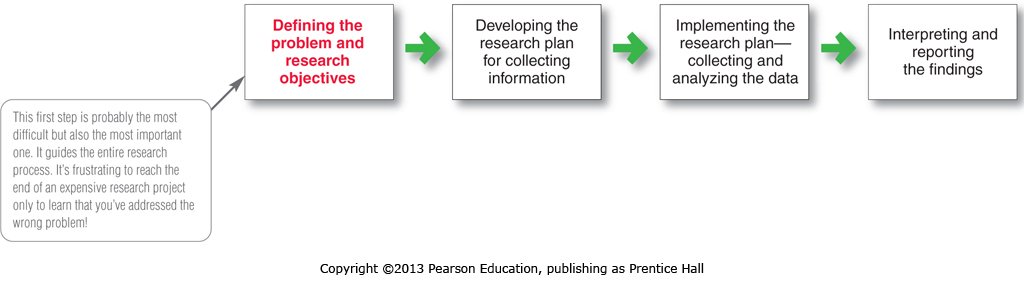 The marketing research process has four steps (see Figure above):
1.Defining the Problem and Research Objectives
Defining the problem and research objectives is often the hardest step in the research process.
A marketing research project might have one of three types of objectives.
1. Exploratory research: to gather preliminary information that will help define the problem and suggest hypotheses.
2. Descriptive research: to describe things, such as the market potential for a product.
3. Causal research: to test hypotheses about cause and effect relationships.
Start with exploratory research and later follow with descriptive or causal research.
2.Developing the Research Plan
The research plan outlines sources of existing data and spells out the specific research approaches, contact methods, sampling plans, and instruments that researchers will use to gather new data.
Research objectives must be translated into specific information needs.
The research plan should be presented in a written proposal.
Secondary data consist of information that already exists somewhere, having been collected for another purpose.
Primary data consist of information collected for the specific purpose at hand.
Gathering Secondary Data
Researchers usually start by gathering secondary data.
Using commercial online databases, marketing researchers can conduct their own searches of secondary data sources.
Internet search engines can also be a big help in locating relevant secondary information sources.
Secondary data can usually be obtained more quickly and at a lower cost than primary data.
Secondary sources can sometimes provide data an individual company cannot collect on its own.
Secondary data can present problems.
· The needed information may not exist.
· The data might not be very usable unless it is:
o relevant (fits research project needs),
o accurate (reliably collected and reported),
o current (up-to-date enough for current decisions), and
o impartial (objectively collected and reported).
Primary Data Collection
In most cases, a company must also collect primary data. Care must be given to making certain the primary data is relevant, accurate, current, and unbiased.
Research Approaches
Observational Research involves gathering primary data by observing relevant people, actions, and situations.
Observational research can obtain information that people are unwilling or unable to provide.
Disadvantages:
· Some things cannot be observed.
· Long-term or infrequent behavior is also difficult to observe.
· Observations can be very difficult to interpret.
Ethnographic research involves sending trained observers to watch and interact with consumers in their “natural habitat.”
Ethnographic research often yields the kinds of details that just don’t emerge from traditional research questionnaires or focus groups.
Survey research, the most widely used method for primary data collection, is the approach best suited for gathering descriptive information.
The major advantage of survey research is its flexibility.
Disadvantages:
· Sometimes people are unable to answer survey questions.
· People may be unwilling to respond to unknown interviewers or about things they consider private.
· Respondents may answer survey questions even when they do not know the answer.
· People may not take the time, or they might resent the intrusion into their privacy.
Experimental Research is best suited for gathering causal information.
Contact Methods
Mail, Telephone, and Personal Interviewing
Mail questionnaires can be used to collect large amounts of information at a low cost per respondent.
Respondents give more honest answers to more personal questions.
No interviewer is involved to bias the respondent’s answers.
Disadvantages:
· Not very flexible
· Take longer to complete
· The response rate is very low.
· The researcher often has little control over the mail questionnaire sample.
Telephone interviewing is one of the best methods for gathering information quickly, and it provides greater flexibility than mail questionnaires.
Interviewers can explain difficult questions.
Response rates are higher than with mail questionnaires.
Disadvantages:
· Cost per respondent is higher than with mail questionnaires.
· People may not want to discuss personal questions with an interviewer.
· Introduces interviewer bias
· Different interviewers may interpret and record responses differently.
· Increasingly high rates of hang-ups
Personal interviewing takes two forms—individual and group interviewing.
· Individual interviewing involves talking with people one-on-one.
· Group interviewing (focus group interviewing) consists of inviting six to ten people to meet with a trained moderator to talk about a product, service, or organization.
Online Marketing Research
Increasingly, researchers are collecting primary data through online marketing research.
The Internet is especially well suited for quantitative research.
More than 80% of Americans now have access to the Web.
Web-based research offers many advantages over more traditional approaches:
· Speed
· Low costs
· More interactive and engaging
· Easier to complete
· Less intrusive
Sample size has little impact on costs.
The primary qualitative Web-based research approach is online focus groups.
Disadvantages:
· Restricted Internet access can make it difficult to get a broad cross section of respondents.
· Controlling who’s in the online sample is difficult.
· Consumer privacy is a major issue.
Online Behavioral and Social Tracking and Targeting
Increasingly, online researchers are listening to and watching consumers by actively mining the rich veins of unsolicited, unstructured, “bottom-up” customer information already available on the Internet.
Behavioral targeting is the practice of marketers using online data to target ads and offers to specific consumers.
Sampling Plan
A sample is a segment of the population selected for marketing research to represent the population as a whole.
Designing the sample requires three decisions.
1. Who is to be surveyed (what sampling unit)?
2. How many people should be surveyed (what sample size)?
3. How should the people in the sample be chosen (what sampling procedure)?
The two types of samples are:
· probability samples and
· nonprobability samples.
Research Instruments
The questionnaire is the most common data collection instrument.
Closed-end questions include all the possible answers, and subjects make choices among them.
Open-end questions allow respondents to answer in their own words.
Care should be given to the wording and ordering of questions.
Researchers also use mechanical instruments to monitor consumer behavior.
Checkout scanners are an example.
3.Implementing the Research Plan
This stage involves collecting, processing, and analyzing the information.
Researchers must process and analyze the collected data to isolate important information and findings.
4.Interpreting and Reporting the Findings
Researchers should present important findings and insights that are useful in the major decisions faced by management.

