
市场营销学(英)

林国超/福建省/本科/福州外语外贸学院

目录

  • 1 CHAPTER 1 Marketing: Creating and capturing customer value
    • 1.1 What is marketing?
    • 1.2 Understanding the marketplace and customer needs
    • 1.3 Designing a customer-driven marketing strategy
  • 2 CHAPTER 2 Company and marketing strategy: partnering to build customer relationships
    • 2.1 Designing the business portfolio
    • 2.2 Planning marketing
    • 2.3 Marketing strategy and marketing mix
  • 3 CHAPTER 3 Analyzing the marketing environment
    • 3.1 The microenvironment
    • 3.2 The macroenvironment
    • 3.3 Responding to the marketing environment
  • 4 CHAPTER 4 Managing marketing information to gain customer insights
    • 4.1 Marketing information and customer insights
    • 4.2 Developing marketing infromation
    • 4.3 Marketing research
  • 5 CHAPTER 5 Understanding consumer and business buyer behavior
    • 5.1 Customer markets and customer buyer behavior
    • 5.2 Business markets and business buyer behavior
    • 5.3 The buyer decision process
  • 6 CHAPTER 6 Customer-driven marketing strategy: creating value for target customers
    • 6.1 Market segmentation
    • 6.2 Market targeting
    • 6.3 Differentiation and positioning
  • 7 CHAPTER 7 Products, Services, and brands: Building customer value
    • 7.1 What is product?
    • 7.2 Product and service decision
    • 7.3 Services marketing
    • 7.4 Branding strategy: building strong brands
  • 8 CHAPTER 8 Developing new products and managing the product life cycle
    • 8.1 New-product development strategy
    • 8.2 The new product development process
    • 8.3 Product life cycle strategies
  • 9 CHAPTER 9 Pricing: Understanding and capturing customer value
    • 9.1 Major pricing strategies
    • 9.2 New product pricing strategies
    • 9.3 Price adjustment strategy
  • 10 CHAPTER 10 Marketing Channels: delivering customer value
    • 10.1 Supply chains and the value delivery network
    • 10.2 Channel design decisions
    • 10.3 Channel management decisions
  • 11 CHAPTER 11 Communicating customer value: Advertising and public relations
    • 11.1 Integrated marketing communications
    • 11.2 Advertising
    • 11.3 Public relations
  • 12 CASE STUDY seminar 1
    • 12.1 Marketing to Millennials
    • 12.2 Milennials and Social E-commerce
    • 12.3 Social Media and Big Data Marketing
  • 13 CASE STUDY seminar 2
    • 13.1 The application of Chinese style in marketing
Marketing information and customer insights

Companies use such customer insights to develop competitive advantage.

To gain good customer insights, marketers must effectively manage marketing information from a wide range of sources.

The real value of marketing research and marketing information lies in how it is used—in the customer insights that it provides.

Customer insights groups collect customer and market information from a wide variety of sources.


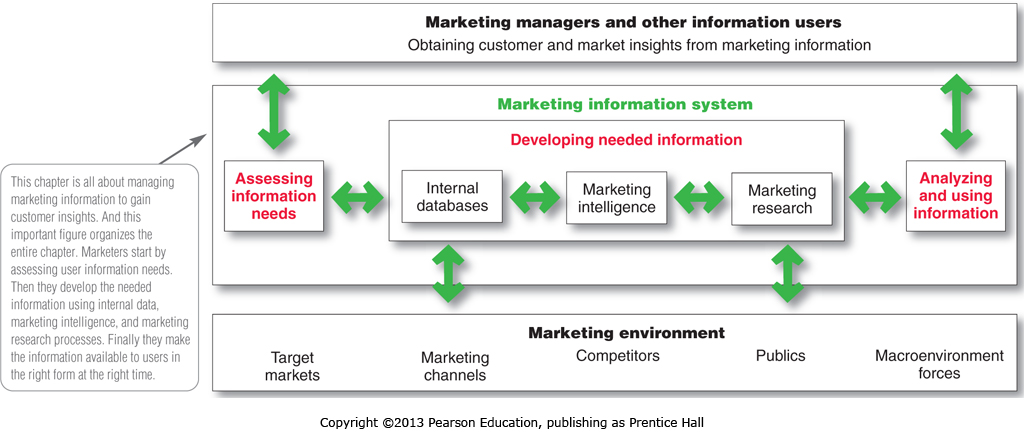
A marketing information system (MIS) consists of people and procedures for assessing information needs, developing the needed information, and helping decision makers to use the information to generate and validate actionable customer and market insights. (Figure below)
 

ASSESSING MARKETING INFORMATION NEEDS

A good marketing information system balances the information users would like to have against what they really need and what is feasible to offer.

Sometimes the company cannot provide the needed information, either because it is not available or because of MIS limitations.

By itself, information has no worth; its value comes from its use