
The Figure below shows the six major forces in the company’s macroenvironment.
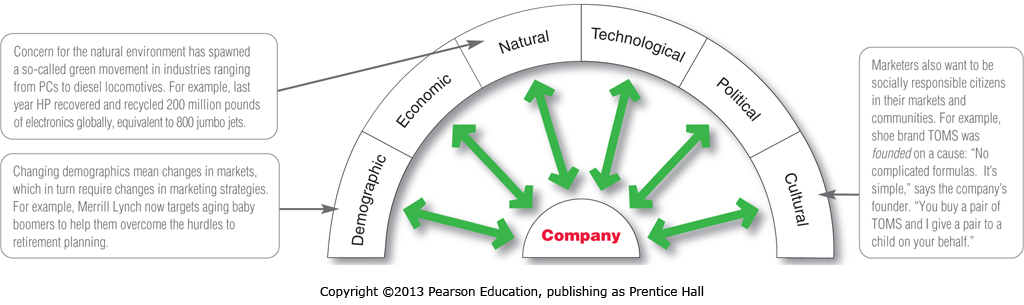
Demographic Environment
Demography is the study of human populations in terms of size, density, location, age, gender, race, occupation, and other statistics.
Changes in the world demographic environment have major implications for business.
Thus, marketers keep close track of demographic trends and developments in their markets, both at home and abroad.
Changing Age Structure of the Population (Useing USA as an example)
The U.S. population stands at nearly 320 million and may reach almost 364 million by the year 2030.
The single most important demographic trend in the United States is the changing age structure of the population.
Baby Boomers
The post-World War II baby boom produced 78 million baby boomers, born between 1946 and 1964.
Baby boomers account for nearly 25 percent of the population, account for almost 50 percent of total consumer spending, and hold 70 percent of the nation’s disposable income.
Generation X
The baby boom was followed by a “birth dearth,” creating another generation of 49 million people born between 1965 and 1976.
Author Douglas Coupland calls them Generation X.
Increasing parental divorce rates and higher employment for their mothers made them the first generation of latchkey kids.
They developed a more cautious economic outlook.
The GenXers are a more skeptical bunch.
Millennials (also called Generation Y or the echo boomers)
Born between 1977 and 2000, these children of the baby boomers number 83 million.
They don’t just embrace technology. It’s a way of life.
For them, technology is not something separate; it’s just something they do.
Generation Z
Born after the year 2000.
In the U.S., Gen Zers consist of 20 million girls and boys who spend an estimated $30 billion annually of their own money and influence another $150 billion of their parents’ spending.
They have an utter fluency and comfort with digital technologies – even more so than Millennials.
Generational Marketing
Defining people by their birth date may be less effective than segmenting them by their lifestyle, life stage, or the commons values they seek in the products they buy.
The Changing American Family
The “traditional household” consists of a husband, wife, and children (and sometimes grandparents).
In the U.S.:
· Married couples with children make up 20 percent of the households;
· Married couples without children make up 28 percent;
· Single parents comprise 18 percent.
· Nonfamily households make up 34 percent.
Both husband and wife work in 58 percent of all married-couple families.
Geographic Shifts in Population
About 14 percent of all U.S. residents move each year.
The U.S. population has shifted toward the Sunbelt states.
Americans have been moving from rural to metropolitan areas.
A Better-Educated, More White-Collar, More Professional Population
The U.S. population is becoming better educated.
In 2012, 88 percent of the U.S. population over age 25 had completed high school and 30 percent had completed college.
Between 2010 and 2020, of 30 detailed occupations projected to have the fastest employment growth, 17 require some type of postsecondary education.
Increasing Diversity
The United States has become more of a “salad bowl” in which various groups have mixed together but have maintained their diversity by retaining important ethnic and cultural differences.
The U.S. population is about 64 percent white, 17 percent Hispanic, and 13 percent African American.
The Asian American population now totals about 5 percent of the population.
By 2050, Hispanics will comprise an estimated 30 percent of the U.S. population.
Many companies have begun to target gay and lesbian consumers.
Another attractive segment is the nearly 57 million adults with disabilities.
The Economic Environment
The economic environment consists of factors that affect consumer purchasing power and spending patterns.
Industrial economies – constitute rich markets for many different kinds of goods.
Developing economies – offer outstanding marketing opportunities for the right kinds of products.
Subsistence economies – consume most of their own agricultural and industrial output.
Changes in Consumer Spending
In recent years, American consumers spent freely, fueled by income growth, a boom in the stock market, and rapid increases in housing values.
However, the global economic crisis has dashed this free-spending attitude. As a result, consumers who overindulged in the past have now adopted a ‘back-to-basics’ frugality.
Value marketing—just the right combination of product quality and service at a fair price.
Income Distribution
Income distribution in the United States is very skewed.
The top 5 percent of Americans earn 22 percent of the country’s adjusted gross income, and the top 20 percent of earners capture almost 50 percent of all income.
In contrast, the bottom 40 percent of American earners receive just 12 percent of the total income.
Natural Environment
The natural environment involves the natural resources that are needed as inputs by marketers or that are affected by marketing activities.
Trends in the natural environment:
1. Shortages of raw materials.
2. Increased pollution.
3. Increased government intervention.
Companies are developing environmentally sustainable strategies.
The Technological Environment
The technological environment is the most dramatic force now shaping our destiny.
Technology has released such wonders as antibiotics, robotic surgery, miniaturized electronics, laptop computers, and the Internet.
New technologies create new markets and opportunities; however, every new technology replaces an old technology.
Political and Social Environment
The political environment consists of laws, government agencies, and pressure groups that influence or limit various organizations and individuals in a given society.
Legislation Regulating Business
Governments develop public policy to guide commerce.
Legislation affecting business around the world has increased steadily over the years.
Business legislation has been enacted for a number of reasons.
1. To protect companies from each other.
2. To protect consumers from unfair business practices.
3. To protect the interests of society against unrestrained business behavior.
Because government agencies have discretion in enforcing laws, they can have an impact on a company’s marketing performance.
Increased Emphasis on Ethics and Socially Responsible Actions
Socially Responsible Behavior. Enlightened companies encourage their managers to “do the right thing.”
The boom in online, mobile, and social media marketing has created a new set of social and ethical issues.
Cause-Related Marketing. Many companies are now linking themselves to worthwhile causes.
Cause-related marketing has stirred some controversy.
Cultural Environment
The cultural environment is made up of institutions and other forces that affect a society’s basic values, perceptions, preferences, and behaviors.
Persistence of Cultural Values
Core beliefs and values are passed on from parents to children and are reinforced by schools, churches, businesses, and government.
Secondary beliefs and values are more open to change.
Shifts in Secondary Cultural Values
Marketers want to predict cultural shifts in order to spot new opportunities or threats.
People’s Views of Themselves
People vary in their emphasis on serving themselves versus serving others.
People use products, brands, and services as a means of self-expression.
People’s Views of Others
Shifts in people’s attitudes toward and interactions with others have been noted.
Trend trackers see “mass mingling”—people are using online social media and mobile communications to connect more than ever.
People’s Views of Organizations
People are willing to work for major organizations and expect them to carry out society’s work.
Many people see work as a required chore to earn money to enjoy their non-work hours.
People’s Views of Society
People vary in their attitudes toward their society.
People’s Views of Nature
Recently, people have recognized that nature is finite and fragile, that it can be destroyed by human activities.
This renewed love of things natural has created a 41-million-person “lifestyles of health and sustainability” (LOHAS) market.
The U.S. organic-food market generated $31 billion in sales last year, more than doubling over the last five years.
People’s Views of the Universe
Religious conviction and practice have been dropping off gradually through the years.
33% of Americans (between 18 and 29 years of age) say they are not affiliated with any particular faith.

