
Strategic planning is the process of developing and maintaining a strategic fit between the organization’s goals and capabilities and its changing marketing opportunities.
Strategic planning sets the stage for the rest of the planning in the firm.
Companies usually prepare annual plans, long-range plans, and strategic plans.
The annual and long-range plans deal with the company’s current businesses and how to keep them going.
In contrast, the strategic plan involves adapting the firm to take advantage of opportunities in its constantly changing environment.
The strategic planning process begins with the company defining its overall purpose and mission.
The stages of the strategic planning process are outlined in the following Figure.
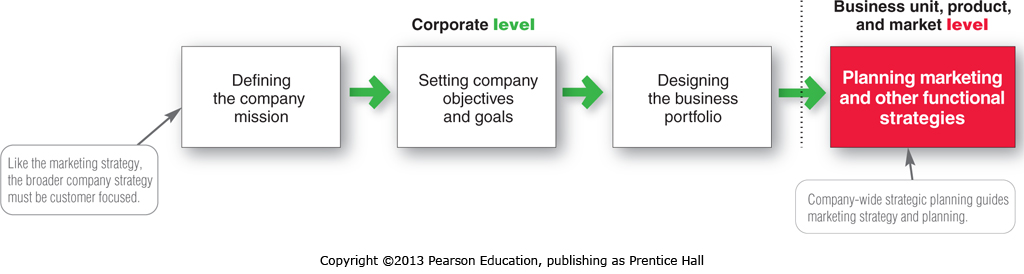
This mission is turned into objectives that guide the whole company.
Marketing planning occurs at the business-unit, product, and market levels.
Defining a Market-Oriented Mission
An organization exists to accomplish something, and this purpose should be clearly stated.
A mission statement is a statement of the organization’s purpose—what it wants to accomplish in the larger environment.
A clear mission statement acts as an “invisible hand” that guides people in the organization.
Mission statements should be market oriented and defined in terms of customer needs.
A market-oriented mission statement defines the business in terms of satisfying basic customer needs.
Mission statements should be meaningful and specific, yet motivating.
A company’s mission statement should not be stated as making more sales or profits; profits are a reward for creating value for customers.
Setting Company Objectives and Goals
The company turns its mission into detailed supporting objectives for each level of management.
Each manager should have objectives and be responsible for reaching them.
Marketing strategies and programs must be developed to support these marketing objectives.
Each broad marketing strategy must then be defined in greater detail.
Designing the Business Portfolio
A business portfolio is the collection of businesses and products that make up the company.
The best business portfolio is the one that matches the company’s strengths and weaknesses to opportunities in the environment.
Business portfolio planning involves two steps:
1. The company must analyze its current business portfolio and decide which businesses should receive more, less, or no investment.
2. It must shape the future portfolio by developing strategies for growth and downsizing.
Analyzing the Current Business Portfolio
The major activity in strategic planning is business portfolio analysis.
Portfolio analysis is where management evaluates the products and businesses making up the company.
The steps in portfolio analysis are:
1. To identify the strategic business units (SBU). An SBU is a separately managed unit of the company with its own missions and objectives.
2. To assess the attractiveness of its various SBUs and decide how much support each deserves. Most companies are well advised to “stick to their knitting” when designing their business portfolios.
The purpose of strategic planning is to find ways in which the company can best use its strengths to take advantage of attractive opportunities in the environment.
Most standard portfolio-analysis methods evaluate SBUs on two dimensions:
1. The attractiveness of the market or industry, and
2. The strength of the position in that market or industry.
The Boston Consulting Group Approach
A company classifies all its SBUs according to the growth-share matrix (see Figure below).
The vertical axis: market growth rate provides a measure of market attractiveness.
The horizontal axis: relative market share provides a measure of company strength in the market.
 The growth-share matrix defines four types of SBUs:
Stars. High-growth, high-share businesses or products. They will turn into cash cows.
Cash cows. Low-growth, high-share businesses or products. They produce a lot of cash that the company uses to pay its bills and support other SBUs that need investment.
Question marks. Low-share business units in high-growth markets. They require a lot of cash to hold their position.
Dogs. Low-growth, low-share businesses and products.
One of four strategies can be pursued for each SBU:
1. The company can invest to build its share.
2. It can invest just enough to hold its share.
3. It can milk its short-term cash flow, or harvest.
4. It can divest by selling it or phasing out.
As time passes, SBUs change their positions in the growth-share matrix. Each SBU has a life cycle.
Problems with Matrix Approaches
Difficult, time consuming, and costly to implement.
These approaches focus on classifying current businesses but provide little advice for future planning.
Many companies have dropped matrix methods in favor of customized approaches better suited to their specific situations.
Developing Strategies for Growth and Downsizing
A company’s objective must be “profitable growth.”
Marketing has the main responsibility for achieving profitable growth for the company.
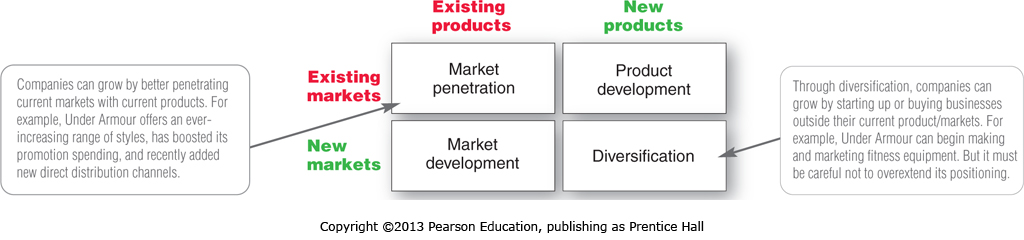
The product/market expansion grid is used in identifying growth opportunities (see Figure below).
· Market penetration—making more sales to current customers without changing its products.
· Market development—identifying and developing new markets for its current products.
· Product development—offering modified or new products to current markets.
· Diversification—starting up or buying businesses outside of its current products and markets.
Companies must also develop strategies for downsizing.
When a firm finds brands/businesses that are unprofitable or no longer fit the overall strategy, it may prune, harvest, or divest them.

