
Marketing management is defined as the art and science of choosing target markets and building profitable relationships with them.
The marketing manager must answer two important questions:
1. What customers will we serve (what’s our target market)?
2. How can we serve these customers best (what’s our value proposition)?
Selecting Customers to Serve
A company must decide whom it will serve.
It does this by dividing the market into segments of customers (market segmentation) and selecting which segments it will go after (target marketing).
Marketing managers know they cannot serve all customers. By trying to do so, they end up not serving any well.
Marketing management is customer management and demand management.
Choosing a Value Proposition
A company’s value proposition is the set of benefits or values it promises to deliver to consumers to satisfy their needs. (Facebook helps you “connect and share with the people in your life,” whereas YouTube “provides a place for people to connect, inform, and inspire others across the globe.”)
Such value propositions differentiate one brand from another.
Marketing Management Orientations
Marketing management wants to design strategies that will build profitable relationships with target consumers. But what philosophy should guide these marketing strategies?
There are five alternative concepts under which organizations design and carry out their marketing strategies:
1) The Production Concept
The production concept holds that consumers will favor products that are available and highly affordable.
Management should focus on improving production and distribution efficiency.
2) The Product Concept
The product concept holds that consumers will favor products that offer the most in quality, performance, and innovative features.
Under this concept, marketing strategy focuses on making continuous product improvements.
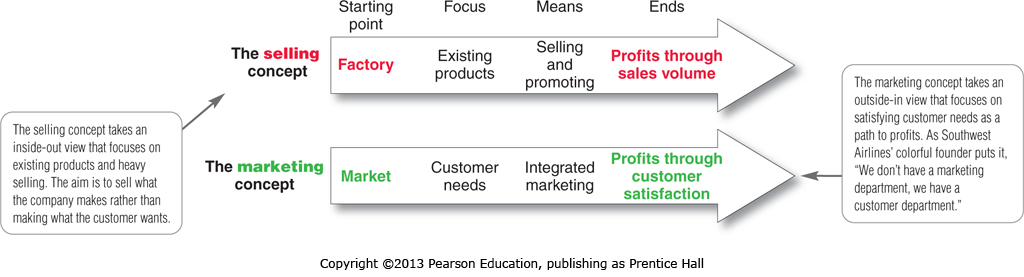
3) The Selling Concept
The selling concept holds that consumers will not buy enough of the firm’s products unless the firm undertakes a large-scale selling and promotion effort.
The concept is typically practiced with unsought goods – those that buyers do not normally think of buying, such as insurance or blood donations.
These industries must be good at tracking down prospects and selling them on product benefits.
4) The Marketing Concept
The marketing concept holds that achieving organizational goals depends on knowing the needs and wants of target markets and delivering the desired satisfactions better than competitors do.
Under the marketing concept, customer focus and value are the paths to sales and profits.
The job is not to find the right customers for your product but to find the right products for your customers.
The selling concept takes an inside-out approach, whereas the marketing concept uses an outside-in perspective. (Figure below )
Customer-driven companies research current customers deeply to learn about their desires, gather new product and service ideas, and test proposed product improvements.
Customer-driving marketing involves understanding customer needs even better than customers themselves do and creating products and services that meet existing and latent needs.
5) The Societal Marketing Concept
The societal marketing concept questions whether the pure marketing concept overlooks possible conflicts between consumer short-run wants and consumer long-run welfare.
The societal marketing concept holds that marketing strategy should deliver value to customers in a way that maintains or improves both the consumer’s and the society’s well-being. (Figure below)


