市场营销学(英)

林国超/福建省/本科/福州外语外贸学院

目录

  • 1 CHAPTER 1 Marketing: Creating and capturing customer value
    • 1.1 What is marketing?
    • 1.2 Understanding the marketplace and customer needs
    • 1.3 Designing a customer-driven marketing strategy
  • 2 CHAPTER 2 Company and marketing strategy: partnering to build customer relationships
    • 2.1 Designing the business portfolio
    • 2.2 Planning marketing
    • 2.3 Marketing strategy and marketing mix
  • 3 CHAPTER 3 Analyzing the marketing environment
    • 3.1 The microenvironment
    • 3.2 The macroenvironment
    • 3.3 Responding to the marketing environment
  • 4 CHAPTER 4 Managing marketing information to gain customer insights
    • 4.1 Marketing information and customer insights
    • 4.2 Developing marketing infromation
    • 4.3 Marketing research
  • 5 CHAPTER 5 Understanding consumer and business buyer behavior
    • 5.1 Customer markets and customer buyer behavior
    • 5.2 Business markets and business buyer behavior
    • 5.3 The buyer decision process
  • 6 CHAPTER 6 Customer-driven marketing strategy: creating value for target customers
    • 6.1 Market segmentation
    • 6.2 Market targeting
    • 6.3 Differentiation and positioning
  • 7 CHAPTER 7 Products, Services, and brands: Building customer value
    • 7.1 What is product?
    • 7.2 Product and service decision
    • 7.3 Services marketing
    • 7.4 Branding strategy: building strong brands
  • 8 CHAPTER 8 Developing new products and managing the product life cycle
    • 8.1 New-product development strategy
    • 8.2 The new product development process
    • 8.3 Product life cycle strategies
  • 9 CHAPTER 9 Pricing: Understanding and capturing customer value
    • 9.1 Major pricing strategies
    • 9.2 New product pricing strategies
    • 9.3 Price adjustment strategy
  • 10 CHAPTER 10 Marketing Channels: delivering customer value
    • 10.1 Supply chains and the value delivery network
    • 10.2 Channel design decisions
    • 10.3 Channel management decisions
  • 11 CHAPTER 11 Communicating customer value: Advertising and public relations
    • 11.1 Integrated marketing communications
    • 11.2 Advertising
    • 11.3 Public relations
  • 12 CASE STUDY seminar 1
    • 12.1 Marketing to Millennials
    • 12.2 Milennials and Social E-commerce
    • 12.3 Social Media and Big Data Marketing
  • 13 CASE STUDY seminar 2
    • 13.1 The application of Chinese style in marketing
Understanding the marketplace and customer needs

Five core customer and marketplace concepts are critical: (1) needs, wants, and demands; (2) market offerings (products, services, and experiences); (3) value and satisfaction; (4) exchanges and relationships; and (5) markets.


Customer Needs, Wants, and Demands

The most basic concept underlying marketing is that of human needs.

Human needs are states of felt deprivation. They include physical, social, and individuals needs. These needs were not created by marketers; they are a basic part of the human makeup.

Wants are the form human needs take as they are shaped by culture and individual personality. An American needs food but wants a Big Mac.

When backed by buying power, wants become demands.

The best marketing companies go to great lengths to learn and understand their customers’ needs, wants, and demands.


Market Offerings—Products, Services, and Experiences

Needs and wants are fulfilled through market offerings—some combination of products, services, information, or experiences offered to a market to satisfy a need or want.

Market offerings are not limited to physical products. They also include services—activities or benefits offered for sale that are essentially intangible and do not result in the ownership of anything.

Marketing myopia occurs when a company becomes so taken with their own products that they lose sight of underlying customer needs. 


Customer Value and Satisfaction

Customers form expectations about the value and satisfaction that various market offerings will deliver and buy accordingly.

Satisfied customers buy again and tell others about their good experiences.

Dissatisfied customers switch to competitors and disparage the product to others.

Customer value and customer satisfaction are key building blocks for developing and managing customer relationships.


Exchanges and Relationships

Exchange is the act of obtaining a desired object from someone by offering something in return.

Marketing consists of actions taken to build and maintain desirable exchange relationships with target audiences.


Markets

A market is the set of actual and potential buyers of a product.

Marketing means managing markets to bring about profitable customer relationships.

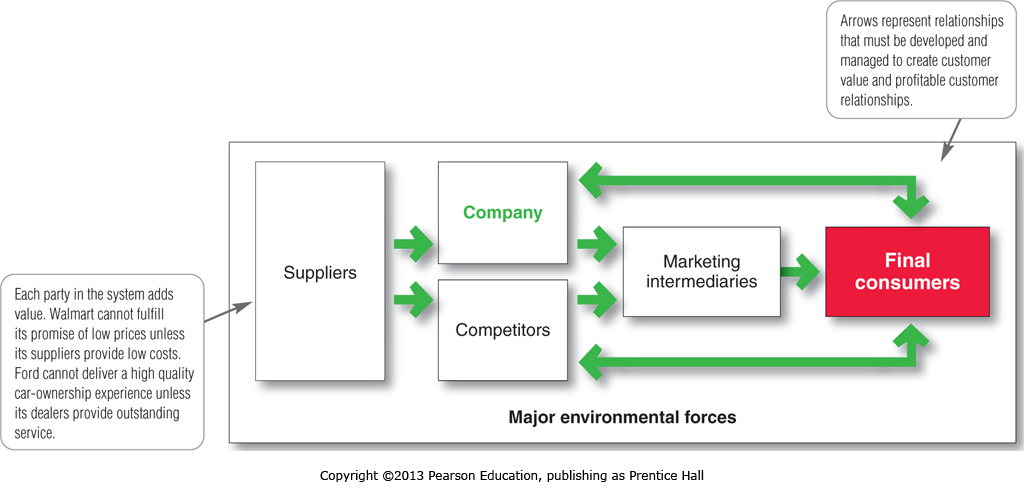
The following figure shows the main elements in a modern marketing system.