In the FRUIT category there are a great number of examples such as orange, apple,banana, peach,apricot, plum, tangelo and papaya. If you are asked which are the best examples,you would possibly answer that orange and apple are the best ones. The best examples of a category are called prototypes.
Some scholars think that natural categories are organized according to prototypes. According to the prototype theory,people decide whether an entity belongs to a category by comparing that entity with a prototype. If the entity is similar to the prototype,it is included in the category. However,if it is sufficiently different,it is placed in another category,in which it resembles the prototype for that category more closely. Members of a category therefore differ in their prototypicality,or degree to which they are prototypical. For example,a robin and a sparrow are very prototypical birds,while ostriches and penguins are very low in prototypicality. In fact,ostriches and penguins can be called nonprototypes because they are far away from being the prototype of a bird (Figure 1 on page 247).
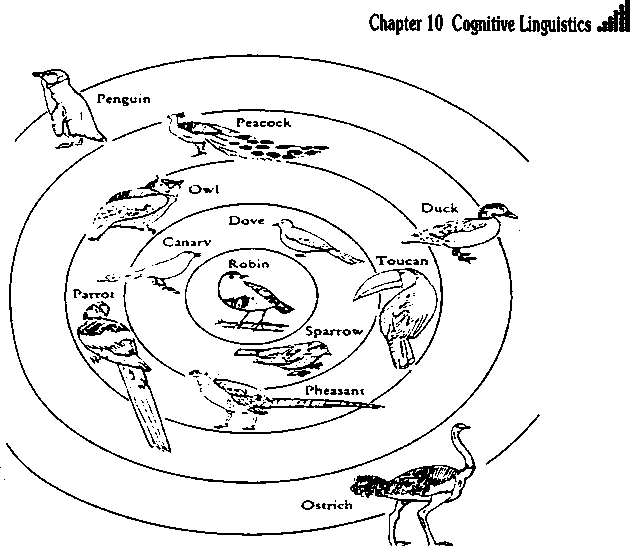
Figure 1:The BIRD category
The prototype theory started in the mid-1970s with E. Rosch's psychological research into the internal structure of categories. From its psychological origin,the prototype theory has moved mainly in two directions. On the one hand,information-processing psychology takes Rosch’s findings and proposals,and tries to devise formal models for human conceptual memory and its operation. On the other hand,the prototype theory has had a steadily growing success in linguistics since the early 1980s. It is for this linguistic tradition of prototype-theoretical research that the prototype theory has a very important status in cognitive linguistics.
The prototype theory is useful for explaining how people deal with atypical examples of a category. This is how unbirdy birds such as penguins and pelicans can still be regarded as birds. They are sufficiently like the prototype,even though they do not share all its characteristics. But it has a further advantage:It can explain how people deal with damaged examples. Previously linguists had found it difficult to explain why people could still categorize a one-winged robin who couldn't fly as a bird,or a three-legged lion as a lion. Now we just assume that these animals get matched against the prototype in the same way as an atypical category member. A one-winged robin who can't fly can still be a bird,even though it's not such a typical one. In addition,the prototype theory can work for actions as well as objects. For example,people can judge that murder is a better example of killing than execute or suicide,and that stare is a better example of looking than peer or squint.

