Word Family II

程华明

目录

  • 1 Starter 开篇
    • 1.1 A    How to use a unit
    • 1.2 B    How to learn new words
    • 1.3 C    Abbreviations and symbols
  • 2 Learning 学习
    • 2.1 1  I can talk about vocabulary learning
    • 2.2 2  I can describe my progress and aims
    • 2.3 3  I can understand a learner’s dictionary
    • 2.4 4  I can talk about English punctuation
    • 2.5 Review
  • 3 People 人
    • 3.1 5  I can talk about appearance
    • 3.2 6  I can talk about character
    • 3.3 7  I can describe my feelings
    • 3.4 8  I can talk about relationships
    • 3.5 9  I can talk about families
    • 3.6 10  I can talk about weddings and funerals
    • 3.7 Review
  • 4 The world around us 周围的世界
    • 4.1 11  I can describe the universe
    • 4.2 12  I can talk about rivers and the sea
    • 4.3 13  I can describe the climate
    • 4.4 14  I can describe natural disasters
    • 4.5 15  I can describe animals and insects
    • 4.6 Review
  • 5 Daily life 日常生活
    • 5.1 16  I can describe a range of food
    • 5.2 17  I can talk about diets and cooking
    • 5.3 18  I can talk about money
    • 5.4 19  I can talk about sleep
    • 5.5 20  I can talk about injuries
    • 5.6 21  I can talk about cars and driving
    • 5.7 22  I can describe travel problems and accidents
    • 5.8 23  I can talk about clothes and fashion
    • 5.9 Review
  • 6 Getting things done 完成每一件事
    • 6.1 24  I can describe a visit to the dentist
    • 6.2 25  I can describe hospital procedures
    • 6.3 26  I can explain household tasks
    • 6.4 27  I can describe housework
    • 6.5 28  I can talk to a hairdresser
    • 6.6 Review
  • 7 Describing things 描述事物
    • 7.1 29  I can describe urban life
    • 7.2 30  I can describe parts of a building
    • 7.3 31  I can describe objects
    • 7.4 32  I can describe the senses
    • 7.5 33  I can describe a painting
    • 7.6 34  I can describe actions
    • 7.7 Review
  • 8 Social and political  issues 社会与政治话题
    • 8.1 35  I can talk about crime
    • 8.2 36  I can describe the justice system
    • 8.3 37  I can discuss health issues
    • 8.4 38  I can talk about politics
    • 8.5 39  I can talk about war and peace
    • 8.6 40  I can talk about events in history
    • 8.7 Review
  • 9 Media and entertainment 媒体与娱乐
    • 9.1 41  I can understand newspapers
    • 9.2 42  I can talk about films
    • 9.3 43  I can talk about art and photography
    • 9.4 44  I can talk about music
    • 9.5 45  I can talk about people and places in sport
    • 9.6 46  I can describe sporting events
    • 9.7 47  I can talk about books
    • 9.8 48  I can describe festivals
    • 9.9 Review
  • 10 Work and study 工作与学习
    • 10.1 49  I can get through exams
    • 10.2 50  I can describe university life
    • 10.3 51  I can apply for a job
    • 10.4 52  I can describe jobs
    • 10.5 53  I can describe a career
    • 10.6 54  I can describe working conditions
    • 10.7 Review
  • 11 Business 商务
    • 11.1 55  I can talk about finance
    • 11.2 56  I can talk about companies
    • 11.3 57  I can describe a successful business
    • 11.4 58  I can discuss marketing
    • 11.5 Review
  • 12 Social English 社交英语
    • 12.1 59  I can express probability
    • 12.2 60  I can explain similarities and differences
    • 12.3 61  I can make arrangements to meet
    • 12.4 62  I can discuss my likes and dislikes
    • 12.5 63  I can give my opinion
    • 12.6 64  I can talk about rules
    • 12.7 65  I can discuss hopes and plans
    • 12.8 66  I can express dissatisfaction
    • 12.9 67  I can understand warnings
    • 12.10 Review
  • 13 Language 语言
    • 13.1 68  I can use link words
    • 13.2 69  I can use a range of adjectives
    • 13.3 70  I can express place and time
    • 13.4 71  I can use prepositions in phrases
    • 13.5 72  I can use prefixes
    • 13.6 73  I can use suffixes
    • 13.7 74  I can use verb patterns
    • 13.8 75  I can use phrasal verbs
    • 13.9 76  I can use a range of adverbs
    • 13.10 Review
  • 14 Styles of English 英语文体
    • 14.1 77  I can recognize informal English
    • 14.2 78  I can write a formal letter
    • 14.3 79  I can understand abbreviations and short forms
    • 14.4 80  I can understand American English
    • 14.5 Review
  • 15 Vocabulary building 构词表
  • 16 Spotlight boxes 词汇要点
  • 17 Word list 单词表
23  I can talk about clothes and fashion

23   I can talk about clothes and fashion

A    Clothes
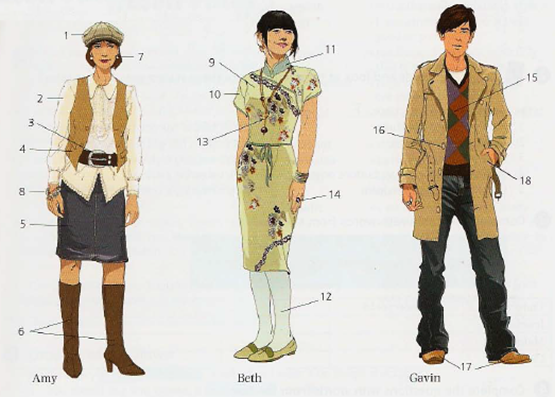

1     cap

2     cotton blouse/shirt

3     belt

4     waistcoat

5     denim shirt

6     high-heeled leather boots

7     earrings

8     bracelet

9     silk dress

10   short sleeves

11   collar

12   tights

13   necklace

14   ring

15   V-neck sweater

16   button

17   suede shoes

18   pocket


spotlight  jewellery and material

Necklace, bracelet, ring, and earrings are all examples of jewellery.

Cotton and silk are types of material. SYN fabric.

Leather and suede are materials made from animal skin.


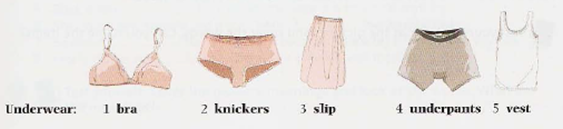
3     Complete the table with words below.

cotton  skirt  waistcoat  vest  bracelet  leather  cap

underpants  ring  necklace  slip  bra  blouse

suede  earrings  silk

Underwear   ► underpants  ____  ____  ____

Jewellery  ____  ____  ____  ____

Material(s)  ____  ____  ____  ____

Clothes  ____  ____  ____  ____


vest, slip, bra

bracelet, ring, necklace, earrings

cotton, leather, suede, silk

skirt, waistcoat, cap, blouse


5     ABOUT YOU  Write your answers to Exercise 4, or ask another student.

Answers from a Polish person

►   No, I don’t think I’ve ever worn a cap.

1     Yes, I wear a ring on my middle finger.

2     I wear a bracelet on my right wrist.

3     I’ve got four leather belts.

4     I’ve got seven pairs of jeans but I rarely wear them.

5     All of my shoes, boots, handbags, and belts are made of leather. I’ve got a few silk scarves, pyjamas, and pillowcases.

6     Yes, I’ve got lots of V-neck sweaters, in various colours.

7     Yes, I often wear short sleeves.

8     My favourite material is linen.


6     Test yourself. Look at the pictures and cover the words. Can you name the items? 


B    Fashion

Three golden rules for fashion

Fashion expert Alyson Walsh says that every stylish woman should have a ‘capsule wardrobe’ - a timeless collection of clothes for every occasion. This includes: a little black dress, the perfect jeans, leather handbag, a fine wool jumper, white shirt, knee- length skirt, etc. Being stylish is about what suits you and your figure. Here are three golden rules:

• Spend as much as possible on the basics (your capsule wardrobe) and don’t worry too much about fashionable clothes - you probably won’t wear them after one season.

• Choose neutral colours: black, cream, white, and dark blue. Neutrals look elegant, and are versatile and easy to match. Just think of Armani fashions, year after year.

• A simple outfit can be transformed with the latest fashion accessory, e.g. a belt.


Glossary

stylish  attractive and fashionable. style N.

suit  If something suits you, it looks good on you.

figure  the shape of the body, especially that of a woman.

fashionable  popular at the present time. OPP unfashionable.

neutral   (of a colour) not strong or bright. neutral N.

elegant   attractive and well designed.

versatile  having many different uses.

match  look good with something else. matching ADJ.

outfit  a set of clothes that you wear together.

transform sth  change sth completely, usually in a positive way.

latest  new or very recent.

accessory  sth you wear or carry that goes with your clothes, e.g. a bag.


9     Test yourself. Cover the glossary meanings and look at the words. What are the meanings?