Word Family II

程华明

目录

  • 1 Starter 开篇
    • 1.1 A    How to use a unit
    • 1.2 B    How to learn new words
    • 1.3 C    Abbreviations and symbols
  • 2 Learning 学习
    • 2.1 1  I can talk about vocabulary learning
    • 2.2 2  I can describe my progress and aims
    • 2.3 3  I can understand a learner’s dictionary
    • 2.4 4  I can talk about English punctuation
    • 2.5 Review
  • 3 People 人
    • 3.1 5  I can talk about appearance
    • 3.2 6  I can talk about character
    • 3.3 7  I can describe my feelings
    • 3.4 8  I can talk about relationships
    • 3.5 9  I can talk about families
    • 3.6 10  I can talk about weddings and funerals
    • 3.7 Review
  • 4 The world around us 周围的世界
    • 4.1 11  I can describe the universe
    • 4.2 12  I can talk about rivers and the sea
    • 4.3 13  I can describe the climate
    • 4.4 14  I can describe natural disasters
    • 4.5 15  I can describe animals and insects
    • 4.6 Review
  • 5 Daily life 日常生活
    • 5.1 16  I can describe a range of food
    • 5.2 17  I can talk about diets and cooking
    • 5.3 18  I can talk about money
    • 5.4 19  I can talk about sleep
    • 5.5 20  I can talk about injuries
    • 5.6 21  I can talk about cars and driving
    • 5.7 22  I can describe travel problems and accidents
    • 5.8 23  I can talk about clothes and fashion
    • 5.9 Review
  • 6 Getting things done 完成每一件事
    • 6.1 24  I can describe a visit to the dentist
    • 6.2 25  I can describe hospital procedures
    • 6.3 26  I can explain household tasks
    • 6.4 27  I can describe housework
    • 6.5 28  I can talk to a hairdresser
    • 6.6 Review
  • 7 Describing things 描述事物
    • 7.1 29  I can describe urban life
    • 7.2 30  I can describe parts of a building
    • 7.3 31  I can describe objects
    • 7.4 32  I can describe the senses
    • 7.5 33  I can describe a painting
    • 7.6 34  I can describe actions
    • 7.7 Review
  • 8 Social and political  issues 社会与政治话题
    • 8.1 35  I can talk about crime
    • 8.2 36  I can describe the justice system
    • 8.3 37  I can discuss health issues
    • 8.4 38  I can talk about politics
    • 8.5 39  I can talk about war and peace
    • 8.6 40  I can talk about events in history
    • 8.7 Review
  • 9 Media and entertainment 媒体与娱乐
    • 9.1 41  I can understand newspapers
    • 9.2 42  I can talk about films
    • 9.3 43  I can talk about art and photography
    • 9.4 44  I can talk about music
    • 9.5 45  I can talk about people and places in sport
    • 9.6 46  I can describe sporting events
    • 9.7 47  I can talk about books
    • 9.8 48  I can describe festivals
    • 9.9 Review
  • 10 Work and study 工作与学习
    • 10.1 49  I can get through exams
    • 10.2 50  I can describe university life
    • 10.3 51  I can apply for a job
    • 10.4 52  I can describe jobs
    • 10.5 53  I can describe a career
    • 10.6 54  I can describe working conditions
    • 10.7 Review
  • 11 Business 商务
    • 11.1 55  I can talk about finance
    • 11.2 56  I can talk about companies
    • 11.3 57  I can describe a successful business
    • 11.4 58  I can discuss marketing
    • 11.5 Review
  • 12 Social English 社交英语
    • 12.1 59  I can express probability
    • 12.2 60  I can explain similarities and differences
    • 12.3 61  I can make arrangements to meet
    • 12.4 62  I can discuss my likes and dislikes
    • 12.5 63  I can give my opinion
    • 12.6 64  I can talk about rules
    • 12.7 65  I can discuss hopes and plans
    • 12.8 66  I can express dissatisfaction
    • 12.9 67  I can understand warnings
    • 12.10 Review
  • 13 Language 语言
    • 13.1 68  I can use link words
    • 13.2 69  I can use a range of adjectives
    • 13.3 70  I can express place and time
    • 13.4 71  I can use prepositions in phrases
    • 13.5 72  I can use prefixes
    • 13.6 73  I can use suffixes
    • 13.7 74  I can use verb patterns
    • 13.8 75  I can use phrasal verbs
    • 13.9 76  I can use a range of adverbs
    • 13.10 Review
  • 14 Styles of English 英语文体
    • 14.1 77  I can recognize informal English
    • 14.2 78  I can write a formal letter
    • 14.3 79  I can understand abbreviations and short forms
    • 14.4 80  I can understand American English
    • 14.5 Review
  • 15 Vocabulary building 构词表
  • 16 Spotlight boxes 词汇要点
  • 17 Word list 单词表
72  I can use prefixes

72   I can use prefixes

A    Negative prefixes 

Adjective/OPP  

Example     

Meaning     

Other words


insecure OPP secure

She’s very insecure about her appearance.

not confident about yourself. 

informal  inflexible


immoral OPP moral 

She stole money from my children. That’s immoral.

thought to be wrong or dishonest by most people.    

impossible  impatient


illegible OPP legible 

My doctor’s writing is illegible.     

very difficult or impossible to read.      

illegal


irrelevant OPP relevant  

I need some new shoes. The colour’s irrelevant.      

not important to what you are discussing or doing.  

irregular  irresponsible


unfair OPP fair 

His office is bigger than mine. It’s so unfair!    

not treating each person in the same way or equally. 

unpleasant  unsuccessful


unacceptable OPP acceptable      

The player hit the ref. That’s unacceptable.

so bad that you think it should not be allowed. 

uncertain  unkind


disloyal OPP loyal

They were very disloyal to the family. 

not supporting your friends, family, country, etc.      

dishonest  disorganized


non-alcoholic OPP alcoholic

Is this drink non-alcoholic?

Juice is non-alcoholic, beer and wine are alcoholic.

non-smoking  non-fiction


spotlight  prefixes

A prefix is a letter or group of letters that you put at the beginning of a word to change its meaning. The prefixes above have the meaning ‘not’, e.g. insecure = not secure, illegible = not legible. 


ABOUT YOU Write your own answers, or ask another student.

Answers from a Colombian person

1     Life is always unfair, but knowing that means that I do not expect anything marvellous to happen and have therefore become cynical.

2     It has always been acceptable to them and unacceptable to others and it will remain so.

3     My friends tend to be loyal but a disloyal friend can always appear loyal at first.

4     My handwriting is probably the clearest sign of a confused mind! Even I can’t read it - it is completely illegible.

5     I think it should be legal. I learnt to drive when I was 17 and didn’t have an accident: for the first four years.


B    Reversing an action
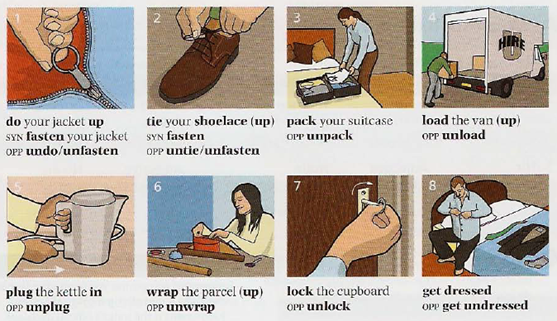


5     Complete the table using a synonym of the verb on the left, then write the opposite.

Sentence       Synonym      Opposite

► Take the bags out of the car.  Unload the car.  Load the car.

1     Take the paper off the present.      

2     Shut the suitcase with a key.          

3     Put your clothes on.         

4     Put your things in your suitcase.           

5     Fasten the buttons on your shirt.          

6     Fasten your shoelaces.     


1     Unwrap the present. Wrap (up) the present.

2     Lock the suitcase. Unlock the suitcase.

3     Get dressed. Get undressed.

4     Pack your suitcase. Unpack your suitcase.

5     Do up your shirt. Undo your shirt.

6     Tie up / Do up your shoelaces. Untie / Undo your shoelaces. 


6     Test yourself. Look at the pictures and cover the words. Say the words and opposites.