Word Family II

程华明

目录

  • 1 Starter 开篇
    • 1.1 A    How to use a unit
    • 1.2 B    How to learn new words
    • 1.3 C    Abbreviations and symbols
  • 2 Learning 学习
    • 2.1 1  I can talk about vocabulary learning
    • 2.2 2  I can describe my progress and aims
    • 2.3 3  I can understand a learner’s dictionary
    • 2.4 4  I can talk about English punctuation
    • 2.5 Review
  • 3 People 人
    • 3.1 5  I can talk about appearance
    • 3.2 6  I can talk about character
    • 3.3 7  I can describe my feelings
    • 3.4 8  I can talk about relationships
    • 3.5 9  I can talk about families
    • 3.6 10  I can talk about weddings and funerals
    • 3.7 Review
  • 4 The world around us 周围的世界
    • 4.1 11  I can describe the universe
    • 4.2 12  I can talk about rivers and the sea
    • 4.3 13  I can describe the climate
    • 4.4 14  I can describe natural disasters
    • 4.5 15  I can describe animals and insects
    • 4.6 Review
  • 5 Daily life 日常生活
    • 5.1 16  I can describe a range of food
    • 5.2 17  I can talk about diets and cooking
    • 5.3 18  I can talk about money
    • 5.4 19  I can talk about sleep
    • 5.5 20  I can talk about injuries
    • 5.6 21  I can talk about cars and driving
    • 5.7 22  I can describe travel problems and accidents
    • 5.8 23  I can talk about clothes and fashion
    • 5.9 Review
  • 6 Getting things done 完成每一件事
    • 6.1 24  I can describe a visit to the dentist
    • 6.2 25  I can describe hospital procedures
    • 6.3 26  I can explain household tasks
    • 6.4 27  I can describe housework
    • 6.5 28  I can talk to a hairdresser
    • 6.6 Review
  • 7 Describing things 描述事物
    • 7.1 29  I can describe urban life
    • 7.2 30  I can describe parts of a building
    • 7.3 31  I can describe objects
    • 7.4 32  I can describe the senses
    • 7.5 33  I can describe a painting
    • 7.6 34  I can describe actions
    • 7.7 Review
  • 8 Social and political  issues 社会与政治话题
    • 8.1 35  I can talk about crime
    • 8.2 36  I can describe the justice system
    • 8.3 37  I can discuss health issues
    • 8.4 38  I can talk about politics
    • 8.5 39  I can talk about war and peace
    • 8.6 40  I can talk about events in history
    • 8.7 Review
  • 9 Media and entertainment 媒体与娱乐
    • 9.1 41  I can understand newspapers
    • 9.2 42  I can talk about films
    • 9.3 43  I can talk about art and photography
    • 9.4 44  I can talk about music
    • 9.5 45  I can talk about people and places in sport
    • 9.6 46  I can describe sporting events
    • 9.7 47  I can talk about books
    • 9.8 48  I can describe festivals
    • 9.9 Review
  • 10 Work and study 工作与学习
    • 10.1 49  I can get through exams
    • 10.2 50  I can describe university life
    • 10.3 51  I can apply for a job
    • 10.4 52  I can describe jobs
    • 10.5 53  I can describe a career
    • 10.6 54  I can describe working conditions
    • 10.7 Review
  • 11 Business 商务
    • 11.1 55  I can talk about finance
    • 11.2 56  I can talk about companies
    • 11.3 57  I can describe a successful business
    • 11.4 58  I can discuss marketing
    • 11.5 Review
  • 12 Social English 社交英语
    • 12.1 59  I can express probability
    • 12.2 60  I can explain similarities and differences
    • 12.3 61  I can make arrangements to meet
    • 12.4 62  I can discuss my likes and dislikes
    • 12.5 63  I can give my opinion
    • 12.6 64  I can talk about rules
    • 12.7 65  I can discuss hopes and plans
    • 12.8 66  I can express dissatisfaction
    • 12.9 67  I can understand warnings
    • 12.10 Review
  • 13 Language 语言
    • 13.1 68  I can use link words
    • 13.2 69  I can use a range of adjectives
    • 13.3 70  I can express place and time
    • 13.4 71  I can use prepositions in phrases
    • 13.5 72  I can use prefixes
    • 13.6 73  I can use suffixes
    • 13.7 74  I can use verb patterns
    • 13.8 75  I can use phrasal verbs
    • 13.9 76  I can use a range of adverbs
    • 13.10 Review
  • 14 Styles of English 英语文体
    • 14.1 77  I can recognize informal English
    • 14.2 78  I can write a formal letter
    • 14.3 79  I can understand abbreviations and short forms
    • 14.4 80  I can understand American English
    • 14.5 Review
  • 15 Vocabulary building 构词表
  • 16 Spotlight boxes 词汇要点
  • 17 Word list 单词表
55  I can talk about finance

55   I can talk about finance

A    Financial terms

Example  

Meaning


We need to raise capital.  

capital  the money you need to start a business (to raise capital is to find the money you need).


The company has an annual turnover of $20 million.  

turnover  the total value of goods or services that a company sells in a particular period of time (annual = every year). SYN sales revenue.


Operating costs have gone up this year.  

operating costs  the amount of money that a business needs to spend to continue as a business.


Inflation is now at 3 per cent.  

inflation  a general rise in the price of services and goods in a particular country.


We paid £1 million in tax.  

tax  money you have to pay to the government.


The company made a pre-tax profit of £2 million.  

profit  the money you make in a business after paying costs (pre-tax is before paying tax). OPP loss.


I think the company has cash flow problems.  

cash flow  the movement of money into and out of a business (a cash flow problem means more money is going out than coming in).


I need a bank loan.  They took out a loan.  

bank loan  money the bank lends and sb borrows. 

take out  obtain (you also take out insurance).


We pay a lot of interest.  The interest rate is 4 per cent.  

interest  extra money you pay when you borrow money (the interest rate is the exact cost of borrowing).


spotlight  finance

Finance can be:

1    the money somebody borrows or receives to operate a business (They need to raise more finance.) finance V.

OR

2    the activity of managing money in a company. financial ADJ. (He’s the new Director of Finance /Financial Director.


3     Test yourself. Look at the examples and cover the meanings. What do the examples mean?


B    Financial trends
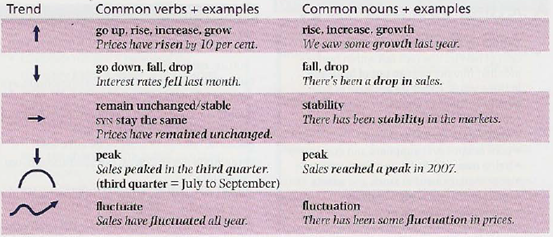

Adjective            

Meaning             

Adverb


slight rise in costs  

very small.  

Costs rose slightly.


gradual rise in profits  

slow and over a long period of time.  

Profits have risen gradually.


steady increase in the interest rate  

slow but regular and continuing.  

The interest rate has increased steadily.


significant fall in profits  

noticeable and important.  

Profits fell significantly.


sharp fall in sales  

very large and sudden.  

Sales have fallen sharply.


4     Complete the sentences on the right. The meaning must stay the same.

►   There has been a sharp fall in sales. Sales have fallen sharply.

1     There was significant growth in sales.   

Sales ________.

2     There was a gradual rise in the price.     

The price ________.

3     There was a slight fall in profits.            

Profits ________.

4     There has been stability in costs.            

Costs have remained ________.

5     There has been a steady rise in sales.     

Sales have ________.


1     grew significantly; rose significantly

2     rose gradually

3     fell slightly

4     stable; unchanged

5     risen steadily


6     Look at the arrows and complete the sentences.
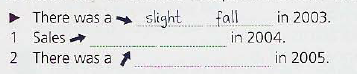
 

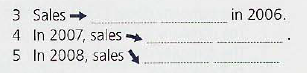
1     rose slightly; went up slightly; increased slightly; grew slightly

2     sharp rise; sharp increase; sharp growth

3     remained stable; remained unchanged; stayed stable; stayed unchanged

4     fell slightly; dropped slightly; went down slightly

5     fell sharply; dropped sharply; went down sharply