
Word Family II

程华明

目录

  • 1 Starter 开篇
    • 1.1 A    How to use a unit
    • 1.2 B    How to learn new words
    • 1.3 C    Abbreviations and symbols
  • 2 Learning 学习
    • 2.1 1  I can talk about vocabulary learning
    • 2.2 2  I can describe my progress and aims
    • 2.3 3  I can understand a learner’s dictionary
    • 2.4 4  I can talk about English punctuation
    • 2.5 Review
  • 3 People 人
    • 3.1 5  I can talk about appearance
    • 3.2 6  I can talk about character
    • 3.3 7  I can describe my feelings
    • 3.4 8  I can talk about relationships
    • 3.5 9  I can talk about families
    • 3.6 10  I can talk about weddings and funerals
    • 3.7 Review
  • 4 The world around us 周围的世界
    • 4.1 11  I can describe the universe
    • 4.2 12  I can talk about rivers and the sea
    • 4.3 13  I can describe the climate
    • 4.4 14  I can describe natural disasters
    • 4.5 15  I can describe animals and insects
    • 4.6 Review
  • 5 Daily life 日常生活
    • 5.1 16  I can describe a range of food
    • 5.2 17  I can talk about diets and cooking
    • 5.3 18  I can talk about money
    • 5.4 19  I can talk about sleep
    • 5.5 20  I can talk about injuries
    • 5.6 21  I can talk about cars and driving
    • 5.7 22  I can describe travel problems and accidents
    • 5.8 23  I can talk about clothes and fashion
    • 5.9 Review
  • 6 Getting things done 完成每一件事
    • 6.1 24  I can describe a visit to the dentist
    • 6.2 25  I can describe hospital procedures
    • 6.3 26  I can explain household tasks
    • 6.4 27  I can describe housework
    • 6.5 28  I can talk to a hairdresser
    • 6.6 Review
  • 7 Describing things 描述事物
    • 7.1 29  I can describe urban life
    • 7.2 30  I can describe parts of a building
    • 7.3 31  I can describe objects
    • 7.4 32  I can describe the senses
    • 7.5 33  I can describe a painting
    • 7.6 34  I can describe actions
    • 7.7 Review
  • 8 Social and political  issues 社会与政治话题
    • 8.1 35  I can talk about crime
    • 8.2 36  I can describe the justice system
    • 8.3 37  I can discuss health issues
    • 8.4 38  I can talk about politics
    • 8.5 39  I can talk about war and peace
    • 8.6 40  I can talk about events in history
    • 8.7 Review
  • 9 Media and entertainment 媒体与娱乐
    • 9.1 41  I can understand newspapers
    • 9.2 42  I can talk about films
    • 9.3 43  I can talk about art and photography
    • 9.4 44  I can talk about music
    • 9.5 45  I can talk about people and places in sport
    • 9.6 46  I can describe sporting events
    • 9.7 47  I can talk about books
    • 9.8 48  I can describe festivals
    • 9.9 Review
  • 10 Work and study 工作与学习
    • 10.1 49  I can get through exams
    • 10.2 50  I can describe university life
    • 10.3 51  I can apply for a job
    • 10.4 52  I can describe jobs
    • 10.5 53  I can describe a career
    • 10.6 54  I can describe working conditions
    • 10.7 Review
  • 11 Business 商务
    • 11.1 55  I can talk about finance
    • 11.2 56  I can talk about companies
    • 11.3 57  I can describe a successful business
    • 11.4 58  I can discuss marketing
    • 11.5 Review
  • 12 Social English 社交英语
    • 12.1 59  I can express probability
    • 12.2 60  I can explain similarities and differences
    • 12.3 61  I can make arrangements to meet
    • 12.4 62  I can discuss my likes and dislikes
    • 12.5 63  I can give my opinion
    • 12.6 64  I can talk about rules
    • 12.7 65  I can discuss hopes and plans
    • 12.8 66  I can express dissatisfaction
    • 12.9 67  I can understand warnings
    • 12.10 Review
  • 13 Language 语言
    • 13.1 68  I can use link words
    • 13.2 69  I can use a range of adjectives
    • 13.3 70  I can express place and time
    • 13.4 71  I can use prepositions in phrases
    • 13.5 72  I can use prefixes
    • 13.6 73  I can use suffixes
    • 13.7 74  I can use verb patterns
    • 13.8 75  I can use phrasal verbs
    • 13.9 76  I can use a range of adverbs
    • 13.10 Review
  • 14 Styles of English 英语文体
    • 14.1 77  I can recognize informal English
    • 14.2 78  I can write a formal letter
    • 14.3 79  I can understand abbreviations and short forms
    • 14.4 80  I can understand American English
    • 14.5 Review
  • 15 Vocabulary building 构词表
  • 16 Spotlight boxes 词汇要点
  • 17 Word list 单词表
46  I can describe sporting events

46   I can describe sporting events

A    The Olympics
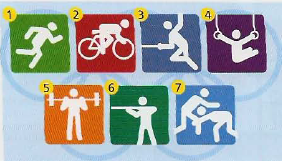
The first games took place in 776 BC, with one competition, a race of about 192 metres.

The first modern Olympics took place in 1896 with 241 competitors taking part in nine sports: athletics1cycling2, fencing3, gymnastics4, weightlifting5, shooting6, swimming, tennis, and wrestling7. By 2004, there were over 11,000 people competing in 28 sports. 

Gymnast Larissa Latynina holds the record for the most Olympic medals (18).

Boxing is now the only Olympic sport where professionals are not allowed to compete.


Glossary

take place  (used about a meeting or an event) happen.

competition  a situation in which two or more people are trying to win sth or be better than sb (a person trying to win is a competitor). compete V. competitive ADJ.

race  a competition to see who is fastest or best, or who wins.

take part in sth  join with other people in an activity. SYN participate.

medal  a piece of metal given to an athlete who comes 1st, 2nd, or 3rd.

professional  a person who plays a sport for money as their job. OPP amateur.


spotlight  record

A record is the best performance in something, especially sport.

She holds the record for the long jump.

(She has the record.)

He broke the record in the 100 metres.

(He set a new record.) 


4     Test yourself. Cover the words and look at the pictures. What are the sports?


B    Winners and losers

In a very one-sided contest, Roger Federer defeated Andy Roddick 6-4, 6-0, 6-2 in the semi-final of the Australian Open to go through to his tenth grand slam final. Federer won the first set quite easily, then broke Roddick’s resistance in the second with some brilliant tennis. Afterwards, Roddick was very critical of his own performance, but praised his opponent for some outstanding tennis. Federer is now clearly the favourite to take his third Australian Open, and tenth grand slam overall. This would put him just one behind Rod Laver, a tremendous achievement for someone who is still only 25.


spotlight  defeat

As a verb, to defeat sb means to be stronger or better than somebody in a game, fight, etc. SYN beat sb.

Italy defeated Wales 2-0 in the last match they played.

As a noun, a defeat is an occasion when you don’t win something.

We won our first match, then followed it with three defeats.


Glossary

one-sided  If a game is one-sided, one person or team is much better than the other.

contest   an activity between two players or teams to see who is best.

semi-final  one of two games to decide who plays in the final.

final  the last game or match in a competition.

resistance  the action of trying to stop sth happening or stop sb doing sth. resist V.

brilliant  very good, clever, or skilful. SYN outstanding.

critical of sth/sb  saying what is wrong with sth/sb. criticize sth/sb V.

performance  the way in which sb plays or does sth. perform V.

praise sb/sth  say that sb/sth is very good. praise N.

opponent  a person who plays against you in a sport or competition.

favourite  the person or team who is expected to win. OPP outsider.

overall    including everything; in total.

achievement  a thing that you have done successfully through hard work or skill. achieve sth V.


7     Test yourself. Cover the glossary meanings and look at the words. What are the meanings?