Word Family II

程华明

目录

  • 1 Starter 开篇
    • 1.1 A    How to use a unit
    • 1.2 B    How to learn new words
    • 1.3 C    Abbreviations and symbols
  • 2 Learning 学习
    • 2.1 1  I can talk about vocabulary learning
    • 2.2 2  I can describe my progress and aims
    • 2.3 3  I can understand a learner’s dictionary
    • 2.4 4  I can talk about English punctuation
    • 2.5 Review
  • 3 People 人
    • 3.1 5  I can talk about appearance
    • 3.2 6  I can talk about character
    • 3.3 7  I can describe my feelings
    • 3.4 8  I can talk about relationships
    • 3.5 9  I can talk about families
    • 3.6 10  I can talk about weddings and funerals
    • 3.7 Review
  • 4 The world around us 周围的世界
    • 4.1 11  I can describe the universe
    • 4.2 12  I can talk about rivers and the sea
    • 4.3 13  I can describe the climate
    • 4.4 14  I can describe natural disasters
    • 4.5 15  I can describe animals and insects
    • 4.6 Review
  • 5 Daily life 日常生活
    • 5.1 16  I can describe a range of food
    • 5.2 17  I can talk about diets and cooking
    • 5.3 18  I can talk about money
    • 5.4 19  I can talk about sleep
    • 5.5 20  I can talk about injuries
    • 5.6 21  I can talk about cars and driving
    • 5.7 22  I can describe travel problems and accidents
    • 5.8 23  I can talk about clothes and fashion
    • 5.9 Review
  • 6 Getting things done 完成每一件事
    • 6.1 24  I can describe a visit to the dentist
    • 6.2 25  I can describe hospital procedures
    • 6.3 26  I can explain household tasks
    • 6.4 27  I can describe housework
    • 6.5 28  I can talk to a hairdresser
    • 6.6 Review
  • 7 Describing things 描述事物
    • 7.1 29  I can describe urban life
    • 7.2 30  I can describe parts of a building
    • 7.3 31  I can describe objects
    • 7.4 32  I can describe the senses
    • 7.5 33  I can describe a painting
    • 7.6 34  I can describe actions
    • 7.7 Review
  • 8 Social and political  issues 社会与政治话题
    • 8.1 35  I can talk about crime
    • 8.2 36  I can describe the justice system
    • 8.3 37  I can discuss health issues
    • 8.4 38  I can talk about politics
    • 8.5 39  I can talk about war and peace
    • 8.6 40  I can talk about events in history
    • 8.7 Review
  • 9 Media and entertainment 媒体与娱乐
    • 9.1 41  I can understand newspapers
    • 9.2 42  I can talk about films
    • 9.3 43  I can talk about art and photography
    • 9.4 44  I can talk about music
    • 9.5 45  I can talk about people and places in sport
    • 9.6 46  I can describe sporting events
    • 9.7 47  I can talk about books
    • 9.8 48  I can describe festivals
    • 9.9 Review
  • 10 Work and study 工作与学习
    • 10.1 49  I can get through exams
    • 10.2 50  I can describe university life
    • 10.3 51  I can apply for a job
    • 10.4 52  I can describe jobs
    • 10.5 53  I can describe a career
    • 10.6 54  I can describe working conditions
    • 10.7 Review
  • 11 Business 商务
    • 11.1 55  I can talk about finance
    • 11.2 56  I can talk about companies
    • 11.3 57  I can describe a successful business
    • 11.4 58  I can discuss marketing
    • 11.5 Review
  • 12 Social English 社交英语
    • 12.1 59  I can express probability
    • 12.2 60  I can explain similarities and differences
    • 12.3 61  I can make arrangements to meet
    • 12.4 62  I can discuss my likes and dislikes
    • 12.5 63  I can give my opinion
    • 12.6 64  I can talk about rules
    • 12.7 65  I can discuss hopes and plans
    • 12.8 66  I can express dissatisfaction
    • 12.9 67  I can understand warnings
    • 12.10 Review
  • 13 Language 语言
    • 13.1 68  I can use link words
    • 13.2 69  I can use a range of adjectives
    • 13.3 70  I can express place and time
    • 13.4 71  I can use prepositions in phrases
    • 13.5 72  I can use prefixes
    • 13.6 73  I can use suffixes
    • 13.7 74  I can use verb patterns
    • 13.8 75  I can use phrasal verbs
    • 13.9 76  I can use a range of adverbs
    • 13.10 Review
  • 14 Styles of English 英语文体
    • 14.1 77  I can recognize informal English
    • 14.2 78  I can write a formal letter
    • 14.3 79  I can understand abbreviations and short forms
    • 14.4 80  I can understand American English
    • 14.5 Review
  • 15 Vocabulary building 构词表
  • 16 Spotlight boxes 词汇要点
  • 17 Word list 单词表
36  I can describe the justice system

36   I can describe the justice system

A    A police investigation

A crime is reported to the police, usually by the victim.

The police investigate it. The victim and witnesses tell the police what they know.

The police may take fingerprints, or take photos where the crime took place.

If possible, they catch the suspect and arrest him.

If there is enough evidence, they will charge the suspect and he will go to court.


Glossary

report sth  give information that sth has happened.

victim  a person who has been robbed, injured, etc.

investigate sth  try to find out about sth.

witness  a person who sees sth happen (e.g. a crime or an accident).

may  we use may to say that sth is possible. SYN might.

take place  happen.

catch sb PT caught PP caught  find and hold sb.

suspect  a person who the police think has committed a crime.

evidence  facts, signs, or objects that make you believe sth is true.

charge sb  (of the police) say officially that they believe sb has done sth illegal. 


2     Answer the questions. One question has more than one answer.

►   Who has to find the evidence? ~ The police

1     Who takes fingerprints? ________

2     Who is charged? ________

3     Who investigates the crime? ________

4     Who is hurt by the crime? ________

5     Who is caught? ________

6     Who usually reports the crime? ________

7     Who is arrested? ________

8     Who sees the crime take place? ________


1     The police

2     The suspect  

3     The police

4     The victim

5     The suspect

6     The victim; A witness

7     The suspect

8     A witness; witnesses


3   Test yourself. Cover the words in the glossary and look at the meanings. Can you remember the words?


B    In court

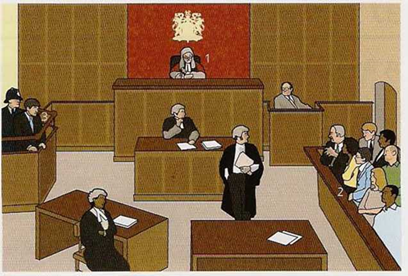
In Britain, serious crimes such as robbery and murder are tried by a judgeand jury2. At the trial, the prosecution aims to prove that the accused3 (or defendant) has committed the crime; the defence aims to prove he is innocent.

At the end, the jury decides whether the defendant is guilty or not guilty. If he is guilty, he is sentenced by the judge. He may get a fine or a prison sentence.

Glossary

try sb  ask questions and listen to evidence in court to decide if sb has done sth illegal.

trial  an examination of evidence in court to decide if sb has done sth illegal.

the prosecution  the lawyers who try to prove that the accused person has committed a crime. prosecute sb V.

prove sth  give evidence to show that sth is true. proof N.

the defence  the lawyers who try to prove that the accused person has not committed the crime. defend sb V.

innocent  If you are innocent, you have done nothing wrong. OPP guilty.

sentence sb  tell sb who is guilty what they will have to do, e.g. go to prison. sentence N.

fine  a sum of money you have to pay if you break a law. fine sb V. 


6     Test yourself. Cover the glossary meanings and look at the words. Can you remember the meanings?