Word Family II

程华明

目录

  • 1 Starter 开篇
    • 1.1 A    How to use a unit
    • 1.2 B    How to learn new words
    • 1.3 C    Abbreviations and symbols
  • 2 Learning 学习
    • 2.1 1  I can talk about vocabulary learning
    • 2.2 2  I can describe my progress and aims
    • 2.3 3  I can understand a learner’s dictionary
    • 2.4 4  I can talk about English punctuation
    • 2.5 Review
  • 3 People 人
    • 3.1 5  I can talk about appearance
    • 3.2 6  I can talk about character
    • 3.3 7  I can describe my feelings
    • 3.4 8  I can talk about relationships
    • 3.5 9  I can talk about families
    • 3.6 10  I can talk about weddings and funerals
    • 3.7 Review
  • 4 The world around us 周围的世界
    • 4.1 11  I can describe the universe
    • 4.2 12  I can talk about rivers and the sea
    • 4.3 13  I can describe the climate
    • 4.4 14  I can describe natural disasters
    • 4.5 15  I can describe animals and insects
    • 4.6 Review
  • 5 Daily life 日常生活
    • 5.1 16  I can describe a range of food
    • 5.2 17  I can talk about diets and cooking
    • 5.3 18  I can talk about money
    • 5.4 19  I can talk about sleep
    • 5.5 20  I can talk about injuries
    • 5.6 21  I can talk about cars and driving
    • 5.7 22  I can describe travel problems and accidents
    • 5.8 23  I can talk about clothes and fashion
    • 5.9 Review
  • 6 Getting things done 完成每一件事
    • 6.1 24  I can describe a visit to the dentist
    • 6.2 25  I can describe hospital procedures
    • 6.3 26  I can explain household tasks
    • 6.4 27  I can describe housework
    • 6.5 28  I can talk to a hairdresser
    • 6.6 Review
  • 7 Describing things 描述事物
    • 7.1 29  I can describe urban life
    • 7.2 30  I can describe parts of a building
    • 7.3 31  I can describe objects
    • 7.4 32  I can describe the senses
    • 7.5 33  I can describe a painting
    • 7.6 34  I can describe actions
    • 7.7 Review
  • 8 Social and political  issues 社会与政治话题
    • 8.1 35  I can talk about crime
    • 8.2 36  I can describe the justice system
    • 8.3 37  I can discuss health issues
    • 8.4 38  I can talk about politics
    • 8.5 39  I can talk about war and peace
    • 8.6 40  I can talk about events in history
    • 8.7 Review
  • 9 Media and entertainment 媒体与娱乐
    • 9.1 41  I can understand newspapers
    • 9.2 42  I can talk about films
    • 9.3 43  I can talk about art and photography
    • 9.4 44  I can talk about music
    • 9.5 45  I can talk about people and places in sport
    • 9.6 46  I can describe sporting events
    • 9.7 47  I can talk about books
    • 9.8 48  I can describe festivals
    • 9.9 Review
  • 10 Work and study 工作与学习
    • 10.1 49  I can get through exams
    • 10.2 50  I can describe university life
    • 10.3 51  I can apply for a job
    • 10.4 52  I can describe jobs
    • 10.5 53  I can describe a career
    • 10.6 54  I can describe working conditions
    • 10.7 Review
  • 11 Business 商务
    • 11.1 55  I can talk about finance
    • 11.2 56  I can talk about companies
    • 11.3 57  I can describe a successful business
    • 11.4 58  I can discuss marketing
    • 11.5 Review
  • 12 Social English 社交英语
    • 12.1 59  I can express probability
    • 12.2 60  I can explain similarities and differences
    • 12.3 61  I can make arrangements to meet
    • 12.4 62  I can discuss my likes and dislikes
    • 12.5 63  I can give my opinion
    • 12.6 64  I can talk about rules
    • 12.7 65  I can discuss hopes and plans
    • 12.8 66  I can express dissatisfaction
    • 12.9 67  I can understand warnings
    • 12.10 Review
  • 13 Language 语言
    • 13.1 68  I can use link words
    • 13.2 69  I can use a range of adjectives
    • 13.3 70  I can express place and time
    • 13.4 71  I can use prepositions in phrases
    • 13.5 72  I can use prefixes
    • 13.6 73  I can use suffixes
    • 13.7 74  I can use verb patterns
    • 13.8 75  I can use phrasal verbs
    • 13.9 76  I can use a range of adverbs
    • 13.10 Review
  • 14 Styles of English 英语文体
    • 14.1 77  I can recognize informal English
    • 14.2 78  I can write a formal letter
    • 14.3 79  I can understand abbreviations and short forms
    • 14.4 80  I can understand American English
    • 14.5 Review
  • 15 Vocabulary building 构词表
  • 16 Spotlight boxes 词汇要点
  • 17 Word list 单词表
34  I can describe actions

34   I can describe actions

A    Using your hands 
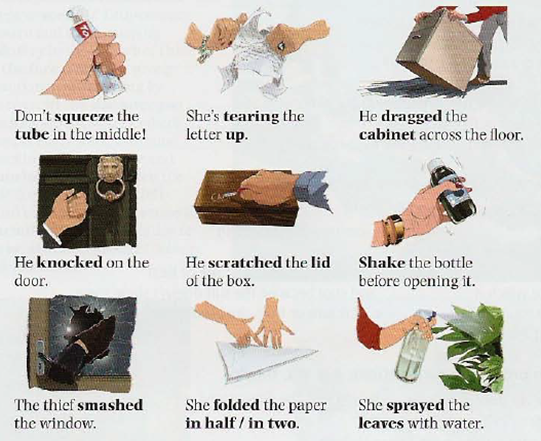


3     Test yourself. Look at the pictures and cover the words. Can you remember the sentences? 


B    Making noises    

Word   

Example     

Meaning


shout    

Don’t shout! I can hear you.  

speak in a loud voice.


whisper

He whispered ‘I love you’ in her ear.   

speak very quietly so that other people can’t hear you.


cry 

The baby next door cried all night.

tears drops of liquid that come out from your eyes when you cry.


scream 

The plane dropped suddenly and we screamed.

cry out in a high voice because you are in pain, upset, frightened, etc.


burst into tears 

He sat down and burst into tears.

start crying suddenly.


burst out laughing   

I walked into the room and they all burst out laughing.

start laughing suddenly.


breathe (in/out) 

Breathe in, count to ten, and then breathe out.

take air into your lungs and let it out again. breath N.


sigh

He sat down and sighed: it had been a hard decision.     

let out a long deep breath that shows you are sad, bored, relieved, etc.


sneeze  

I’ve got a terrible cold: I’ve been sneezing all day.    


spotlight  loud, out loud / aloud, silent, silence

Loud means ‘making a lot of noise’. OPP silent. silence N.

The radio’s too loud.

We worked in silence.

If you speak out loud (SYN aloud) you speak so that people can her you.

I read the letter out loud / aloud to my father. The radio’s too loud.


4     Complete the sentences with a suitable word or phrase.

►   If you shout angrily at a child, they might cry.

1     When you have a cold, you might ____ a lot.

2     If you eat onions, your ____ might smell.

3     If something is incredibly funny, you might ____.

4     If your nose is blocked, you have to ____ and out through your mouth.

5     If you don’t want to be heard when you’re speaking to someone, you should ____.

6     If you are very relieved that something has gone well, you might ____.

7     If you suddenly get some very sad news, you might ____.

8     If your friend isn’t looking and a car is coming, you would ____ to him.

9     If all the class wanted to hear a short story you’ve written, you could read it ____.

10   The room was completely ____; no one said a word.

11   If you upset her, she will burst into ____.

12   You can’t speak in an exam; you must work in ____.


1     sneeze

2     breath

3     burst out laughing

4     breathe in

5     whisper

6     sigh

7     burst into tears; cry 

8     shout

9     out loud; aloud

10     silent

11     tears

12     silence


5     ABOUT YOU Write your answers, or ask another student. When did you last…

1     hear someone screaming? Who was it, and why? ________

2     burst out laughing? Why? ________

3     whisper to someone? Why? ________

4     read something out loud? What was it? ________


Answers from an Italian person

1     Yesterday I heard my neighbours’ baby screaming in the night because she was hungry.

2     I last burst out laughing when I went to a comedy show.

3     I last whispered to someone when I was visiting a museum.

4     I last read something out loud to my boyfriend. It was part of a review of a film.